Skip to comments.
Osprey heads out on Bataan for deployment
The Virginian-Pilot ^
| February 20, 2009
| Louis Hansen
Posted on 02/20/2009 3:15:20 PM PST by csvset
On the flight deck of the amphibious ship Bataan, the hybrid aircraft known as the V-22 Osprey has taken roost. Lined up on the deck with its wings folded, the tilt-rotor aircraft hides its unique gift - it lifts off and hovers like a helicopter and flies like a plane.
Almost 20 years after its first test flight, and a decade since two fatal crashes grounded it, the Osprey is poised for its first full deployment with a Navy amphibious group.
Marines and sailors are now training with about 10 Ospreys aboard the Norfolk-based Bataan, off the coast of North Carolina, doing touch-and-go landings, folding and maintaining the odd-looking plane at sea.
Airmen are learning how to steer the Osprey through the tight confines of the flight deck, shared with Harrier jets and helicopters. Commanders are working to find the best missions for it, given its extra speed and range. And the squadron has brought aboard dozens of extra personnel and additional equipment to prepare for the mission.
Top officers acknowledge the hurdles ahead but in the same breath say the Osprey is the future of the amphibious force.
"It's a challenge, but so far it hasn't been an insurmountable challenge," said Navy Capt. J.L. Sotherland, commodore of the amphibious group. "We still don't know all the things we can do with it."
When the Osprey was conceived about 25 years ago, the Marines envisioned the tilt-rotor craft would replace medium-lift helicopters like the CH-46 Sea Knight and CH-53 Sea Stallion.
Versions of those workhorses have served the Marines and Navy since the Vietnam War. But the Marines' desire to deliver leathernecks quicker to the fight and from farther away led to the development of the V-22.
The design allows the twin rotors to point vertically at takeoff and hover, then rotate 90 degrees in midflight to transform into a fixed-wing plane.
Two of the first six aircraft crashed in 1989 during testing. A July 1992 accident during a landing at Quantico Marine Corps Air Station in Northern Virginia killed seven people. Its poor performance and its narrow capabilities led then-Secretary of Defense Dick Cheney to try to kill the program in Congress.
The program survived with design changes, modifications and improvements to correct faulty systems. But two more fatal accidents occurred in 2000, including one near Camp Le jeune in North Carolina that killed the Osprey's two most experienced Marine pilots. Thirty Marines and civilians died during its development.
Marine Lt. Col. Paul Ryan, now the commanding officer of the Osprey squadron embarked aboard the Bataan, served as a test pilot at the time. The 18-month grounding of the fleet and blue-ribbon panel investigation was a humbling and difficult experience, he said.
Ryan was the first military pilot back into the cockpit. Extensive testing convinced him and his fellow Marines that the Osprey is safe, he said.
The aircraft now flying from the deck of the Bataan is greatly improved, he said. He ticked off a quick list of examples - it is twice as fast, carries more than double the load and can fly three times as far.
That combination is valuable for raids and resupply missions, he said. The challenge for commanders is to find the right missions and the V-22's best role in the air wing. The speed and range will make it more versatile than helicopters, but with only one machine gun as a weapon, it may play a smaller role in combat operations.
"The V-22's truly revolutionary," Ryan said. "We have the opportunity to think bigger than the other guys."
Each Osprey also carries a $68 million price tag, according to the Marines. But a recent congressional study said the figure grows to nearly $100 million when research and development costs are included. It's about five times as expensive as the Sea Knight helicopters it's replacing, the report said.
The squadron went to Iraq two years ago for its first operational deployment with the Osprey. The squadron transported supplies and troops in the province of Anbar.
Cpl. Davon Darden, an aircraft mechanic, said the V-22 performed well in the desert even with sand as fine as baby powder. "I thought it was going to get all over, but it didn't," said Darden, a 22-year-old from Hampton.
Now aboard the Bataan, he's convinced that "the V-22 is the future of the Marine Corps."
The desert mission didn't train pilots in all the skills needed to land aboard a ship. Marine Capt. Adam Richard, a co-pilot, said pilots have been spending hours in simulators to prepare for that.
Richard and his fellow pilots will be practicing touch-and-goes during the monthlong training. They will also be participating in scenarios that mimic real-life deployments on missions, such as search-and-rescue and disaster relief.
Richard downplayed the transition from shore to ship. The plane has been performing well over the water, he said.
On the flight deck, a pair of Ospreys readied for takeoff on a crisp, clear February afternoon.
The first craft lifted off from the port side, tipped slightly over the water, th en rose straight up. A second followed. In a few minutes, above the horizon, their rotors swung down and delivered a sudden burst of speed.
Marines say the Osprey can cruise at speeds of more than 300 mph.
In a small room with a window overlooking the flight deck, crew members have added another piece to their Ouija board, the simple but fail-safe board used to show the position of every aircraft on the deck and in the hangar bay.
Senior Chief Petty Officer David Kouskouris said his deck handlers are well-versed in handling the smaller helicopters they affectionately call "frogs." They need to figure out how the Osprey moves and where it can squeeze in on the flight deck.
"One mistake can damage an aircraft and take it out of flight," said Kouskouris, the ship's assistant aircraft handling officer and a 23-year veteran.
The Bataan deck handlers' experience will be shared throughout the Navy. Similarly, other sailors' feedback from the deployment this spring will be used to write the manual for handling, maintenance and operations for the entire fleet.
"We're going to fine-tune it for the rest of the fleet," Kouskouris said. "No more shore duty."
Louis Hansen, (757) 446-2322, louis.hansen@pilotonline.com
TOPICS: Foreign Affairs; US: Virginia; War on Terror
KEYWORDS: bataan; marineaviation; navair; osprey; usmc; usn
Navigation: use the links below to view more comments.
first 1-20, 21-23 next last
I saw this in the paper and found it interesting. There's some pics and a short generic Osprey video at the link.
1
posted on
02/20/2009 3:15:20 PM PST
by
csvset
To: csvset
My son is deployed on this ship and he got to ride on the new air craft last week. He said it was amazing!
2
posted on
02/20/2009 3:24:13 PM PST
by
Snappy1MarineMom
(Don't Blame me I voted for Keyes.)
To: csvset
I have been an advocate of the Osprey for a long time. There have been some heated debates on here, and I understand many of the arguments against it, but I think the advantages of this platform far outweigh the risks.
Many detractors think it is a deathtrap...many were simply and genuinely concerned for the welfare of the troops. I can understand that.
3
posted on
02/20/2009 3:31:34 PM PST
by
rlmorel
("The Road to Serfdom" by F.A.Hayek - Read it...today.)
To: A.A. Cunningham
4
posted on
02/20/2009 3:32:35 PM PST
by
csvset
To: rlmorel
Yeah, I've read the back and forth.
As a infrequent helo passenger during my time in the service, I'll say anything has to be an improvement over the CH-46. That thing shook so much, I couldn't wait to get off of it.
5
posted on
02/20/2009 3:35:52 PM PST
by
csvset
To: rlmorel
Fingers crossed for this bird. I don’t like it, but, there it is.
To: Vroomfondel; SC Swamp Fox; Fred Hayek; NY Attitude; P3_Acoustic; Bean Counter; investigateworld; ...
SONOBUOY PING!
Click on pic for past Navair pings.
Post or FReepmail me if you wish to be enlisted in or discharged from the Navair Pinglist.
The only requirement for inclusion in the Navair Pinglist is an interest in Naval Aviation.
This is a medium to low volume pinglist.
7
posted on
02/20/2009 3:47:37 PM PST
by
magslinger
(I talk to myself but sometimes I like a third opinion.)
To: Eric in the Ozarks
I actually think you and I have had discussions...I understand and respect your point of view on it.
As a former jet mech, I keep my fingers crossed for all of them, and this one too...:)
8
posted on
02/20/2009 3:58:09 PM PST
by
rlmorel
("The Road to Serfdom" by F.A.Hayek - Read it...today.)
To: Eric in the Ozarks
Thing that got me about it before the crashes was how it was oversold. I’ll be the judge of whether I like an aircraft or not. I hope they got the bugs worked out now for our troops sake.
9
posted on
02/20/2009 4:01:57 PM PST
by
Hillarys Gate Cult
(The man who said "there's no such thing as a stupid question" has never talked to Helen Thomas.)
To: csvset
I have heard those exact sentiments from a variety of people!
I worked on fixed wing, but I will admit, watching those guys, covered with grease working on the rotors...man, there was a lot of exposed moving parts there.
10
posted on
02/20/2009 7:17:04 PM PST
by
rlmorel
("The Road to Serfdom" by F.A.Hayek - Read it...today.)
Its poor performance and its narrow capabilities led then-Secretary of Defense Dick Cheney to try to kill the program in Congress. Hansen is quite mistaken. Cheney made the short sighted decision to kill the Osprey in April of 1989, about a month after the first flight and even before the aircraft had been flown in "airplane" mode. That decision was based on the advice of an accountant, David S. Chu, as Cheney began his task of killing weapon systems; the F-14D is another example of his poor decisions, and spending the peace dividend, not on "poor performance" and "narrow capabilities" of the platform. Hansen also fails to mention that Cheney, during his tenure as SecDef, repeatedly spent money appropriated for the V-22 on other projects, which was a felony and stopped only when threatened by Congress with legal action. If Hansen wanted to do some real reporting he should dig into the ties Cheney had to United Technologies and his continued attempts to shove the H-60 down the Marine Corps' throat.
Hansen also fails to mention that the two fatal accidents in 2000 were due to pilot error, Marana in April 2000, and aircrew error as a contributing factor, New River in December 2000.
To: csvset
Glad I dont have to ride in it.
12
posted on
02/20/2009 11:11:47 PM PST
by
valkyry1
To: csvset
Osprey on the USS Bataan

13
posted on
02/22/2009 5:17:09 AM PST
by
BroJoeK
(a little historical perspective...)
To: csvset
The rear view, with seven Osprey (of eight) on deck.
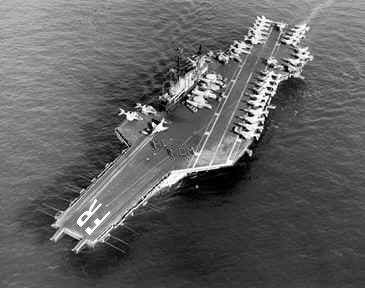
Note, the Bataan is not considered an "aircraft carrier," but at 41,000 tons is larger than almost any other non-US carrier. It is the fifth of eight in its class -- Wasp.
The Wasp Class is being followed by America Class Amphibious Assault Ships, which eliminate the well decks used to house landing craft on the Wasps and Tarawa Class ships. Instead, the America class at 45,000 tons, is especially intended to carry more aircraft, including the Osprey.

14
posted on
02/22/2009 5:46:59 AM PST
by
BroJoeK
(a little historical perspective...)
To: rlmorel
"I worked on fixed wing, but I will admit, watching those guys, covered with grease working on the rotors...man, there was a lot of exposed moving parts there." No offense intended, but in new technology, the "cutting edge" is also the bleeding edge.
In the news business they say, "if it bleeds it leads." Well, in the military: if it leads it bleeds. And when the day comes that we are too afraid to bleed, then we'll also cease to lead. Imho, of course. ;-)
15
posted on
02/22/2009 5:58:35 AM PST
by
BroJoeK
(a little historical perspective...)
To: BroJoeK
I agree completely with you. I was talking about watching guys work on Sea King rotors...
16
posted on
02/22/2009 8:14:39 AM PST
by
rlmorel
("The Road to Serfdom" by F.A.Hayek - Read it...today.)
To: rlmorel
The V-22 has indeed arrived, IMO. This—the fourth squadron deployment—will continue to extract the tactical utility of the tiltrotor. It was a long time coming, and it’s not cheap, but no other aircraft gives the battlefield commander the options the Osprey does. Many of the squadron leaders went through the painful times we all experienced around 2000. Bless them all.
TC
To: Pentagon Leatherneck
This is an article if anyone is interested that describes why there are people out there who see the risks in the Osprey as being far outweighed by the benefits. I am one of them, and this article was an excellent compilation of those benefits into a single, readable scenario.
Personally, I have always hoped that we will someday be able to look at the success of this platform, think of those who died and thank the men whose young lives were cut short by tragedy. If the platform succeeds, it will likely be due to the changes in the design their deaths compelled.
The Right Perspective
Wednesday Jan 10, 2007
The Right Perspective
by Maj Jeffrey P. Hogan JANUARY 2007
Departing the tanker with full fuel tanks, the MV–22 from Marine Medium Tiltrotor Squadron 162 (Reinforced) throttles back to maximum endurance airspeed. At 14,500 feet above sea level the aircraft is high above the threat and burning fuel ever so slowly—slow enough to remain on station for another 31/2 hours without additional refueling. Line-of-sight communications is crisp at this altitude, complementing the integrated satellite communications capability. The relative calm of this casualty evacuation (CasEvac) platform relaxing at altitude (the engines are operating at a mere 38 percent of capacity) is in sharp contrast to the situation below.
When the call comes in the crew knows the seriousness of the situation without asking. As the fastest evacuation platform in theater, most of the CasEvac missions they receive are focused on patients who have no time to spare. Immediately plotting the evacuation site on the digital map, the crew slews the forwardlooking infrared sensor to the landing site near the point of injury. Even from this altitude the thermal signature of a burning coalition vehicle is easy to break out of the scene. With the copilot still copying the CasEvac brief, the flying pilot begins the descent and turns inbound to the landing zone (LZ) at 300 miles per hour. Although the aircraft can range any zone within 70,000 square miles in less than 30 minutes, this will be a relatively short trip of only 75 miles—15 minutes for the Osprey.
Continuing the descent at maximum speed, the crew confirms the configuration of the aircraft survivability equipment and checks the readiness of the ramp-mounted M240. Based on the threat, the crew opts for a low-level ingress and levels off about 10 miles from the LZ at 200 feet above ground level. In an effort to reduce exposure, the crew maintains 220 knots until just 2 nautical miles from the zone. As they throttle back to prepare for landing, the reduction in engine thermal signature makes engagement by heat seeking missiles even more difficult for the enemy.
Half a mile from the zone, the aircraft receives fire from a nearby building. The components in the left nacelle, which have been hardened to withstand direct hits from 12.7mm ammunition, continue to function normally. Nearby hydraulic lines do not fair as well and are compromised during the engagement. Instantaneously and without crew action, the triple redundant flight control computers and vehicle management systems isolate the leak and reroute hydraulic power to critical flight controls. The crew, feeling a slight transient, notes the failure and decides to continue for the landing.
As the casualty is loaded, the crew confirms the status of the aircraft using the cockpit management system and prepares for takeoff. In order to expedite their departure, the crew rotates the nacelles forward before lift-off to maximize acceleration after becoming airborne. Passing through 30 knots the aircraft again receives fire from a nearby rooftop—this time in the form of a salvo of rocket propelled grenades. While two of the rockets pass under and behind the aircraft, the third strikes the right nacelle just forward of the engine compartment. Consequently the engine fails when it ingests debris from the shattered intake. The cockpit crew executes its procedures as the crew chief engages with the ramp gun. Fortunately, the aircraft needs little more than 40 to 50 knots of forward speed at this altitude to fly away on a single engine. The left engine, now required to drive the entire rotor system, feeds torque to the failed engine’s rotor through a backup cross-shaft connecting the two transmissions. As the nacelles rotate forward, the burden on the good engine decreases considerably as more of the aircraft’s weight is borne by the wing.
Up and away from the threat, the aircraft turns not for the battalion aid station but directly for the Level 3 treatment facility 50 miles farther away. Even with the failed engine the Osprey can cover the distance in nearly half the time of a conventional (undamaged) helicopter. After completing a slight rolling landing to the treatment facility, the crew relays a safe on deck call to its base via another squadron aircraft that has just arrived on the tanker to pick up CasEvac standby for the remainder of the night.
While an elegant depiction of the Osprey’s future worth in combat, the narrative above has a hollow ring to it. Somewhere in the reader’s subconscious the scenario is being compared to the distant echo of all of the others contrived over the years to make the case for the MV–22. It’s a standard recipe; get the audience to buy your scenario and then plug the system you advocate into it for maximum effect. Of course, in some far-off parallel universe the crew is not as sharp, the enemy is luckier or better equipped, or maybe the Osprey just doesn’t live up to expectations. Scenarios are informative, but none are definitive. For each one that proves a concept, another can easily be constructed to immediately disprove it. Scenario models also tend to be intellectually confining, inviting us to fight the last war rather than the next. Ask yourself, were you thinking about Iraq when you read the CasEvac example above?
A better way to think about the potential of tiltrotor technology is to first separate fact from myth. People are entitled to their own opinions, but they are not entitled to their own facts. The discussions below are intended to arm the reader with some ground truth about this aircraft. However, there are simply not enough pages in this magazine to clarify every bit of bad information orbiting the V–22 program. Questions will remain. Anxiety will continue. But healthy skepticism, based on reality and truth, is far preferable to cynicism founded on rumor and myth.
Folklore Management
Myth. The V–22 has poor survivability characteristics.
Fact. Survivability consists of susceptibility, vulnerability, and crashworthiness. Put another way, your chance of survival depends on not getting hit, being able to fly if you do get hit, and (if you get hit badly enough) controlling and surviving the crash.
The V–22’s range and speed increase the crew’s ability to avoid threat areas entirely and still accomplish the mission. Even in a threat area, the susceptibility of a V–22 flying at 240 knots and 200 feet above the ground is far less than a helicopter flying half as fast. For an enemy to engage an aircraft he must detect, identify, track, fire, and (in some cases) control a weapon in flight. The increased speed of the V–22 reduces the time available for the enemy to get a weapon into the air before the aircraft leaves the engagement envelope. Even in multiship formations, the V–22 can maintain this high speed until just a few miles from the LZ. From this point the Osprey is a little over 1 minute from landing—a narrow window for the enemy to engage even though the aircraft is slowing down. The integrated suite of aircraft survivability equipment is able to automatically detect missile launches and dispense countermeasures while the crew maneuvers. Combined with the low infrared signature of the V–22, these countermeasures are particularly effective in defeating shoulder-fired heat seeking missiles.
But what if the aircraft is hit by enemy fire? How vulnerable is it? The MV–22 has undergone an extensive live fire test and evaluation (LFT&E) program consisting of no less than 60 test events and totaling more than 592 ballistic test firings (more than any aircraft in Department of Defense history). All flight control actuators were proven to be resistant to light antiaircraft artillery armor piercing incendiary (API) at 90 percent muzzle velocity. During tests of the wing structure, multiple 23mm (API and high-explosive incendiary (HEI)) shots failed to compromise the load carrying integrity of the wing. Portions of the structure were actually determined to be invulnerable to all API and HEI projectiles up to and including 23mm. Overall the LFT&E effort determined that the probability of an aircraft kill (given a hit) was significantly less than that of existing helicopters.
What about failures subsequent to the initial ballistic impact? The use of nitrogen inerting in the fuel tanks reduces the probability of fires and explosions. A fire suppression system in the wing is capable of extinguishing a fire automatically and within microseconds. The vehicle management system can isolate a hydraulic leak within a few tenths of a second to reduce the amount of fluid that might feed a fire to approximately one quart. Engine tests have shown that the AE1107C Liberty engine can run for as long as 5 or 6 minutes without engine oil. The emergency lubrication system is capable of providing oil to the transmissions for 30 minutes in the event the primary system fails. The wide separation between the two engines on a V–22 reduces the possibility that a single shot could damage both engines. The single engine capability of the aircraft is also considerable, and the V–22’s unique ability to transition to airplane mode reduces the load on the good engine significantly.
Okay, all of that stuff didn’t work. We got hit and the damage is so severe we can’t continue flying. What now? The design of the V–22 places the mass of the major components (engines, transmissions, coolers) at the wing tips as opposed to right over the passenger compartment as in conventional helicopters. The wing box is designed to shear the wing (and the high mass components) away on impact and protect the cabin section. The composite blades are designed to “broomstraw” after contact with the ground to further reduce any possibility of cabin intrusion. Passengers are seated with a five-point harness a stroking seat designed to absorb a 13.5 G (gravitational acceleration) impact. The use of suction pumps to transfer fuel up to the wing tanks means that there are no pressurized fuel lines in the cabin to spray on passengers following impact. The self-sealing fuel cells have been drop tested and contain breakaway fittings to reduce the possibility of a postimpact fire. The bottom line is that your chances of surviving an enemy engagement are far better in a V–22 than in any conventional helicopter in the Marine Corps.
Myth. The V–22’s size and down wash limit the number and type of feasible LZs.
Fact. There seems to be some confusion about the size of the V–22 relative to the CH–46. The CH–46 is 84.33 feet long by 51 feet wide. The Osprey is 84.58 feet wide and 57.33 feet long. It’s bigger but only marginally. Additionally, it should be selfevident that the increased range and speed of the V–22 greatly increases the number of feasible LZs. This issue of fewer zones isn’t just a myth; it’s completely inverted from reality.
Another often cited concern is the down wash of the V–22 and the ability to land in dusty zones. To be sure, the down wash of a V–22 is greater than that of a CH–46. (The Osprey weighs more than twice as much and has only 58 percent of the rotor disk area.) But does this mean that the aircraft can’t land in the dust? No. Anyone who has ever landed a helicopter in the dust can testify to the skill required to do it safely and consistently. In most cases, visual reference with the ground is lost at some point prior to touchdown. The generic technique is to set a landing attitude (with deceleration and rate of descent under control) prior to losing visual contact with the ground and letting the aircraft land. This technique also works in a V–22, although visual reference is normally lost at a higher altitude.
However, the V–22 also has equipment and features to assist during reduced visibility landings that no other Marine Corps helicopter has. For instance, each of the three inertial navigation systems contains a highly accurate ring laser gyroscope to resolve velocities down to fractions of a knot. These precise velocities support the current hover coupled capability that can be used to automatically hold the aircraft over a point (hands off ) or land on that same point without visual reference to the ground. Even for a hand-flown landing, the hover page in the V–22 gives the crew a situational awareness about drift and position over the ground that is unprecedented in our history.
Myth. The V–22 lacks a defensive weapons system.
Fact. The first MV–22 deployments will be made with an M240 ramp-mounted weapons system. This system has the capability to fire both on the ground and while airborne with a 180-degree field of fire. Work continues within the program to procure a permanent defensive weapons system to either replace or complement this interim solution. The goal, based on the Capabilities Production Document for Block B, is to field a system capable of firing into all quadrants (a significantly improved field of fire compared to legacy helicopters).
Myth. The V–22 is not maneuverable at low airspeeds. (Specifically, it cannot descend as fast as a helicopter.) Fact. Figure 1 depicts the allowable rate of descent at given airspeeds for the V–22 versus other Marine Corps helicopters. While helicopters must restrict rate of descent to 800 feet per minute at 40 knots, the V–22 is capable of 1,700 feet per minute at the same speed. Additionally, only the V–22 has a warning system to alert the crew of a high rate of descent situation at low forward airspeed. Testing has also shown that tiltrotors are able to recover from a high rate of descent situation as fast (if not faster) than conventional helicopters. Low speed, high rate of descent profiles have been (and will remain) a hazard to rotorcraft. Contrary to popular mythology, the associated risks will actually decrease once the V–22 is fully fielded.
Technology Doesn’t Win Wars, Marines Do
Nothing stated above guarantees anything. No test, regardless of scope or complexity, can perfectly simulate today’s battlefield (or tomorrow’s). Ultimately, the enemy gets a vote. And of course, not all of the news is universally good. Almost no one is satisfied with the ramp-mounted weapons system as anything more than an interim solution on the way to something better. The lack of weather radar reduces the V–22’s potential significantly. The current coupled approach to a hover terminates at 50 feet, which most believe is too high. The electronic warfare suite could be better integrated into the cockpit controls and displays. More expendables would be a welcome improvement. Such is life. More importantly, such is life in every other weapons program. These issues and others are getting attention at the appropriate levels, and improvements are (slowly) making their way to the Operating Forces.
In the meantime, what should be the source of confidence in the V–22? The answer is simple—people. Marines should rest assured that people just like them, those who share their concerns, values, and experiences, work hard every day to make sure the V–22 will be at the right place, at the right time, with the right tactics, to get the job done. The CH–46, CH–53, UH–1, and AH–1 are not successful because they are great aircraft. They do not post phenomenal readiness rates because they are inherently well designed. They do it because people work incredibly hard to keep the aircraft ready to fly. These communities do not keep combat losses low because of perfect systems but, rather, because of great flight leaders and crews who know how to exploit the strengths and guard the weaknesses of their aircraft.
The V–22 will be no different. The people in this program, the ones who identify and solve problems every day, are people just like you. They are Operations DESERT SHIELD/DESERT STORM, Operations ENDURING FREEDOM/IRAQI FREEDOM, and Horn of Africa veterans—many highly decorated for their actions in combat. They are experts in their legacy aircraft—most are weapons and tactics instructors. They are graduates of the resident and nonresident schools of our own and sister Services. They include Air Force personnel with impeccable credentials in special operations. They are professionals all and profoundly committed to their mission.
What Is Past Is Prologue
This program is controversial. The skepticism harbored by many Marines toward the V–22 is understandable and not entirely unhealthy. But in our zeal to explore every issue and identify every challenge, too much of our energy has been spent sitting in judgment of the past. The time to argue whether tiltrotor technology is worthy of our investment is over. The time to conjecture over the value of alternatives like the H–60 or a service-life extension for the CH–46 is long past. Spirited deliberation and debate can be constructive. But deliberation and debate without end is pernicious. In the case of the MV–22, we often end up arguing about how the aircraft got here rather than where we’re going to take it. It’s time to face reality. It is here.
The changing face and pace of conflict is another reality we are confronting at a time when our Armed Forces seem to be shrinking. Distributed operations will continue to move from the theoretical to the absolutely essential. Certainly the MV–22 is not the answer to every tactical problem, but it can increase the raw productivity of an important warfighting function. How do we integrate and exploit such a potentially disruptive technology as our doctrine evolves? The question isn’t how to get an MV–22 to do what helicopters do now, but how to do assault support better across the spectrum of conflict. The question isn’t how to simply subtract the CH–46 from our force structure and add the V–22 in its place, but how to move this function of Marine aviation so far forward that all of the others benefit. Maybe the better question is whether we need toconfine the MV–22 to an assault support “box” at all. We have tackled technology insertion issues like this before (global positioning system, laser guided weapons, and night vision goggles all come to mind), and we will be forced to again in the future (expeditionary fighting vehicle, lightweight howitzer, Joint Strike Fighter). These are the questions that require the attention of the best and brightest in our Corps.
If you are wearing the uniform today you will be part of finding the answers.
Your input will be based on your experiences and rightly so. But you will also be asked to put your own biases, passions, and emotions in perspective—to see the future the way it can be, as opposed to where conventional wisdom would predict. You’ll recognize the importance of avoiding words like “always” and “never” when discussing tactics. You’ll grow beyond the world of the here and now and start thinking about the next generation of Marines who are relying on you to lay the foundation for victory on the battlefields of the future. In the end you might even conclude that the only real problem we face is that we can’t find a way to by MV-22s faster.
18
posted on
02/22/2009 7:15:08 PM PST
by
rlmorel
("The Road to Serfdom" by F.A.Hayek - Read it...today.)
To: Pentagon Leatherneck
I read your bio-thank you for your service. I used to be a jet mechanic on A-7s. The Skyhawk was one hell of a plane. I’ll bet it was a lot of fun to fly!
Regards-
Bob
19
posted on
02/22/2009 7:22:03 PM PST
by
rlmorel
("The Road to Serfdom" by F.A.Hayek - Read it...today.)
To: rlmorel
I watched at Alliance/Fort Worth as a Marine V-22 departed after a maintenance issue handled there at the Bell plant.
These guys taxied out on the ramp to the taxi way then stopped in place, turned completely around and faced the Bell apron where the maintenace people were watching.
In unison they tipped they're noses down to the ground and bowed in thanks, then turned back and departed.
One of the coolest things Ive seen in a long time.
Navigation: use the links below to view more comments.
first 1-20, 21-23 next last
Disclaimer:
Opinions posted on Free Republic are those of the individual
posters and do not necessarily represent the opinion of Free Republic or its
management. All materials posted herein are protected by copyright law and the
exemption for fair use of copyrighted works.
FreeRepublic.com is powered by software copyright 2000-2008 John Robinson