Skip to comments.
New class of submarine all about mission of stealth
azstarnet/AP ^
| 02.17.2008
Posted on 02/17/2008 9:26:07 AM PST by nuconvert
New class of submarine all about mission of stealth
The Associated Press
02.17.2008
ABOARD THE USS OHIO — Capt. Andy Hale has just worked out and is still in a sweaty T-shirt and shorts as he stands in the battle command center. He is watching a flat-screen display that shows what's happening outside on the bow and the aft.
His billion-dollar submarine — the U.S. Navy's newest twist on underwater warfare — is hovering just below the surface off the Pacific island of Guam as a submersible disappears into the dark waters, carrying a team of commandos.
The USS Ohio is the first of a new class of submarine created in a conversion from 1970s vessels by trading nuclear-tipped ICBMs for conventional cruise missiles and a contingent of commandos ready to be launched onto virtually any shore through rejiggered missile tubes — against conventional forces or terrorists. The sub's cruise across the Pacific comes as China builds its submarine fleet into the region's largest as part of the bulking up of its military. The voyage is the Ohio's first deployment since the makeover, and Hale is in the odd position of showing the ship off.
Commandos aboard
It's odd because the sub is all about stealth. Hale can't talk about where the ship is going. The back of the ship, where the nuclear power plant is located, is off- limits. The leader of the SEAL commando contingent aboard can't be named, and the commandos themselves can't be photographed in any way that shows their faces.
But, over the next few months, the Ohio will be making a very public statement, training intensively in some of the world's most crowded and contested waters and joining in exercises with America's Asian allies. Instead of hiding them, the Ohio will be showcasing its abilities to elude detection and operate too deeply and quickly to be tracked.
Then it will likely do what it does best — vanish. "Submarines are the original stealth platform," Hale said. "Submarine forces have always viewed the Pacific as a very important strategic area . . . it's certainly grown in importance in the last 10 years." Just about every country with a coastline in Asia wants or has subs.
China, Japan, Australia, India, Malaysia, Pakistan, Indonesia, Singapore, Bangladesh and South Korea and North Korea either now have or are planning to acquire them. Most don't pose much of a threat to the more advanced American fleet. But that is changing.
Large Chinese fleet
While Russia continues to be a factor, China now has the biggest submarine fleet in the region, with nearly 60. The United States has upped its presence in the Pacific and now has more ships — and more subs — in this part of the world than in the Atlantic. But they are still outnumbered. "There are many challenges in the Pacific," Hale said. "China is certainly one of them, but it is not the only one."
China's subs are mainly diesel-powered, meaning they must come up for air more frequently than U.S. nuclear-powered vessels, and their crews are not believed to be as well trained as American submariners, who spend several months at a time at sea.
China's fleet is also highly focused on patrolling its own coastal waters and on dealing with potential hostilities over Taiwan, rather than with "projecting force," or trying to control faraway shipping lanes. But its the long-term goals remain opaque.
Two years ago, a Chinese sub shocked the U.S. Navy by surfacing within torpedo range of the USS Kitty Hawk aircraft carrier near the Japanese island of Okinawa. Beijing claimed the sub was in international waters and was not "stalking" the carrier, which was taking part in a naval exercise.
The growing rivalry was underscored in November, when Beijing refused a scheduled port call by the Kitty Hawk's battle group to Hong Kong, forcing thousands of sailors to spend Thanksgiving at sea. In January, however, China allowed a visit to the port by another U.S. Navy vessel.
Washington has repeatedly expressed concern that China is pouring money into expanding its forces. Beijing increased its military budget by nearly 18 percent to about $45 billion last year, the largest annual hike in more than a decade, and U.S. officials believe actual spending is greater.
"Devil of deterrence"
The Chinese, meanwhile, are closely watching to see how U.S. concern translates into changes in the U.S. Navy. When the Ohio, which is based in Bangor, Wash., docked at Guam last month, China's official Xinhua news agency called the submarine a "warehouse of explosives" and a "devil of deterrence." "If the Ohio turns west from Guam, it would need only hours to travel to the coastal waters of many Asian nations," it said. "The U.S. Navy believes the power of the cruise missile-armed nuclear submarine will be tremendous in a future war."
That is exactly what the Navy wants China and others to think, and why the Ohio is in the Pacific.
Major firepower
"The advanced capabilities that we have brought to this ship make it a premier front-line submarine," said the Ohio's executive officer, Lt. Commander Al Ventura. "This has taken the submarine force to a whole new level."
The Ohio has both vast firepower and the ability to deploy quickly to wherever it's needed. It has 24 launch tubes, 15 of which have been fitted for multiple Tomahawks — more than 100 in total. That's more than were launched in the entire first Persian Gulf War. From an offshore position in the Pacific, it could strike Pyongyang, North Korea. From the Indian Ocean, it could hit anywhere in Afghanistan.
The switch to conventional missiles is a concept borne of necessity. Under a 1992 disarmament treaty, the U.S. Navy had to give up four of its 18 "boomers," huge submarines that have for decades served as mobile launch platforms for long-range nuclear missiles and were primary players in the Cold War game of cat-and-mouse between Washington and Moscow.
Instead of scrapping the ships, however, the Navy converted them. The nuclear weapons were replaced with conventional Tomahawk guided missiles and several of the launch tubes refitted to deploy the Navy SEALs in submersible boats.
More room available
Because of the sheer size of the sub — it's 560 feet long — it has more room for its 160-member crew and dozens of commandos than an attack submarine. While still cramped and claustrophobic, sailors have bigger beds and several places for working out, which the SEALs do constantly.
Among the SEALs, stealth remains a way of life. While near Guam, the SEALs conducted operations simulating an undersea launch in their submersible and a landing to assess a fictitious terrorist threat.
The SEAL commander said the simulations were not aimed at any particular country. Still, he said, it's not just idle training. "This capability has been used before, and it will probably be used again," he said.
TOPICS: Front Page News; News/Current Events
KEYWORDS: navy; stealth; sub; submarine; usn; ussohio
Navigation: use the links below to view more comments.
first 1-20, 21-28 next last
1
posted on
02/17/2008 9:26:09 AM PST
by
nuconvert
To: nuconvert
New class of submarine all about mission of stealthOh good. None of the old submarines gave any thought to stealth...
Maybe there is a reason the MSM is being abandoned in favor of the new media... Substance.
2
posted on
02/17/2008 9:28:54 AM PST
by
MrEdd
(Heck? Geewhiz Cripes, thats the place where people who don't believe in Gosh think they aint going.)
To: nuconvert
China's fleet is also highly focused on patrolling its own coastal waters .., rather than with "projecting force," or trying to control faraway shipping lanes.They don't have to the OWN the shipping lines, products, and ports.
To: nuconvert
USS Ohio (SSGN 726)
- formerly SSBN 726 -
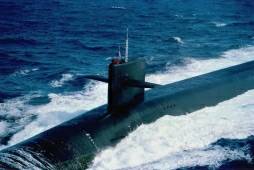
USS OHIO is the first TRIDENT - class nuclear powered submarine and the fourth United States vessel to bear the name of the 17th state of the union. USS OHIO has already completed more than 50 patrols. On December 9, 2001, she successfully launched four Trident I C4 missiles.
On November 15, 2003, conversion started to modify the USS OHIO to carry 154 conventional cruise missiles instead of 24 Trident missiles. Conversion was finished in late 2005, and the OHIO was redesignated SSGN 726. As an SSGN, the OHIO is now also able to support operations of up to 66 Special Forces Personnel for up to 90 days. OHIO rejoined the fleet on January 9, 2006.
| General Characteristics: |
Keel Laid: April 10, 1976 |
| Launched: April 7, 1979 |
| Commissioned: November 11, 1981 |
| Builder: General Dynamics Electric Boat Division, Groton, Conn. |
| Propulsion system: one nuclear reactor |
| Propellers: one |
| Length: 560 feet (171 meters) |
| Beam: 42 feet (12.8 meters) |
| Draft: 36,5 feet (11.1 meters) |
| Displacement: |
Surfaced: approx. 16,765 tons
Submerged: approx. 18,750 tons |
|
| Speed: 20+ knots |
| Armament: Tomahawk missiles, Mk-48 torpedoes, four torpedo tubes |
| Homeport: Bangor, Wash. |
| Crew: 17 Officers, 15 Chief Petty Officers and 122 Enlisted |
4
posted on
02/17/2008 9:47:16 AM PST
by
papasmurf
(Calm down! I've got Greenspan's book, you jerk!)
To: nuconvert
"This capability has been used beforeFor midnight runs to get beer?
5
posted on
02/17/2008 9:51:43 AM PST
by
John123
(Wahhabism is the best choice for anyone too stupid for scientology...)
To: papasmurf
Love this picture...
The USS Ohio stops for a personnel boat transfer off the coast of Puget Sound, Wash.

6
posted on
02/17/2008 9:58:13 AM PST
by
papasmurf
(Calm down! I've got Greenspan's book, you jerk!)
To: papasmurf
This picture isn’t accurate. The newly remodeled sub has a docking station on the deck for a mini-sub.
To: tom paine 2
It was taken in 2007, same time frame as this one...

Do you have one that shows the dcoking station?
8
posted on
02/17/2008 10:16:52 AM PST
by
papasmurf
(Calm down! I've got Greenspan's book, you jerk!)
To: papasmurf
Behind the tower in your pic?
9
posted on
02/17/2008 10:25:17 AM PST
by
patton
(cuiquam in sua arte credendum)
To: nuconvert
The US is missing a bet by not having a “noisy boat”, not for military use, but for scientific research.
Our oceanographic research is about where our space research was before NASA. That is, we can look, but not touch.
A noisy boat submarine should be special built for extreme deep water operations. It doesn’t need to be fast or silent, in fact it should make a distinct, unique noise, so anyone can tell where it is, but not so noisy that its sound acts like sonar against other submarines.
It also needs to be built to be able to *do* things at those great depths. Things like disabled submarine crew recovery, study of extreme depth specimens without destroying them by transporting them to a low pressure environment, perhaps even pouring large amounts of submarine concrete over potentially dangerous nuclear and chemical waste.
And be flexible enough to do everything from rock core samples to undersea cable repair.
To: patton
This is the only other one I can find.

11
posted on
02/17/2008 10:38:55 AM PST
by
papasmurf
(Calm down! I've got Greenspan's book, you jerk!)
To: yefragetuwrabrumuy
It also needs to be built to be able to *do* things at those great depths...
...and cutting undersea cables {wink-wink}
12
posted on
02/17/2008 10:41:01 AM PST
by
papasmurf
(Calm down! I've got Greenspan's book, you jerk!)
To: papasmurf
Go back and look at the pick that you posted in #8.
What is the big oblect on the boat, just behind the tower?
13
posted on
02/17/2008 10:44:19 AM PST
by
patton
(cuiquam in sua arte credendum)
To: patton
Another boat next to them, is what I thought.
14
posted on
02/17/2008 10:45:55 AM PST
by
papasmurf
(Calm down! I've got Greenspan's book, you jerk!)
To: John123
Seals used this concept as far back as Viet Nam.
15
posted on
02/17/2008 10:47:14 AM PST
by
hetzman
To: papasmurf
That’s what they want you to think. ;)
16
posted on
02/17/2008 10:51:14 AM PST
by
patton
(cuiquam in sua arte credendum)
To: John123
The first combat mission using the mini subs off of a submarine was in 1972, the Op. now has been declassified and awards are just now being given out to SEAL team participants. It was called Operation Thunderhead took place in june of 72.
https://www.navsoc.socom.mil/Thunderhead/index.html
17
posted on
02/17/2008 11:06:41 AM PST
by
hetzman
To: nuconvert; Doohickey; judicial meanz; submarinerswife; PogySailor; chasio649; gobucks; ...
18
posted on
02/17/2008 12:23:10 PM PST
by
SmithL
(My tagline dropped out)
To: SmithL
Submarines don’t have flat decks.
19
posted on
02/17/2008 1:22:58 PM PST
by
Doohickey
(McCain 2008: A President with Tourette's will make press conferences interesting...)
To: papasmurf
That’s doesn’t look like an OHIO SSGN. That’s an attack boat at Norfolk. Nautica museum and USS WISCONSIN in the background.
20
posted on
02/17/2008 2:07:26 PM PST
by
GATOR NAVY
(Your parents will all receive phone calls instructing them to love you less now.)
Navigation: use the links below to view more comments.
first 1-20, 21-28 next last
Disclaimer:
Opinions posted on Free Republic are those of the individual
posters and do not necessarily represent the opinion of Free Republic or its
management. All materials posted herein are protected by copyright law and the
exemption for fair use of copyrighted works.
FreeRepublic.com is powered by software copyright 2000-2008 John Robinson