Skip to comments.
Mitt Romney: Putting Conservative Principles to Work in Health Care
Townhall.com ^
| August 21, 2007
| Jim Talent
Posted on 08/21/2007 1:28:41 AM PDT by Kaslin
Each candidate in the 2008 Presidential race will undoubtedly offer a health care plan. Those plans will include initiatives ranging from a single payer system, to employer mandates, to tax incentives for the purchase of private health insurance. But only one candidate has actually done something, waded into the issue and emerged with a successful plan that does not resort to one-size-fits-all, government run "Hillary Care." That innovative candidate is former Governor Mitt Romney.
On April 12, 2006, Governor Romney signed into law landmark legislation ensuring that every resident of Massachusetts would have access to affordable, portable, quality private health insurance – without higher taxes, an employer mandate or a government takeover of health care.
Massachusetts was afflicted with many of the same problems that plague the health care system across the country. There was no easy way to buy affordable insurance except through an employer. Without the employer option, it just was not feasible for many people to buy health insurance. As a result, they had to resort to emergency room care and the taxpayers ended up footing the bill. People choosing their health care provider could not get critical information about the cost or quality of care, and excessive state regulations reduced choices and drove up costs.
When Governor Romney decided to tackle the double-digit annual increases in health insurance costs, the average uninsured resident in Massachusetts had to pay $335 a month for private health insurance, which did not include coverage for prescription drugs and featured a $5,000 deductible. Moreover, the state was spending over $1.3 billion a year on "free care" for the uninsured.
Governor Romney actually got the Democrat-controlled legislature to enact a plan that addressed these problems. He took the time to understand what makes private health insurance markets work and transformed the market in his state from one that was government-controlled to one that allows competition to flourish.
Governor Romney's health care plan featured a number of reforms. First, his plan deregulated the overburdened Massachusetts insurance market to reduce the cost of private insurance, while giving consumers more choice from a broader range of plans. Second, the plan addressed the problems caused by the fact that many people could not get healthcare through their employers and could not afford it on the individual market. Third, he redirected the millions of dollars that were being spent on free emergency room care and used it instead to help those who truly were not able to afford private health insurance.
Finally, Governor Romney recognized that competition is the key to the success of any market – so doing what no one had ever done before, he created a new market where consumers can go to pick the health care plan that suits them best. Called the "Connector," this marketplace is not a new regulatory agency or insurance purchasing pool. It is a place that gives people access to more choices, better information, and lower costs in selecting a private health insurance plan. The Connector also provides a way for individuals to purchase insurance with the same pre-tax advantage given to those buying insurance through their employers. Even better, the Connector gives people the chance to buy private insurance independent of their jobs, so that they don't have to worry about losing their coverage when they change employers.
But Governor Romney's reforms did not stop at reducing the cost of insurance today. He also tackled a number of reforms that will help reduce the rise in health care costs over the long-term. His plan included medical transparency provisions that allow consumers to compare the quality of hospitals and providers, while tracking and recording the costs associated with the care they provide. The reforms also instituted measures to encourage the use of electronic health records, which will reduce medical errors and lower costs.
What's been the result of all these reforms? Although the reforms were signed into law just over a year ago, the changes are dramatic. The same uninsured individual whose choice was formerly limited to a policy with a $335 a month insurance premium with no drug benefits and a $5,000 deductible now can purchase quality private insurance, which includes coverage for prescription drugs, office and emergency room visits, and a $2,000 deductible, for $175 per month. Between July 1, 2006 and May 1, 2007, nearly 125,000 previously uninsured residents of Massachusetts got health insurance coverage.
Taxpayer-funded "free care" is falling at double-digit rates, because the Romney reforms no longer allow people to let others pay for their health care if they can afford their own health insurance. Those who previously couldn't afford health insurance now have the help they need to get access to affordable, quality, portable private coverage. And, as he promised, Governor Romney did all this without raising taxes and without a government take-over of health care.
All of Governor Romney's reforms are consistent with the goal of making private health insurance more available, flexible, and affordable. That is why many conservative organizations have hailed Governor Romney's health care reforms. The Heritage Foundation called it "one of the most promising strategies out there." Massachusetts Citizens For Limited Taxation said that Romney's plan was a responsible solution to America's health care challenges. And the Ethan Allen Institute praised Governor Romney's plan because of its focus on personal responsibility and choice.
The bipartisanship, innovation, conservative statesmanship and creativity he exhibited confirms my view that he is the kind of leader this nation needs.
TOPICS: Culture/Society; Editorial; Politics/Elections; US: District of Columbia; US: Massachusetts
KEYWORDS: elections; healthcare; hillarycare; mittromney; problemsolver; romney
Navigation: use the links below to view more comments.
first 1-20, 21-40 next last
1
posted on
08/21/2007 1:28:43 AM PDT
by
Kaslin
To: Kaslin
Someone please correct me: Didn't Romney's law FORCE EVERYONE to buy health insurance, even if they didn't need or want it?
I mean, right at the outset, didn't he strip each and every citizen of personal freedom and choice and compel them to submit to a government decree or be subjected to stiff penalties, including having one's paycheck held to pay for insurance that would be assigned to them automatically?
Then he took people's tax dollars and paid for low income families to have policies for free?
"From each according to his ability, to each according to his need..."
Sounds kind of familiar...

Mitt, you lost my vote before you had my vote...
But the hair, man, nice hair!...
2
posted on
08/21/2007 2:04:04 AM PDT
by
Caipirabob
(Communists... Socialists... Democrats...Traitors... Who can tell the difference?)
To: Caipirabob
3
posted on
08/21/2007 2:09:36 AM PDT
by
EternalVigilance
(States' rights don't trump God-given, unalienable rights...support the Reagan pro-life platform)
To: Caipirabob
"Didn't Romney's law FORCE EVERYONE" That was sure my understanding.
This article puts forth things that don't make sense. If it was optional a freeloader who previously received care for free willingly forks over $175 a month? Not in my universe.
Secondly what was the free market reason for premiums going down from $335 to $175 unless it was the forced participation in the "free market" by the state?
Methinks this is hollow spin or maybe Ma. exists in some weird parallel universe that exists contrary to the cause and effect of other states. Humm, on second thought maybe that's the case. At least it'd explain Kennedy and Kerry.
4
posted on
08/21/2007 2:16:33 AM PDT
by
Proud_texan
(Just my opinion, no relationship to reality is expressed or implied.)
To: Proud_texan
I’m really developing a deep dislike for these Republicans like Talent who are shilling for Romney.
I’ll never support one of them for anything, not even dogcatcher, when and if they run for office again.
5
posted on
08/21/2007 2:23:43 AM PDT
by
EternalVigilance
(States' rights don't trump God-given, unalienable rights...support the Reagan pro-life platform)
To: Proud_texan
"Commonwealth Care" also provides taxpayer-funded abortions.
Summary of Commonwealth Care Benefits | Plan Type 2, 3, and 4
Outpatient Medical Care
· Office visits (PCP / specialty)
· Outpatient surgery (Outpatient hospital / ambulatory surgery centers)
· Community health center visits (PCP / specialty)
· Radiology, imaging (X-rays) / labs
· Abortion services
6
posted on
08/21/2007 2:27:33 AM PDT
by
EternalVigilance
(States' rights don't trump God-given, unalienable rights...support the Reagan pro-life platform)
To: Kaslin; Caipirabob; EternalVigilance; Proud_texan
The Romney Care Statutes
CHAPTER 176Q. COMMONWEALTH HEALTH INSURANCE CONNECTOR
Chapter 176Q: Section 1. Definitions
Chapter 176Q: Section 2. Commonwealth health insurance connector authority; board; meetings; executive director
Chapter 176Q: Section 3. Powers and duties of board
Chapter 176Q: Section 4. Health benefit plans to be offered to eligible individuals and groups
Chapter 176Q: Section 5. Requirements for health insurance plans offered through connector
Chapter 176Q: Section 6. Binding agreement as condition of participation in connector for eligible small groups
Chapter 176Q: Section 7. Administration of commonwealth care health insurance program
Chapter 176Q: Section 8. Interagency agreements with department of revenue
Chapter 176Q: Section 9. Health benefit plans for commonwealth employees and contractors
Chapter 176Q: Section 10. Seal of approval
Chapter 176Q: Section 11. Enrollment in connector by producer; commission
Chapter 176Q: Section 12. Surcharge to health benefit plans; reports; withdrawal of health plan from connector
Chapter 176Q: Section 13. Expenses incurred by connector; liabilities; indemnity and reimbursement; rights and property of connector upon dissolution, etc.
Chapter 176Q: Section 14. Accounting; audits
Chapter 176Q: Section 15. Study of connector and enrolled persons; written report
Chapter 176Q: Section 16. Regulations
7
posted on
08/21/2007 2:28:55 AM PDT
by
tiger-one
(The night has a thousand eyes)
To: Kaslin
The way the Mitt fans approach his plan, it is great it will solve the health care crisis in this country.
8
posted on
08/21/2007 2:31:07 AM PDT
by
tiger-one
(The night has a thousand eyes)
To: Kaslin
9
posted on
08/21/2007 2:32:27 AM PDT
by
Son House
($$Proud Memeber of Vast Right Wing, Out To Lower Your Tax Rates For More Opportunities.$$)
To: Caipirabob
The Heritage Foundation called it "one of the most promising strategies out there." Massachusetts Citizens For Limited Taxation said that Romney's plan was a responsible solution to America's health care challenges. And the Ethan Allen Institute praised Governor Romney's plan because of its focus on personal responsibility and choice.
Are all these people lying? If so, what is their motive? Are they all "shills for Romney"?
To: samtheman
I'd submit that in any circumstance where the government forces you to pay and partake in something you have no desire to participate in, your personal freedom has unquestionably been diminished.
11
posted on
08/21/2007 4:13:14 AM PDT
by
Caipirabob
(Communists... Socialists... Democrats...Traitors... Who can tell the difference?)
To: Caipirabob
Mitt putting conservative principles to work?
He’d have to find some first.
To: Caipirabob
What? You don’t have health insurance you don’t get free care. The Commonwealth is not going door to door asking for everyone’s papers. You choose to go without then haul your uninsured ass up to NH for treatment because the free gravy train is over.
Of course there are those here who would prefer we continue to foot the 1.3 billion a year to pay for those who exercise their “personal freedom” to leech off of taxpayers - never mind the $350 million we we faced with losing from the Federal Government because gee, MA had an unreasonablly high amount of uninsured parties seeking free health care:
On April 12, 2006, Governor Romney signed into law landmark legislation ensuring that every resident of Massachusetts would have access to affordable, portable, quality private health insurance – without higher taxes, an employer mandate or a government takeover of health care.
Massachusetts was afflicted with many of the same problems that plague the health care system across the country. There was no easy way to buy affordable insurance except through an employer. Without the employer option, it just was not feasible for many people to buy health insurance. As a result, they had to resort to emergency room care and the taxpayers ended up footing the bill. People choosing their health care provider could not get critical information about the cost or quality of care, and excessive state regulations reduced choices and drove up costs.
When Governor Romney decided to tackle the double-digit annual increases in health insurance costs, the average uninsured resident in Massachusetts had to pay $335 a month for private health insurance, which did not include coverage for prescription drugs and featured a $5,000 deductible. Moreover, the state was spending over $1.3 billion a year on “free care” for the uninsured.
To: EternalVigilance
Repeat the lie enough will not make it true.
Why don’t you try understanding what you are linking here instead — I have pointed it out to you numermous times.
To: Lovebloggers
The RomneyBOTs think they can lie and long enuf they can spin history like the Clintons.
Romney NEVER allows votes. He is the high priest of HillaryCARE.
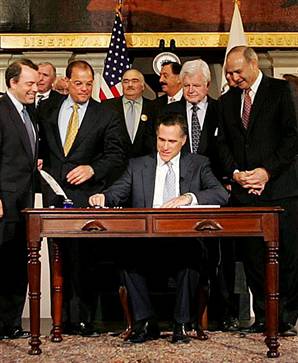
Romney signing RomneyCARE=HillaryCARE
Sen. John Kerry to Don Imus: "I like this health care bill".
Sen. Hillary Clinton: "To come up with a bipartisan plan in this polarized environment is commendable."
James Carville: "It's a feel-good story, this Romney thing. Romney is an ascendant guy."
15
posted on
08/21/2007 6:12:53 AM PDT
by
Diogenesis
(Igitur qui desiderat pacem, praeparet bellum)
To: Caipirabob
Mitt, you lost my vote before you had my vote... He lost your vote before you didn't read the article.
To: EternalVigilance
I’m really developing a deep dislike for these Republicans like Talent who are shilling for Romney. Getting harder to throw your ad hominems on good people like Talent? Come on, doesn't this make Talent a 'lying liberal'?
To: Diogenesis
Yeah sure whatever you say. Insurance is my profession, I do know what I am talking about. You? not so much apparently.
To: samtheman
No, they have actually looked at the plan and recognize it for what it is — a great plan, and a way out of the out of control costs associated with bailing hospitals out for the free care they dole out to those folks who exercise their “personal freedoms” to go without coverage and have no financial means to cover their medical debts.
To: Lovebloggers
So YOU are a RomneyBOT insurance salesman in lockstep with Romney
who thinks that those who don't like forced socialized medicine
'don't know what they are talking about'?
What do you base that on?
20
posted on
08/21/2007 7:05:51 AM PDT
by
Diogenesis
(Igitur qui desiderat pacem, praeparet bellum)
Navigation: use the links below to view more comments.
first 1-20, 21-40 next last
Disclaimer:
Opinions posted on Free Republic are those of the individual
posters and do not necessarily represent the opinion of Free Republic or its
management. All materials posted herein are protected by copyright law and the
exemption for fair use of copyrighted works.
FreeRepublic.com is powered by software copyright 2000-2008 John Robinson