
It launches today at noon, Eastern.
Posted on 06/29/2007 7:37:49 AM PDT by ShadowAce
BURLINGAME, Calif. - We now know what happens when big hairy software coders work with big hairy lawyers. The result, understandably, is anything but slick. Meet GPLv3, the free software movement's latest legal tool to keep their code from being fenced in.
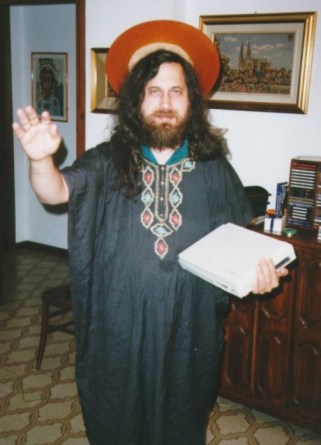
At least its author, Richard Stallman, has pluck. The coder and richly bearded patron saint of free software is launching this wad of legal jargon Friday — with practically every geek on the planet fixated on the retail debut of the iPhone — looking to steal a bit of Apple (nasdaq: AAPL -news - people) Chief Steve Jobs' hype.
The angle: iPhone users won't be free to mess around with all the $500 phone's code, Stallman's Free Software Foundation asserts, while their latest bit of legal mumbo jumbo will give users the ability to tinker with their gadgets freely. Hey, if the circus is in town, you might as well catch a ride in the clown car.
But while it may sound arcane, the latest version of the General Public License (GPL) is important. And not just because it complicates the efforts of Microsoft (nasdaq: MSFT - news - people) to get its hooks into so-called open-source software, as some geeks call it.
An earlier version of the license, GPLv2, has long protected the open-source Linux operating system, which has ground out gains against Unix and Windows in the server rooms of big businesses across the world. That license dictates that the software it protects can be copied and distributed freely, with the puckish twist that all derivative work must also be sold and licensed under the same terms.
The new license aims to push that idea further — even as the movement has won deep-pocketed believers, such as IBM (nyse: IBM - news -people), in the more than 15 years since the earlier license was published. As a result, the draft of the license released May 31 is a dense piece of legalese that, at times, seems torn between pushing the ideals of the revolution, and making "tactical" compromises.
For starters, the draft would discourage deals such as the one between Novell (nasdaq: NOVL - news - people) and Microsoft last year. As part of that arrangement, Microsoft will offer users of Novell software protection from being sued for violations of its patents in their Linux software. That angered many in the free software community, who asserted it created doubts about the legal viability of their software. Yet, in something of a messy compromise, the new license also effectively grandfathers in the Novell-Microsoft deal itself.
The new rules would also restrict something Stallman calls “Tivoization,” a term for devices that are built with free software, but don't allow users to mess around with all of the code, such as the TiVo(nasdaq:TIVO - news - people) digital video recorder. It's a controversial move — while Stallman's group sees the trend as a problem, others see the use of code that can be freely shared by companies such as TiVo as a sign of progress.
Partly as a result, Stallman has failed to win over some of the geeks who have made free software a success. Linux creator Linus Torvalds has criticized drafts of the new license, and there's no guarantee that he'll push for his creation to be covered by the new rules. Clearly, Stallman lacks Steve Jobs' reality distortion field.
But while Stallman lacks a talent for hype, he does have persistence on his side, and the kind of credibility that comes with being a true believer. In an effort to strengthen its free software credentials, Sun Microsystems(nasdaq: SUNW - news - people) CEO Jonathan Schwartz has hinted that it may release its Solaris operating system under the GPLv3 license. And that's prompted Linux creator Torvalds to hint on a popular open-source mailing list that he may follow suit.
It's a bit of social engineering that's hardly on par with a Steve Jobs keynote. But for a hairy software coder, it's pretty slick.
It launches today at noon, Eastern.
 |
"Trolltech has loosened key licensing restrictions on its user-modifiable Linux-based mobile phone for open source software developers. Users of the Greenphone will no longer be restricted to running Qtopia software on the device, nor to using the device only in its supplied hardware/software configuration. ..." Open Linux developer phone opens up more |
This gets tiresome. Derivative works that you don't distribute are not subject to this provision. It's only when you derive something from a GPL work and go to distribute THAT, you gotta put it under the GPL.
Journalism, meh. The watchdogs of culture are the ones least qualified to do it.
I don't agree with Stallman's idea that all software should be freely available. Nope, not giving away my labor without going into it voluntarily. On the other hand, I like cooperative software like Linux and wouldn't want Bill Gates to take it, change one line, rename it Windows-L and claim full copyright and patents on it. I get the impression that Stallman is trying to force anyone who distributes Linux to be required to distribute the source for everything, not just their version of Linux.
Does anyone have a "GPL for Dummies" link?
I'm not familiar with GPLv3, but under GPLv2, it is common for applications to be closed source, and the source not made public. So the custom-written programs for the iPhone would not have to be distributed.
I believe the requirement will be the same in v3 as well.
The GPL, including the GPLv3, does not require software running under a GPL’d operating system to be open source.
What this is about (in part) is preventing certain closed-source kernel modules from limiting the functionality of Linux (and introducing instability). It is also about stopping Microsoft’s FUD insurance program, whereby they indemnify a company against patent claims, while refusing to identify the patents allegedly infringed.
Technically, you are supposed to make the source code available, but that would only apply to the Linux kernel itself. Not that many people would care, btw. Your own application that runs over the kernel could be licensed any way you like. You make up your own stuff, it's yours. GPL does not apply to apps that don't incorporate any GPL code.
Good article by Forbes as usual. They have a pretty good peg on the green party moonbat Stallman and his goal of putting all proprietary software companies out of business, and replacing them with a government “software tax” to help provide the “free software”. You can read all about it in his “GNU Manifesto” at:
http://gnu.org/gnu/manifesto.html
Or his own whacko leftist site:
whoa there the even though Linux is under the GPL the GPL is not Linux. The creator of Linux himself has *no* problem with closed source modules, tivo, or any of the other crap they are saying they are trying to fix.
Limiting the fud of patents? this wont stop MS from doing anything and if companies like Novell, Xadros, and others are dumb enough to carelessly enter into agreement with MS they will get what they deserve. I have no problem with the novell ms deal and I hope it works out for both parties but rms the nutball that he is just cant have that..
I don't think Linus has said that. He has said that previous drafts of GPLv3 went too far in trying to address the problems. And I think they probably did. I was initially against GPLv3, but I think they've fixed most of the problems, and I think the realization has hit more people that the problems the GPLv3 addresses are very real.
Free software will mean little if there is no hardware on which to run it, or if modifying it becomes impossible/impractical.
And Novell and Xandros aren’t just hurting themselves; they are hurting everyone by giving credence to Microsoft’s bogus patent claims.
B,
You can take the tivo parts of their linux os look at it and borrow from it but Tivo has no obligation to produce hardware that you can do whatever you want to. If you want to build your own tivo system you can use the code to see how they did it. The GPL should not be about helping lazy people.
Opps I meant to edit the quote before posting, I have asked the mod to pull it and here is the Linus quoate in pg-13 (ish) form..
The fact is, Tivo didn’t take those rights away from you, yet the FSF says that what Tivo did was “against the spirit”. That’s *(edit) Bravo Sierra (/edit)*.
So the whole “to protect these rights, we take away other rights” argument hinges on the false premise that the new language in GPLv3 is somehow needed. It’s not. You still had the right to distribute the software (and modify it), even if the *hardware* is limited to only one version.
In other words, GPLv3 restricts rights that do not need to be restricted, and yes, I think that violates the spirit of the GPLv2 preamble!
Who Novell is not hurting
Their Customers
Themselves (if they were smart about the deal)
Linus or Linux
Me
You
You don’t get it, do you? The issue is that they are using software hard-coded in hardware to circumvent the GPL. That’s why GPLv3 is trying to stop them.
They are not circumventing the GPL they release their OS what the do is preent you from using the hardware they slle you from running anything but their release...
.
Disclaimer: Opinions posted on Free Republic are those of the individual posters and do not necessarily represent the opinion of Free Republic or its management. All materials posted herein are protected by copyright law and the exemption for fair use of copyrighted works.