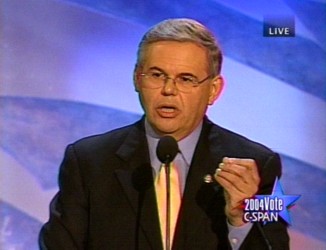
MENENDEZ: "That's some serious dough! I didn't get that much of a kickback...Something must be wrong...Hey Corzine, hook me up!"
Posted on 03/27/2006 1:46:43 PM PST by Diana in Wisconsin
Months after landing lucrative state contracts, executives from two out-of-state consulting firms gave donations totaling nearly $45,000 to Gov. Jim Doyle's re-election campaign.
The donations to Doyle marked the first time that anyone from either company - Chicago-based Equis Corp. and Indianapolis-based Crowe Chizek - gave significant cash to any candidate in Wisconsin, according to an analysis of campaign finance records by the nonpartisan Wisconsin Democracy Campaign.
In the case of Equis Corp., the firm's president and his wife gave Doyle nearly the maximum contribution allowed under state law - $10,000 each - less than a year after the state approved a contract amendment potentially worth millions to the firm.
The firm's chief operating officer and three other top executives gave Doyle a total of more than $7,000 in the same period.
Crowe Chizek officials, meanwhile, gave Doyle a total of $17,500, beginning with a donation of $2,500 from one of the firm's executives only months after the firm won a $6.7 million contract.
Both contractors submitted low bids for their work, but Wisconsin Democracy Campaign director Mike McCabe said the donations renew questions about so-called "pay-to-play" practices in state government.
"This is a classic pattern where campaign contributions flow in after a company wins a contract, where before you didn't see any big donations from folks and then all of a sudden they give these huge amounts," McCabe said. "It could be coincidence, but it creates the appearance that government is for sale," he added.
McCabe noted that only a small fraction of Wisconsin residents ever give money to campaigns, "so it's even more unusual for someone from out-of-state who has given no money before to suddenly jump in with both feet and give the maximum possible."
A spokeswoman for Gov. Jim Doyle's campaign denied any relationship between the approval of the contracts and the donations.
"People support this governor because of the great work he has done in this state," said Doyle's campaign press secretary Melanie Fonder. "There is a firewall between the campaign and state government."
Company officials in both firms said they had never contributed to Wisconsin candidates before because they had never done business in Wisconsin before. The officials said their firms were impressed by Doyle's leadership.
Doyle's aggressive fundraising tactics - and the volume of donations from firms that do business with the state - have been under scrutiny since last year.
Federal, state and local authorities are investigating the relationship between key administrative decisions - including the awarding of state contracts - that benefited major campaign donors to the governor.
A federal grand jury in January indicted Department of Administration procurement officer Georgia Thompson on charges that she allegedly steered a $750,000 state travel contract toward a Milwaukee-based firm whose executives gave money to Doyle.
Investigators are also examining donations from executives of two utility firms to Doyle that came just as the state Public Service Commission was acting on the sale of the nuclear power plant in Kewaunee.
Doyle has maintained that there was no wrongdoing by any top officials in his administration in either decision and that neither he nor any of his top aides played a role in the outcomes. The governor insists that there is a clear line separating campaign activities and governing in his administration.
The two contracts now under fire are both part of Doyle's Accountability, Consolidation and Efficiency Initiative.
The initiative aims to save taxpayers $200 million over the next four years by consolidating some state functions - including information technology services, purchasing, human resources and real estate management - that have been scattered over a host of state agencies.
Critics have warned that although the program may promote greater efficiencies by consolidating state contracts, it also reduces the number of vendors involved and increases the value of those contracts, which in turn may make decisions about awarding the contracts subject to more political pressure.
Lucrative amendments:
Both the Equis and Crowe Chizek contracts were approved in April 2004.
The state hired Equis to review all of its property holdings and leases for possible savings and sales, said Sean Dilweg, executive assistant for the Department of Administration.
The current state budget calls for $36 million in sales of state property and $4.2 million in lease savings over the next two years. Equis is primarily responsible for meeting those targets, Dilweg said.
Following a request for proposals, Equis was the lowest of three bidders, Dilweg said, coming in at $572,000 compared to $3 million for accounting giant Deloitte & Touche and $1 million for CB Richard Ellis.
Equis came in lowest "because it has a lot more experience with other states on this," said Dilweg. "They know what they're handling."
The two other firms outranked Equis on other selection criteria in the bidding process, with Ellis coming ahead on general qualities, including organizational capabilities, and Deloitte ranking highest on technical aspects.
The critical variable in awarding the contract appeared to be cost, at least according to CB Ellis officials who offered a modified bid at the last minute. The firm proposed deferring 50 percent of their fee until they could demonstrate their promised savings to the state.
Equis also had better Wisconsin connections, bringing in First Weber Realty, the J.P. Cullen & Sons construction firm, and the Madison-based law firm of La Follette Godfrey & Kahn as "advisers" on the contract.
But Equis' $572,000 bid has now grown to a contract worth more than $2.5 million, according to the state's own estimates.
In December 2004, the state approved the first of two amendments to the contract, which requires the state to pay Equis a commission of up to 25 percent of the gross on all sales of state property it arranges. Dilweg estimated that agreement is worth at least $1 million.
Then in March 2005, the state agreed to pay Equis another $1 million for developing a governance plan and inventory of all state-owned properties.
The checks from Equis officials to Doyle's campaign began showing up in June 2005, three months after the second amendment was approved.
On June 30, Equis President Michael Silver, and his wife, Mary, gave Doyle $5,750, while Chief Operating Officer David Montross and Executive Vice President John Niemi each gave Doyle $1,000.
Four months later, on Oct. 12, Silver and his wife gave Doyle another $14,000, raising their total contributions to the governor to $19,750, just $250 shy of the maximum a couple can give to any gubernatorial candidate in Wisconsin.
Three other Equis executives gave Doyle a total of $5,500 on the same date, for a total of $27,250 from company officials after winning the $2.5 million contract.
In an interview, Montross, the firm's chief operating officer, said Equis has a policy not to contribute to officials in any state where the company is bidding on a contract.
But after Equis won the contract, Montross said, "we were asked and invited to participate in a couple of events." He recalled two Chicago fundraisers Doyle held in mid-May and mid-October 2005, which roughly correspond to the dates of the donations.
Equis spokeswoman Christine Peterson said the Doyle campaign mailed the company invitations.
"Our standard line is we tell our folks, it's your decision and it's not condoned by the company," said Montross. He added that he was unaware of how much employees had donated to Doyle.
"We do a ton of operational work in Wisconsin. We do work for Ameritech, we have people working out of Milwaukee, and we do a lot of work in the state of Wisconsin," he said. "We're asked to participate in campaigns all over the country. It's a personal decision by the individual about what they think of the politician and their politics."
Montross said "a couple of our management team members" attended the events "because the governor doesn't want to go into empty rooms."
Fonder, Doyle's campaign spokeswoman and former gubernatorial press secretary, confirmed the dates of the two fundraisers but suggested that one or both of the firms might have played a role in organizing them.
"It's not unusual for businesses large and small to offer to support the governor because of his strong pro-business record," she said in a statement today.
"They worked with us to put together events - which is not unusual for businesses that support the governor and appreciate the great progress he's made in Wisconsin for business," she said.
Montross praised Doyle as "a wonderfully nice man and a very smart man. When I've had interactions with him on our real estate work, he is a very, very bright man."
Computer savings:
Crowe Chizek was hired as part of an effort by the Department of Administration to consolidate the number of computer servers used by state agencies.
DOA executive assistant Dilweg said there are more than 2,400 servers scattered among different state agencies, compared to roughly 300 for private-sector firms with roughly the same number of employees. The state aims to reduce that number to 1,500 servers by 2007.
The reductions should produce savings of about $8 million annually when fully phased in, he said. The state has already paid Crowe Chizek more than $6.1 million on the contract to oversee that reduction.
Dilweg acknowledged that the server cuts will also result in the elimination of some jobs in state government.
In addition to Crowe Chizek, six firms bid for the server consolidation contract: BearingPoint, Deloitte & Touche, SBC, Inacom, MaryVille and AE.
As with Equis, the firms' bids were evaluated on three measures: general requirements, technical requirements and cost.
But this time, Crowe Chizek and Deloitte tied on cost and technical requirements, but Crowe Chizek won on general requirements. On that basis, the state awarded Crowe Chizek the contract, Dilweg said.
Money from Crowe Chizek began showing up in Doyle's campaign reports roughly two months later.
According to the Democracy Campaign's database of campaign donations, Robert Lazard, an executive in Crowe Chizek's Indianapolis office and a partner in the Crowe Group, the holding company for Crowe Chizek, gave Doyle $2,500 in June 2004.
A year later, on June 21, Lazard and another Crowe Group partner, Kevin Ohl, each gave Doyle $1,000.
In December 2005, again at about the same time as Doyle's Chicago fundraiser, Ohl and Lazard each gave Doyle another $1,000, for a total of $4,500 from Lazard and $2,000 from Ohl.
Six other Crowe employees - including two managers for the server project who are now listed on the Department of Administration's staff list - gave Doyle contributions totaling $10,000 at the same time.
Crowe spokeswoman Suzanne Robinson said executives from the firm have not contributed to Wisconsin candidates before because the firm has not previously done business in the state.
"Once we started working in Wisconsin, individuals had seen firsthand Gov. Doyle's leadership in transforming Wisconsin's government and they as individuals wanted to support him," she said.
Glad to see the hits keep coming! :)
"Daily Doyle" Ping!
What's that thing about a "Culture of GOP Corruption"?
MENENDEZ: "That's some serious dough! I didn't get that much of a kickback...Something must be wrong...Hey Corzine, hook me up!"
And now we know one more reason Doyle saved Lautenschlagger from going down the toilet she pulled the handle on...
Quid Pro Quo Kid
Tit for Tat Pussycat
Disclaimer: Opinions posted on Free Republic are those of the individual posters and do not necessarily represent the opinion of Free Republic or its management. All materials posted herein are protected by copyright law and the exemption for fair use of copyrighted works.