
In the 1754 scene portrayed here, Washington is forced to
sign surrender papers after a resounding defeat by the
French and their native allies.
Photograph by : THE SENATOR JOHN HEINZ PITTSBURGH REGIONAL HISTORY CENTER
Posted on 03/09/2006 5:28:03 PM PST by Pharmboy
In the 1754 scene portrayed here, Washington is forced to
sign surrender papers after a resounding defeat by the
French and their native allies.
Photograph by : THE SENATOR JOHN HEINZ PITTSBURGH REGIONAL HISTORY CENTER
Clash of Empires recounts story of how Canada, U.S. came to be
It is the war that made Canada and the United States. Not the First World War, nor the second. But the first global war: The Seven Years War, 250 years ago.
A new exhibition telling the story of this extraordinary chapter in North America's history will be at the Canadian War Museum, from May 31 to Nov. 12.
Clash of Empires is an exhibition that challenges popular understanding of North American history: It depicts George Washington not as hero of the American Revolution and great first president of the U.S.
Rather, he is an ambitious young colonial officer -- who dreams of putting on a British officer's red coat, having money and land, but is shaken by defeat.
On July 4, 1754, he signs a surrender, in French, at Fort Necessity, accepting responsibility for the death of a French envoy.
That surrender document is "the smoking gun" of the conflict -- the spark that ignites the Seven Years War. Later, Washington would say he did not understand the precise meaning of the surrender document.
Behind the Clash of Empires exhibition is a museum in downtown Pittsburgh -- which, in that era, was simply a French fort.
The Senator John Heinz Pittsburgh Regional History Center began work on the exhibit five years ago and spent $2 million U.S. on the project, creating remarkable mannequins to draw visitors into historical stories and sending its curators around the world -- to Sweden, France, Germany, Britain and Russia -- to ferret out artifacts.
The museum agreed to send the exhibit to Canada on the understanding that it would be shown at the new Canadian War Museum.
Andrew Masich, president of the Pittsburgh museum, said it's important that people understand how the conflicts between the French with their allies, the English with their allies, and the native peoples in North America shaped the modern world.
The Seven Years War involved fighting on four continents and counted one million casualties, with the vast resources and land of North America being a top prize.
Despite its name, the global conflict actually lasted nine years, from 1754 to 1763.
"The map of the world that we know today was really established as a result of this war, and explains so much about why Canada is the way it is and the United States is the way it is," Mr. Masich said yesterday at a media preview at the war museum.
"The war that created Canada and the United States was a three-way struggle between the British, the French and First Peoples for dominance of North America."
Millions of Canadians and Americans are completely unaware of this history. "We're really trying to make up for some lost ground," said Mr. Masich.
"Obviously, there is a Canada before the Seven Years War. It begins in 1608 with Champlain and Quebec," said Peter MacLeod, pre-Confederation historian at the Canadian War Museum. "But for Canada in its modern form -- as a transcontinental liberal democracy where people speak English and French -- this really begins in the Seven Years War."
The American Revolution would not have happened without the Seven Years War, because it's only after fighting in that war that Americans began to feel entitled to their own representation and country, then bridle at the prospect of paying taxes to Britain, Mr. MacLeod said.
The exhibition, first displayed in Pittsburgh, shows the broad historic themes of the Seven Years War in North America, focusing especially on events in the Ohio Valley. But it also includes personal elements to intrigue visitors, such as Washington's mess plate, his knife and fork.
"He's not the George Washington you see: that stern, stodgy, white-haired guy on an American greenback. He is a young, virile, red-haired, ambitious young man," Mr. Masich said. "Suddenly, you see him as a young man, in a confused situation, who gets involved in the killing of a French envoy. And a few weeks later he signs a document in which he confesses to it. It will intrigue most people."
Also featured among the 200 artifacts, from 55 collections around the world, are a silver wine cup used by Louis-Joseph de Montcalm in the field during the war and the famous Benjamin West painting, The Death of General Wolfe.
That painting, lent to the exhibition by the National Gallery of Canada, "is the most famous image of the Seven Years War," said Mr. MacLeod. "Death of Wolfe just says Seven Years War. People who see it will get a shock of recognition."
People need to remember that Britain was consistently losing battles at the time, Mr. MacLeod said.
"For the British, the war was almost like a blockbuster movie where you keep losing and losing and losing. Then finally, just in the last act, you start winning. There was this enormous surge of triumph throughout the British world.
"Paintings like the Death of Wolfe commemorate this and exploit it. For British people, this is one of the great events of their time. It captures the idea of the fallen hero. Here is someone who has sacrificed his life for the British Empire."
For people of that era, who may have read about the Battle of the Plains of Abraham, the huge Death of General Wolfe painting, completed in 1770, was "as arresting to them as the first satellite broadcasts were to us," Mr. MacLeod said.

I am flying the Union Jack for this RevWar/Colonial History/General Washington ping since we fought under this flag during this period. Freepmail me to get ON or OFF this ping list.
Notice that the Declaration of Independence asks the Canadians to join them ~ most folks think the Canadians rejected the officer. Actually, Canada was ripped in two by the war ~
The document was written in French, a language that Washington did not speak or read.
After all is said is done, WE WON.
No question...the issue (as you probably know) was the term "assassinated"...Colonel Washington had a bad translator.
LOL--you are correct. And most Canadians speak English today--and the Seven Years War is why.
Just a little quirk with the flag you used for Britain: it was not in use until 1801 when the United Kingdom of Great Britain and Ireland was formed. Instread it was a flag of which St Patrick's cross was not present.
Otherwise, a good reminder of an important episode in North American history!
It will be Pittsburgh until April 23. It will then spend some time in Canada and then on to the Smithsonian in Washington for a spell. After that, the important artifacts will be returned to their respective owners and if you don't take this in soon, you will never have another opportunity to see all of this in one place at one time.
Included is this
How many times in you life would you get to see the 22 year-old Washington signature on a document written in the middle of a battlefield in French!
For the history freaks like me out there, it's not to be missed. Call me goofy, but I got chills looking as this document.

And here we have the Cross of St. George (England)

...combining with the Cross of St Andrew(Scotland)
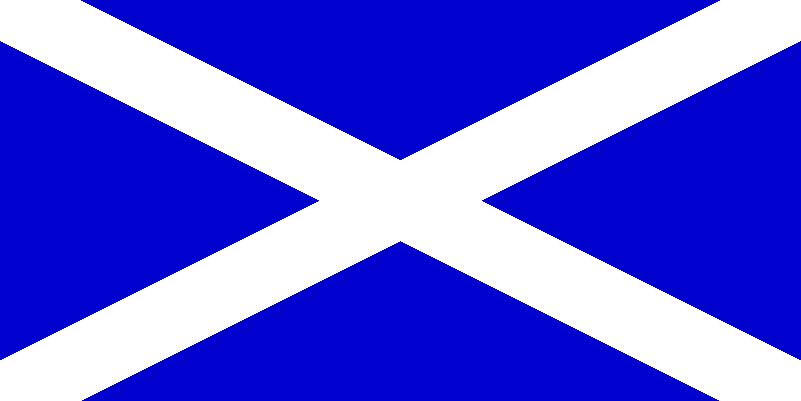
...and the Cross of St. Patrick

...to form the Union Flag (Union Jack)
Which, as you correctly point out, did not arise until 1801.
Cheers,
Pharmboy
Ditto:
Thanks for your first-hand review. I will do my best to make it out to Fort Duquesne to see the exhibit.
See above...a Kiwi beat you to it. But thanks...corrections are ALWAYS appreciated.


I know it is an American exhibit, but the Canadians wrote the review...and that was what I was referring to. Pay attention...
I wasn't sure I got the right one. They are both quite moving in their own way. I remember reading about the "French and Indian Wars" at a very early age, and how important that time was for the American Revolution a few years later.
Indeed...but again, I had never seen the one you posted, and I am glad you put it up. Very interesting...
Disclaimer: Opinions posted on Free Republic are those of the individual posters and do not necessarily represent the opinion of Free Republic or its management. All materials posted herein are protected by copyright law and the exemption for fair use of copyrighted works.