Skip to comments.
Living by the US-Mexico barrier
BBC News ^
| February 27, 2006
| Franc Contreras
Posted on 02/27/2006 1:03:23 PM PST by SwinneySwitch
The BBC's The World programme, Tijuana, Mexico
An intense debate is under way in the United States over what to do about illegal immigration. The Senate is soon to take up the issue, studying a controversial bill that would see the construction of 1,130km (700 miles) of fencing along parts of the border with Mexico.
People along the western edge of the border, south of San Diego, have been living with a barrier for the past 16 years. Franc Contreras travelled there to ask people on both sides what the divide means to them.
More barriers like this one could go up on the border A series of rusty iron panels separate this part of the US from Mexico. On the US side of the border, many people call it "the fence".
Muriel Watson, who was largely responsible for getting the barrier built, says that before it went up in 1990, this part of the border was wide open.
"There was nothing here. There were some streetlights up there from that Mexican freeway, but as you can see, it's all open fields over there, and when the sun went down, all hell broke loose."
Hundreds, and sometimes thousands of illegal immigrants crossed through here into southern California - Mexicans and Central Americans fleeing poverty and unemployment in their countries.
Ms Watson decided to take action, and in 1989 she organised a movement called Light up the Border.
Dozens of supporters came in their cars to the desert.
They turned on their headlights, shedding light on the situation. The media and Congress quickly took notice. Within a year the barrier went up.
'Sign of respect'
"We knew it was not going to stop everything. But it was the first time in history that anyone knew where the actual international border truly was - they would know if they crossed over that they were breaking the law. So that was important," Ms Watson says.
Good neighbours have good fences... It's strictly a line a demarcation and respect for the owners on each side
Muriel Watson
Stadium lights are now in place, and there are 10 times more border patrol agents on duty than in 1990. Illegal crossings at this part of the border have dramatically decreased.
For Ms Watson, widow of a former border patrol chief, the fence is a sign of respect.
"That fence tells you that's your side, and this is ours. If you want to violate that, that's your choice, but it's our right to say there's a fence," she says.
"Good neighbours have good fences... Nobody gets bent out of shape because of a fence, it's strictly a line of demarcation and respect for the owners on each side."
Over the years, more fencing has been added along this part of the border. It now stretches about 40km (25 miles) from the rugged Tecate mountains to the Pacific Ocean.
The gap
In Tijuana, children play on the sandy beaches.
This is the farthest point of northern Mexico - and for that matter, Latin America. Here, the divide is known as "el muro", or the wall.
In the past few weeks, the US has been rebuilding the metal fence, eroded by the salty sea air.
The new divide is made of railroad tracks plunged deep into the sand, sticking some six metres (20ft) up in the air.
And where the old barrier and the new one meet, there is a gap.
In broad daylight, small groups of Mexicans are going through it. A little girl grabs her mother by the hand and both step into the US. A retired man called Enrique Manzo also tries it.
He says it is the first time he has ever set foot on US soil. Mr Manzo, who is in Tijuana visiting relatives, says he cannot wait to tell his son back home about this remarkable moment.
Dangerous routes
Most of the people say they are happy to be in their own country. They had no reason for getting a visa, so for a brief moment they cross the border barrier illegally.
The strongest ones show their power with things like this wall, but it doesn't prevent people from crossing
Antonio Ortega
But for a few, it is not the first time.
Alicia Flores explains that she crossed the border illegally a few years back. Her smugglers led her through a hole in the fence on this very same beach.
She worked for six years in California, then returned to Mexico. She thinks the barrier is divisive.
Antonio Ortega leans on the barrier. He calls it a monument to American racism.
"The strongest ones show their power with things like this wall, but it doesn't prevent people from crossing," he says.
"Most now take the dangerous routes through the desert or over the mountains."
Mr Ortega himself made that difficult journey. After 11 failed attempts he finally made it into the US.
Campaign issue
But not everyone on the Mexican side has such strong views.
Further to the east is the border city of Mexicali.
Retired accountant Francisco Perez says the people on this part of the border have also lived many years with a barrier dividing them, but for him it is no big deal.
"It doesn't affect me because I've had good work here. Besides, I never think of going to live in the US," he says.
Like many Mexicans who live in border communities, Mr Perez has a special visa that allows him to enter the US legally whenever he wants.
He does not think building more barriers will solve the issue of illegal immigration from Mexico. But he does expect the political rhetoric both sides of the border to continue.
That is a safe guess. The US holds Congressional elections in November. Mexicans will vote for a new president in July.
And immigration is a campaign issue in both countries.
TOPICS: Crime/Corruption; Foreign Affairs; Mexico; Politics/Elections; US: Arizona; US: California; US: District of Columbia; US: New Mexico; US: Texas
KEYWORDS: aliens; borderlist; borderwar; elmuro; immigrantlist; immigration; thewall
"Mr Ortega himself made that difficult journey. After 11 failed attempts he finally made it into the US."
Troops.
To: SwinneySwitch
the fence is a sign of respectHahahahahahahaha!
2
posted on
02/27/2006 1:10:32 PM PST
by
mtbopfuyn
(Legality does not dictate morality... Lavin)
To: mtbopfuyn
Twin 15 foot high steel fences with sensors will be a sign of respect.
3
posted on
02/27/2006 1:23:43 PM PST
by
GarySpFc
(de oppresso liber)
To: SwinneySwitch
To: SwinneySwitch
She thinks the barrier is divisive. Oh no! Listen lady, borders are BY DEFINITION divisive.
5
posted on
02/27/2006 1:49:28 PM PST
by
gaijin
To: GarySpFc
Throw in mines and UAV's and you'll get close to keeping me quiet.
6
posted on
02/27/2006 1:50:07 PM PST
by
gaijin
To: SwinneySwitch; HiJinx; gubamyster
Border Reality 101.
This is what most of our southern border looks like: there is no government-built fence at all. There is often just whatever is left over from some forgotten cattle fence, built privately to keep U.S. cattle from wandering freely into Mexico. For hundreds of miles there is not even a broken cattle fence, there is nothing at all.
For comparison, below the broken cattle fence photo is a sample of an inexpensive but highly effective double border fence system, with a plowed strip to reveal footprints. This type of system is very cheap and can be built with great speed.

Here is what some of San Diego County has: a wall made of rusty Viet Nam-era runway mats. The corrugations are even horizontal, (to make climbing easier?) The illegals in this photo were spotted by unexpected civilian volunteers, and jumped back over the border.

Here is what the border looks like where the runway mat wall exists. Mexico begins on the other side of the ineffective rusty wall, which actually helps the smugglers, by hiding their movements until the occasional USBP vehicle has driven out of sight.

This is how "the game" is played. Smugglers hide on the other side of the wall with their dope and/or their illegals, out of sight of the USBP. They wait for the highly visible white BP vehicle to drive over the distant hills. Lookouts with cell phones and walkie-talkies report on the current locations of the BP units. They know with certainty that "the coast is clear" for an hour or two, and the smugglers and illegals hop the fence and run into the scrub only 50 yards away. From there, they are out of sight, and they walk 1-2 miles to holding houses. Then they wait for nightfall, and are picked up and driven in vans to LA or San Diego.
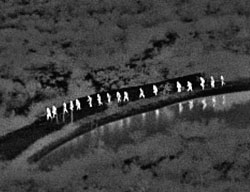
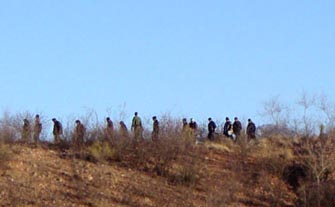
Lastly, below is the Duncan Hunter 15' fence, which is already being built along a few "showplace" miles of San Diego, mainly near the ports of entry, where panderng politicians can conveniently show it off to gullible reporters. The House has approved building 700 miles of it, which would be a great start. As you can see, the rusty runway wall is seen at the left side, Mexico begins on the other side. In areas with the 15 foot fence, dope smugglers and illegals will have to cross the open sand ("the government road" as it is called) before starting to try to get over the 15 foot fence. It's extremely tough, and resists cutting. Attacking the fence would have to be done right out in the open, in full view of cameras. This type of fence, on the U.S. side of the government road, will give the USBP a barrier to patrol, instead of forcing them to chase illegals around 100,000 square miles of wide-open frontier land, which is a fool's errand.

7
posted on
02/27/2006 2:17:14 PM PST
by
Travis McGee
(--- www.EnemiesForeignAndDomestic.com ---)
To: Roverman2K
Troops, fence, AND land mines. That should do it. Add plenty of warnings that you cross the border at your own risk.
To: Travis McGee; 1_Inch_Group; 2sheep; 2Trievers; 3AngelaD; 3pools; 3rdcanyon; 4Freedom; ...
I know most all o' y'all have seen Travis' little expose before...
We need to have our Congress Critters see it, and understand.
Actually, we need to get it to our Senators. The House has already passed the measure to start putting up that fence.
9
posted on
02/27/2006 6:49:30 PM PST
by
HiJinx
(~ Proud Poppa and Dad ~ Grateful Husband ~)
To: HiJinx
Actually, we need to get it to our Senators. And we need to get that message to them SOON! The Senate vote is coming up, and they need to hear from us.
Free faxes at www.numbersusa.com and FAIR.
10
posted on
02/27/2006 7:53:29 PM PST
by
janetgreen
(Washington fiddles while America is invaded!)
To: SwinneySwitch
"Racism" a word invented so morons could join the political debate.
11
posted on
02/28/2006 6:34:52 AM PST
by
junta
(It's Jihad stupid! Liberals, Jihadis and the Mexican elite all deserving of "preemption.")
To: HiJinx
Protect our borders and coastlines from all foreign invaders!
Support our Minutemen Patriots!
Be Ever Vigilant!

12
posted on
02/28/2006 1:47:04 PM PST
by
blackie
(Be Well~Be Armed~Be Safe~Molon Labe!)
Disclaimer:
Opinions posted on Free Republic are those of the individual
posters and do not necessarily represent the opinion of Free Republic or its
management. All materials posted herein are protected by copyright law and the
exemption for fair use of copyrighted works.
FreeRepublic.com is powered by software copyright 2000-2008 John Robinson