
Posted on 01/23/2006 2:24:47 PM PST by A.A. Cunningham
Jet lets fingers do the flying
By JACK DORSEY, The Virginian-Pilot
© January 22, 2006
Last updated: 10:10 PM
VIRGINIA BEACH — Five dozen men, many of them former pilots who have helped shape naval aviation for the past 50 years, were spellbound as they looked into the simulated cockpit of the Navy’s next-generation fighter jet.
Two 8-by-20-inch touch screen displays dominated the dashboard.
Tapping the screen changes radio channels. Touching it elsewhere selects a weapon to use: missile, bomb, cannon.
Pointing to a landing spot on the map display tells the computer to fly the plane there – nearly hands off.
A visual system built into the pilot’s helmet projects an image onto the visor, giving real-time navigation and targeting information. No matter which way the pilot’s head turns, the data are always in view.
Voice commands are integrated into the controls to rapidly react to changing mission requirements.
There is no control stick in the floor. It’s been replaced by sliding knobs on each side of the cockpit, with fingertip switches.
The one on the left is the throttle. The right one controls direction.
“If you have two fingers and can touch the screen, you can fly this thing,” an F/A-18 Hornet pilot quipped from the back of the crowd of admirers.
This is the F-35 Joint Strike Fighter, an amalgam of cutting-edge fighter technology. It will cost between $37 million and $48 million, depending on which of three models is bought.
Although top Pentagon officials are thinking about cutting the size and scope of the F-35 program to reduce defense budgets, for now the plan is a $256 billion, 20-year program to build 3,500 to 4,000 planes.
Up to 6,000 could be turned out when sales to America’s NATO allies are counted.
Nearly ready for flight
The F-35 is scheduled to go into flight less than a year after the first plane rolls off a Texas assembly line in October. The planes could come to Oceana Naval Air Station in Virginia Beach in about 2013 as a replacement for the F/A-18 C and D model Hornets.
Marine Corps Lt. Col. Arthur “Turbo” Tomassetti, the only pilot to have flown all three versions of the fighter, promises that its pilots are in for a treat.
“On the Navy and Marine side, we don’t have stealth airplanes yet, so just the fact we are getting one of those is a huge deal,” said Tomassetti, chief test pilot and commanding officer of Air Test and Evaluation Squadron 23 at Patuxent River Naval Air Station in Maryland.
At war, the F-35 would be among the first jets to enter the conflict to support troops on the ground or knock out missile sites. It also would be able to engage enemy targets in the sky.
It has two bomb bays and 11 places for wing-mounted weapons.
Its low radar profile gives it stealth, while a revolutionary new radar inside the plane will allow it 360-degree vision to better evade attackers.
It will be the first airplane that allows pilots to remain unseen yet still communicate by radio . The F-35 will not carry any iron, or “dumb,” bombs, only next-generation guided munitions.
The uniqueness of the F-35, Tomassetti said, is not in an individual piece of equipment.
“We already have touch screens, voice-activated cockpits and in-helmet displays,” he said. “But now what you are talking about is a combination of the helmet-mounted display, touch screens and voice activation. That’s never been done all in one before.”
Plans call for the F-35 to be a multi national premier strike aircraft through 2040. The plane will allow the Air Force to field an almost all-stealth fighter force by 2025.
The F-35 would replace the Marine Corps’ aging AV-8B Harriers, the Air Force’s A-10 Thunderbolts and F-16 Falcons, the Navy’s F/A-18C Hornets and the United Kingdom’s Harriers, both its air force and navy versions.
Lockheed Martin is developing the plane with its principal industrial partners, Northrop Grumman and BAE Systems.
Two separate, interchangeable engines are under development: one by Pratt & Whitney and the other by the General Electric/Rolls-Royce Fighter Engine Team.
Headed to Oceana?
For Oceana, 100 or more F-35s could replace the F/A-18C Hornets. They would serve beside the newer F/A-18 E and F model Super Hornets.
Then again, that might not happen, said Rear Adm. Steven Enewold, the executive officer of the Joint Strike Fighter Program.
“It’s not clear to me yet that we wouldn’t have a consolidated JSF base somewhere that would have all three versions,” Enewold said from his Washington office.
It would be natural to bring them together because the planes have the same engines and avionics and require the same technical skills to maintain and operate them, he said.
“It is not a far stretch to think we might have an Air Force, Navy and Marine Corps consolidation base somewhere,” he said.
The Navy must decide this year where to base its F-35s.
The pros are impressed
Enewold brought his presentation and a mock-up of the F-35’s cockpit to Oceana in August.
Members of the Association of Naval Aviation’s Hampton Roads Squadron marveled at the aircraft’s gadgets and technology.
It has tools that weren’t even dreams 20 years ago, said retired Vice Adm. Dick Dunleavy of Virginia Beach.
“It is the future, and we are going forward with it,” said the former A-6 Intruder bombardier/navigator, who commanded the aircraft carrier Coral Sea and the Atlantic Fleet’s air arm.
Despite his concerns about the aircraft’s cost, he’s impressed by its innovations.
“That is our strength as Americans – our technology and our people – and they put both of them in there quite well.”
But the aviators also had questions. Among them: What about jet noise?
It is the No. 1 issue among many who live and work near Oceana, the Navy’s only master jet base on the East Coast.
“We don’t know yet,” said Enewold, who has been with the program since January 2002. “The engine is about the same thrust as the F-14 … and will make the same kind of noise.”
However, the plane’s single engine is so powerful that “we don’t see any reason to operate the afterburner around the field,” Enewold said.
Since the engine has not yet been mounted in the first F-35 – the Pratt & Whitney model is being installed –its exact loudness isn’t known.
The engine’s large size may help lessen its noise, though.
“I hear that because it is a bigger engine, it is not near as shrill,” said John Smith, a Lockheed Martin spokesman at the company’s Fort Worth, Texas, plant. “It has a lower sound to it, maybe the same decibels, but it is not the same ear-splitting decibels as the F-18” with its two smaller engines.
International interest
The F-35 program emphasizes collaboration among NATO nations, including Britain, Italy, Norway, Turkey, Australia, Canada and Denmark.
“It is like no other program I have been associated with,” Enewold said.
The plane is designed to have a long range, to use common hardware and software, to be used and maintained by all service branches and to be highly reliable.
“You can schedule maintenance when you want it, because it will tell you when it will break,” Enewold said.
Even its construction is revolutionary, according to Lockheed Martin.
There are three sub- assembly points: The forward fuselage is being built in Fort Worth by Lockheed Martin; BAE Systems is building the aft fuselage and tails in Samlesbury, England; and Northrop Grumman is constructing the center fuselage in Palmdale, Calif.
Once the sub sections are completed, they will be sent to the Fort Worth plant, Smith said.
The first production plane began to take shape just before Christmas in Forth Worth with the installation of horizontal tails, which joined the aft fuselage and forward fuselage.
“For the first time in history, we will have a moving assembly line for a fighter,” Smith said. “There have been moving assembly lines for commercial airliners and other things, but not for a fighter.”
Its engine is to be installed this week.
Final assembly will take five to six months instead of 13 months for previous aircraft, the company said.
“Once full production rates are achieved in the 2013 time frame, we will be building a plane a day. Our goal is 20 per month,” Smith said.
Love and hate
While Tomassetti believes former Marine Corps AV-8B Harrier pilots will be more than pleased with the F-35, he’s not sure other fliers will be.
“If you talk to a Harrier guy, they are very excited,” he said. “It’s all good to them.”
That’s mainly because the F-35 short take-off and vertical-landing model will have all digitized controls, allowing computers to do the things that burden a Harrier pilot.
“Basically you have three things to move with your two hands,” he said of the Harrier. “It’s a very busy aircraft.”
However, the F-35 is not without its detractors.
“Talk to the F-18 guys and they are complaining it is a single engine,” Tomassetti said.
Since the late 1960s, the Navy has preferred twin engines for its carrier-based aircraft but has lived with single engines in the A-7 Corsairs and A-4 Skyhawks.
Some Air Force pilots may not be thrilled either.
“The F-16 guys will say it is not as fast, or potentially maneuverable,” Tomassetti said. “Some of the folks flying the cutting-edge stuff say, 'They can’t do this thing that my current airplane can do.’”
All that aside, Tomassetti said, “there are some tremendous capabilities” with stealth and sensors far ahead of what’s now available in combat aircraft.
“Everything you will get in the F-35 is better than what we get today.”
Reach Jack Dorsey at (757) 446-2284 or jack.dorsey@pilotonline.com.
© 2006 HamptonRoads.com/PilotOnline.com
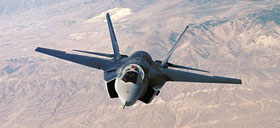
The F-35 Joint Strike Fighter will use a more powerful engine - nearly twice the kick of current engines - stealth technology and touch screen and voice commands in the cockpit to stake its claim as the world's premier strike aircraft through 2040.
The first flight of a production-line model is scheduled for October, with operational aircraft set for delivery in 2007.
STATUS
The Joint Strike Fighter is halfway through a 10-year development and testing phase.
A total of 22 test aircraft will be built during the current phase: 14 for flight tests, seven for tests on the ground and one for radar tests.
Flight tests will be conducted at Edwards Air Force Base in Califoria, Patuxent River Naval Air Station in Maryland and near the Lockheed Martin plant in Fort Worth, Texas. The Navy and Marine variants will undego sea trials aboard U.S., British and Italian aircraft carriers.
Lockheed Martin expects to complete 20 planes in a month once full production begins in 2013. The plane will be built on a moving assmbly line - a first for a fighter. Final assembly will take only five months. Most fighters are assembled in 13 months.
A total of 2,852 aircaft are scheduled for delivery to the Air Force, Navy, Marine Corps and to the British Royal Navy and Air Force.
ENGINE
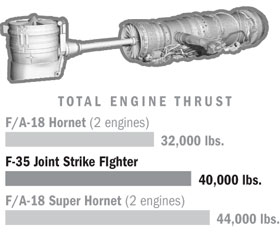
The F-35 will have two interchangeable choices for its single engine, either of which will deliver 40,000 pounds of thrust - more than twice as much as each of the F/A-18 Hornet's twin engines.
The Air Force and Navy versions of the F-35 will use engines built by Pratt & Whitney, above. General Electric and Rolls-Royce are teaming up to build the Marine Corps version, which will be able to take of vertically and hover.
COCKPIT
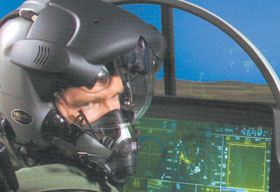
Instead of "heads-up" readouts projected onto fighter cockpit windows, the F-35 will use a system contained within the pilot's helmet. An Israeli firm is developing the technology.
In addition, the vertical-takeoff version of the F-35 will be controlled by only a throttle, as opposed to the three primary controls used in a conventional Harrier jet. the swiveling exhaust nozzles will be controled instead by a computer.
Sources: Air Force; Associated Press; Lockheed Martin; Marine Corps; Northrup Grumman; Pratt & Whitney; teamjsf.com U.S. Navy
Graphics: Charles Apple, Jack Dorsey and Robert D. Voros/The Virginian-Pilot
The bad news: The entire jet is powered by Windows, and if that crashes, guess what else does?
PBS Nova did a real interesting 2 hr. show on the design competition called "Battle of the X-Planes".
How does this relate to the F22 Raptor?
Ummm....get a hacker to install Linux? [dumb answer]
HAHAHA
“If you have two fingers and can touch the screen, you can fly this thing,” an F/A-18 Hornet pilot quipped from the back of the crowd of admirers. "
When everything is going right. Pilots train for when things go wrong. And thats when experience and the ol MkI brain come in.

The one on the left is the throttle. The right one controls direction.
Errr knobs? One is a throttle quadrant and the other a Side Stick Controller (with about a 1/4 inch of movement), been used on the F-16 since it's inception. Although both are covered with knobs, switches and buttons, neither one resembles a "knob".
The F-35 uses technology developed for and from the F-22 project. In some cases, the avionics and stealth are more recent.
While the F-22 will be the USAF "Air Dominance" fighter, the F-35 will compliment it as a multi-role fighter (AA and AG attack), just like the F-16 complimented the F-15.
military aviation XF-35 ping
[i]How does this relate to the F22 Raptor?[/i]
The Raptor is a spare-no-expense air dominance fighter (like the F-15 was) which we hope to have maybe 200 of, while the F-35 is the less expensive utility fighter (like the F-16 was), and we're hoping to have a couple thousand of them.
The Raptor will "kick down the door" and maintain air supremacy while vast numbers of F-35s come in and clean up.
That's a really simplistic answer. The F-22 will eventually be the F/A-22, as the Raptor promises to do some amazing things with all the antennae and electronics on board.
Both planes are being built by Lockheed Martin. The planes will be used for different types of missions. The Raptor (F22) is the new F-16 and the F35 is the new F18.
The freaky version is the vertical life version that is replacing the Harrier. Of course if the F22 is any example it will be drug out and take an additional 15 years to have it flying full time.
So when the "Master Caution" light comes on, then what? And also notice no rearward visibility ... dad says the F16 is the best fighter ever ....
Tell me you're joking... You can't be serious, hell, THEY can't be serious risking a mans life with that piece-o-crap software.
Well of course I'm kidding. Whatever HMI they are running on those touchscreens has to be far more stripped down than any commercially available software - they need real time responses.
Thanks, that's what I figured, but didn't really know.
Man, we have really raised the cost of going to war against us.
Our ships run on Windoze NT...
Yes, and I've read about a ship that had to re-boot cause windoze crashed and the ship was dead in the water. At least it didn't sink. If windoze crashed in a fly-by-wire jet, well... crash is the operative word.
Disclaimer: Opinions posted on Free Republic are those of the individual posters and do not necessarily represent the opinion of Free Republic or its management. All materials posted herein are protected by copyright law and the exemption for fair use of copyrighted works.