
First Nation veterans Len Desjarlais, left, from Victoria, B.C. and Daisa Nebenionquit from Naughton, Ont. visit the Canadian War Cemetery in Dieppe, France on Monday. (CP/Andrew Vaughan)
Posted on 11/03/2005 12:24:20 PM PST by NorthOf45
Veterans remember disastrous raid on Dieppe
Michelle Macafee
Canadian Press
November 01, 2005
First Nation veterans Len Desjarlais, left, from Victoria, B.C. and Daisa Nebenionquit from Naughton, Ont. visit the Canadian War Cemetery in Dieppe, France on Monday. (CP/Andrew Vaughan)
DIEPPE, France -- An impromptu visit to the site of the Allies' disastrous raid on Dieppe in 1942 brought back vivid memories Monday for some aboriginal veterans who later helped liberate the port town.
The veterans, who are taking part in a spiritual journey to commemorate the aboriginal contribution to both the First and Second World Wars, say avenging the loss of more than 900 comrades that Aug. 19 day was foremost on their minds during the victorious 1944 battle.
"They gave the 2nd Division a chance to come in because they lost a hell of a lot of men in the raid," said Charlie St. Germaine, a Metis from Paddle Prairie, Alta., who served with the Calgary Highlanders.
"We thought, 'Look out, you're going to get it now for what you did to our boys in '42'."
Robert Bruce, who drove a supply truck with the Royal Canadian Army Service Corps, tried to choke back the tears as he visited a memorial to the Canadian contribution.
"I lost a lot of good friends," said Bruce, an 83-year-old Metis from Winnipeg. "I don't know what you want to call it - revenge maybe - but at least let's pay them back somehow."
About 20 veterans, part of a delegation of nearly 300 elders, youths and cultural performers on an eight-day tour of France and Belgium, asked organizers for the detour to Dieppe and a nearby Canadian war cemetery instead of sticking to a planned low-key day of travel between Sunday and Tuesday's scheduled events.
The 1942 raid was orchestrated to ease pressure on hard-pressed Allied forces in Russia and North Africa. Of the nearly 5,000 Canadian who participated, 913 died and another 1,946 were taken prisoner.
There has been much debate through the years about whether the soldiers died needlessly, or if the ill-fated attack contributed to the success of D-Day two years later.
As Bruce stared from the rocky beach at the steep white cliffs that offered the Germans an exceptional vantage point over the Canadians, he struggled to accept the more positive interpretation.
"They came here with no supplies and they could only carry so much ammunition and grenades, so they were either going to be killed or taken prisoner," said Bruce.
"They claimed they learned a lot to prepare for the real invasion at Normandy, but it was at a hell of a cost."
The French honour the sacrifice with a small, picturesque park, Place du Canada, that includes two red and white Canadian flag flowerbeds and a stone monument tracing centuries-old links between Canada and Dieppe.
During the veterans' brief stop on the rainy, windy shore, some were caught off guard by an unexpected expression of gratitude. A young French woman approached the group and asked if they were veterans - then promptly burst into tears.
"I'm too emotional," the woman said as she struggled for words. "How do I say thank you?"
Bertha Houle Clark, a veteran of the Royal Canadian Air Force Women's Division, quickly tried to comfort the woman by giving her the entire pile of small Canadian flags and flag pins she carried with her.
"I was so happy and I think she was happy with that," said Clark.
Giving aboriginal veterans the recognition they feel has eluded them through the years is one of the main goals of this trip, organized by various aboriginal groups and elders and funded by Veterans Affairs.
But when they reminisce about their days in battle and remember their fallen comrades, the veterans are adamant they all considered themselves Canadian soldiers first and foremost and fought side by side no matter what their backgrounds.
St. Germaine, who enlisted two months before he was eligible to try to "catch up" with his older brother, said the troops stayed in Dieppe for several days after the liberation to celebrate, but it wasn't easy preparing for the planned military parade.
"It was a little discouraging because we had to iron our uniforms," the 81-year-old, who still works as a welder, said with a laugh.
"So we put sand in our mess tins and heated them to use as irons, but I don't think we looked any better than we did before actually."
Of the 20 veterans participating in the trip, only 18 were able to join Monday's tour.
One veteran fell and broke his hip in a slippery hotel shower early in the trip and has been recovering in hospital, while another was taken to hospital Monday morning.
A medical team has travelled with Veterans Affairs on all its pilgrimages to Europe to help the vets cope with an exhausting schedule of events.
Ping
The Allies learned a hack of alot from this disaster. They did not die in vain.
Canada Ping!
Please FReepmail me to get on or off this ping list.
They learned to come across open (well, semi-open) beaches. Dieppe was a fortified port city. The Mulberries were a direct result of lessons learned.
Brave Canadians. I admire them.
Do you think it also helped fool Hitler the next time around? Maybe he thought we just couldn't do it.
The true accounts of D-Day are really terrifying. We came very close to losing the whole thing.
As some other general said about another battle, "It was a damned close thing." The God of battles was with us.
RIP Canuck heroes.
Dieppe was a cluster-f@#$ and I blame the British idiots (one Lord MountBatten comes to mind) who planned it. They may have learned some lessons from it, but most of those lessons were ones they could have figured out just by taking their brains out of park. It was an ill-considered, poorly-planned and poorly-executed attack with little strategic value.
If anyone has ever read about the Dieppe raid, they know that the Canadians of that day carried real clangers between their legs.
Now their politicians seem to have emasculated them.
As I read in a book,"OSS;Of Spies and Strategems,Stanley Lovell,
-http://www.amazon.com/gp/product/B0007ESKHE/102-3619346-9427321?v=glance&n=283155&s=books&v=glance,
the allies, just prior to the outbreak of the war,had broken a German spy ring operating in London.They gave the captives a choice.Be executed,or continue to send (bad)information to the Germans.But it was neccessary to make the information look legitimate.So "good" intelligence was sent,although pains were taken to make sure it was "just too late".Dieppe was "good" intelligence,and the slaughter resulted.The Germans actually filmed the whole thing,and made it into a propaganda film,according to Lovell.
That was Wellington at Waterloo.
Any relation to the actor, Tom S.?
Grant had an equally close shave at Shiloh. If Sherman had not stepped up; if Johnston had not been killed.
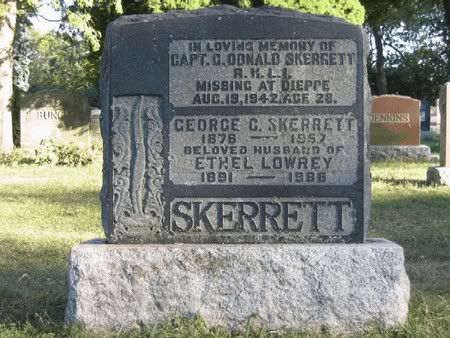
R.H.L.I.
Royal Hamilton Light Infantry .
RHLI . known as the Rileys
My uncle was one. He had his face blown off in Belgium , the only surviver of his platoon lost in a morter attack and endured 27 operations to re build it . He came
home , became a postmaster , had 5 kids and was a good guy to know.
http://www.rhli.ca/
Disclaimer: Opinions posted on Free Republic are those of the individual posters and do not necessarily represent the opinion of Free Republic or its management. All materials posted herein are protected by copyright law and the exemption for fair use of copyrighted works.