Skip to comments.
A piece of the last true man
The Space Review ^
| October 31, 2005
| Dwayne A. Day
Posted on 10/31/2005 3:28:47 AM PST by Cincinatus' Wife
Neil Armstrong has proven to be an enigmatic hero. He is certainly one of the most famous astronauts, having achieved one of the great firsts in spaceflight. He reached that pinnacle through hard work, dedication, focus, endurance, a little luck, and no small amount of sheer talent. But he never really wanted the limelight, and he never really embraced The Cause.
The Cause, of course, is space exploration, and it is no secret that most ardent supporters of space exploration, particularly human exploration, share many traits with religion. Their beliefs are based far more on faith than they are on calculating rationality. They have an internal logic and justification that makes perfect sense to other believers, but are difficult for non-believers to accept. They cast a dim eye on non-believers and skeptics. Neil Armstrong achieved one of the greatest goals in human spaceflight but then did not go on to proselytize the faith. Worse, he no longer signs autographs. For True Believers in The Cause, this is apostasy, and they resent him for it. Some even hate him.
An excellent—albeit odd—example of this view can be found in a recent review of James R. Hansen’s new biography of Neil Armstrong, First Man(Simon & Schuster; $30). The review, by Thomas Mallon, appears in The New Yorker. The New Yorker is a stuffy (and in my opinion, way overrated) magazine for northeast Establishment liberals. But it has always been a little odd. If one can judge a magazine’s readers from the kinds of articles that it runs, then readers of The New Yorker reflect a weird contradiction of wealth and powerlessness. The magazine appears to be written for people who are overwhelmingly white, rich, liberal elites who feel a certain amount of guilt about their wealth and status, but nevertheless feel relatively powerless to actually change society. They have resigned themselves to donating to a few respectable charities and the Democratic Party, attending wine and cheese parties in Manhattan, but not really improving the world. Mallon’s book review reflects that world view rather well, if extremely annoyingly.
We have all met someone like Mallon at one time or another: the manic depressive who only achieves pleasure by dragging everyone around him into the despair that he himself feels. The standard liberal critique of spaceflight is that we should spend the money on the poor, either education for little children or health care for the elderly or some other social program. Mallon does not really take that view. Instead, he just views the entire effort as pointless and hopeless, part of the heavy burden of being alive.
Mallon has apparently decided to use his book review to air his disappointment with the world he inhabits, and spaceflight—and Neil Armstrong—are merely vehicles to carry his inner angst. But he also expresses opinions that are common to a certain segment of the space enthusiast crowd, although without the enthusiasm.
Consider this line from Mallon’s review: “For all its technical brilliance, the unmanned American space program—its Voyagers, Galileo, and Hubble—has been a photo safari, merely a virtual triumph. Mars remains a red gleam in the eye of a species that can’t quite bring itself to go there. The space shuttle, between catastrophes, travels its circles to nowhere.”
Pretty grating, huh?
Obviously Mallon means to imply that robots are no substitute for actual human spaceflight to the planets, a view that many space enthusiasts share. Many people are fans of human spaceflight and still enormously disappointed with the space shuttle program. But “between catastrophes”? It was seventeen years and dozens of spaceflights between Challenger and Columbia. Don’t the achievements—or at least the years—count for anything at all? Or should we measure all of human existence by the low points?
Mallon’s comparison between robotic and human spaceflight is inherently contradictory, however. Although he seems to imply that it would be better for humans to explore than robot proxies, he is so dismissive of the robots themselves that it is hard to believe that he finds any aspect of space exploration exciting, or worthwhile. Notice how casually Mallon dismisses the achievements of Voyager, Galileo, and Hubble: “technically brilliant,” but only a “virtual triumph,” as if they didn’t actually discover anything. Voyager revealed volcanoes on Io and the rings of Saturn. It imaged ice geysers on the frozen plains of a moon orbiting a haunting blue gas giant far from our sun. It has discovered the shockwave at the edge of our solar system. Galileo has provided evidence that several of the giant moons of Jupiter may contain subterranean oceans that might possibly harbor life. Hubble has revealed the age of our universe, and paradoxically has shown us how little we understand it. It has led to the discovery of dark matter and dark energy, both of which may potentially revolutionize our understanding of physics.
But for Mallon, it’s all a letdown—one suspects because it is not enough. Neil Armstrong walked on the Moon in 1969 and human spaceflight has been disappointment ever since. This is actually a view held by many space activists and enthusiasts. They love the idea of human spaceflight and even space settlement, but have been disappointed by NASA’s implementation of it for the past several decades. Some of them cannot help but entertain the nonsensical belief that if only Neil Armstrong had been a better hero—a more vociferous advocate for The Cause—that Things Would Have Been Different.
Most space advocates, not surprisingly, think that spaceflight is worthwhile. Mallon is different because there is nothing in his review that indicates that he shares this belief. One suspects that deep down below all that gloom he actually does value it, but he finds it more satisfying to wallow in the mud, reveling in the pointlessness and hopelessness of human existence. (He even mentions that Armstrong’s mother lost her faith late in life, that it was all just a panacea to shield her from the pain of existence. This sounds like a manic depressive off his meds.)
Mallon continues: “It would be churlish to blame Armstrong—this brave, talented man who briefly took us out of here—for the long failure that followed.”
Presumably this “failure” is that the United States never followed up with more ambitious human space missions. Take away the heavy-handed gloom and one can find similar opinions expressed by many space advocates. The big difference is that Mallon denigrates the Moon missions themselves, never bothering to discuss the scientific results and dismissing them as merely a collection of boring rocks that have been placed in archival storage.
One small step Because the subject of the book he is reviewing is Neil Armstrong and not the space program in general, Mallon has to discuss the man, and it is here that he takes his criticism beyond Hanson’s book to Armstrong himself. It is here that the typical liberal New Yorker disdain for patriotism and traditional American values rears its ugly head.
Mallon expresses no admiration for Armstrong other than a few adjectives (“brave, talented”), and even denigrates his achievements. One of his biggest gripes about Armstrong is that he is boring. Stoicism, which used to be considered noble, strong, and admirable, clashes with the modern demands we place on our heroes.
Mallon’s critique of Armstrong is frequently petty: “but he stopped signing autographs and continues a mild tendency toward litigiousness, suing Hallmark for the unauthorized use of his likeness on a Christmas ornament, and threatening action against a barber for selling his hair.” This statement may also reveal Mallon’s inner space geek—the obsession with owning a piece of an idol is a common trait among space enthusiasts, whether it is an autograph or part of his soul.
In fact, what is perhaps most bizarre about Mallon’s review is that his biggest problem with Armstrong is apparently that the moonwalker didn’t sell out: he didn’t bow down to the confessional culture of Oprah and Dr. Phil that requires that you air all your feelings and failings in public and seek redemption through the power of the tearful television interview. Armstrong does not obey the rules of contemporary American society that decree there is no such thing as privacy, shame, or too much publicity, and that you are a nobody unless you have your own reality show, or your photo on the cover of People magazine. For this Armstrong has been declared a “recluse,” despite the fact that he spent years teaching undergraduates engineering at a school in his native Ohio. Armstrong has never really hidden from the public eye: he simply has not sought it out, which should not qualify one as a recluse.
Space enthusiasts want to own their heroes, and it is not uncommon to hear them complain bitterly that their tax dollars paid to make Armstrong famous, so he should sit at a table in the National Air and Space Museum for the next forty years signing autographs and posing for photos, and most importantly, advocate spending more money on space exploration. Usually this is expressed with bitterness if not outright hostility. Mallon’s pompous depression is a new take on it—about what one would expect from The New Yorker—but it is essentially the same argument: Armstrong is not who I want him to be.
But he is who he is. And all things considered, Neil Armstrong is a man who achieved great things in his life and has the good manners not to flaunt it. The space program already has one publicity-hogging moonwalker, ready to fling himself in front of any TV camera that comes along (and willing to sell his undershirts on eBay). We don’t need another one. Neil Armstrong typifies the kind of silent stoicism, patriotism, and dedication to hard work that disappeared from our culture decades ago, or at least stopped being valued by the celebrity culture. His dignity and unwillingness to bow to the demands of the fickle public is something that we could use more of, not less. He represents a rare commodity, the kind of man who doesn’t talk about doing something—he just goes out and does it. Those are the kinds of values we should praise, not deride.
But Armstrong wouldn’t want the praise anyway.
TOPICS: Culture/Society; Editorial; News/Current Events
KEYWORDS: apollo; firstman; hero; liberalelite; neilarmstrong; space; spaceprogram
Navigation: use the links below to view more comments.
first 1-20, 21-40, 41-42 next last
To: All
***......Presumably this “failure” is that the United States never followed up with more ambitious human space missions. Take away the heavy-handed gloom and one can find similar opinions expressed by many space advocates. The big difference is that Mallon denigrates the Moon missions themselves, never bothering to discuss the scientific results and dismissing them as merely a collection of boring rocks that have been placed in archival storage. ....***
Maybe just a small matter to some but Apollo changed the way we understand impacts and how they have, and will, effect our very existence.
To: All
***....Mallon expresses no admiration for Armstrong other than a few adjectives (“brave, talented”), and even denigrates his achievements. One of his biggest gripes about Armstrong is that he is boring. Stoicism, which used to be considered noble, strong, and admirable, clashes with the modern demands we place on our heroes. ....***
This mentality explains a lot about why New York elected Hillary.
To: Cincinatus' Wife
Give the ISS to the UN. Obsolete the STS. Build the Super Conducting Super Collider. Get the US out of the UN. Get the UN out of the US.
4
posted on
10/31/2005 3:44:36 AM PST
by
dhuffman@awod.com
(The conspiracy of ignorance masquerades as common sense.)
To: dhuffman@awod.com
The U.S. space program is slimed down and lined up with a mission. Dumping "search for life" science in favor of exploration is their ticket to survial, as well as our own. Private industry will be a big part of it but this quote by Dinkin is a lot of hot air as well as just plain creepy.
An interview with Sam Dinkin, CEO of SpaceShot***.....TSR: What are your thoughts on the results of the Exploration Systems Architecture Study? Is NASA on the right track? What odds would you give that NASA will get back to the moon this way?
Dinkin: Here’s what I thought last year. Now, I am seeing how our way works by putting my money where my mouth is. NASA policy reminds me of my “Saturn 5, Going to the Moon” shirt from Johnson Space Center. NASA may find in 2018 that it is being welcomed by the Chinese, who have won a trip to the Moon on SpaceShot.
To: Cincinatus' Wife
Armstrong is a hero still, and he doesn't have to tell everyone about it.
6
posted on
10/31/2005 3:53:22 AM PST
by
Ecclesiastes
(Ghandi would have been a Republican, in time.)
To: Ecclesiastes
To: Ecclesiastes
What does it tell you when the new head of NASA cleaned out 8 managers with the stated intention of taking NASA back to the good old days when they went to the moon with Armstrong. Mallon might be reacting to some of his Chablis sipping manager friends being fired.
8
posted on
10/31/2005 3:56:06 AM PST
by
Thebaddog
(K9 4ever)
To: Cincinatus' Wife; All
Armstrong, IMHO, had one of the funniest lines ever at a press conference held while the astronauts were in quarantine...(and for those who forget, the crew was isolated for three weeks after they returned because of worries about "space germs")..he was asked what were his thoughts in the moments before blast off, knowing they were heading for the moon....he said..( paraphrasing from memory.....)
I was thinking that I was sitting atop this huge poweful, incredibly complex product of American technology, consisting of millions of components, each which was built by the lowest bidder..
9
posted on
10/31/2005 4:02:19 AM PST
by
ken5050
To: Thebaddog
May well be.
There are a lot of noses out of joint in academia and NASA about building an infastructure to go into space. The idea of learning how to use lunar resources (live off the land instead of dragging everything with you) rubs a lot of people the wrong way. But the fact is, it has a lot of people excited and they're the ones planning the programs.
To: ken5050
That was a great quote.
I thought it was an Alan Shepard quote. No matter, they probably all were thinking the same thing!
To: Cincinatus' Wife
For a number of years everyday I drove by Neil Armstrong's small farm outside Lebanon, Ohio. Armstrong was no recluse, not to the folks in Lebanon or University of Cincinnati where he taught a class.
I don't own any autographs nor do I have a fascination with famous people, but I have said the if there is one person I would like to meet it is Neil Armstrong. Of all the people that have ever existed on this planet he was the first to step on another celestial body. No one will ever be able to say this, it is so monumental.
12
posted on
10/31/2005 4:09:29 AM PST
by
Recon Dad
( Now to be known as Force Recon Dad (and proud of it))
To: Cincinatus' Wife
If they wanted a bullshooting self promoter, they could have sent little Al Franken to the moon.
13
posted on
10/31/2005 4:10:18 AM PST
by
Ecclesiastes
(Ghandi would have been a Republican, in time.)
To: Cincinatus' Wife
Yes. I remember when Rickover did similar things to technologists that had gotten too big for their britches. They advertised 'Zero Defects' and the Admiral instructed that no human endeavor could achieve such. He insisted a good error correction system be put in place. It was still effective when I retired.
My point was, though, that space exploration is NOT science but technology demonstration. It is a testament only to our science-ignorance that politicians, especially 'democratic politicians', are allowed to involve themselves in science.
Democracy is the rule of fools by fools. The US is and was founded as a republic - as 'science' should be led.
14
posted on
10/31/2005 4:11:38 AM PST
by
dhuffman@awod.com
(The conspiracy of ignorance masquerades as common sense.)
To: Cincinatus' Wife
Space. The final frontier.
Let's get there before the Chicoms do.
To: Recon Dad
Thank you for the post.
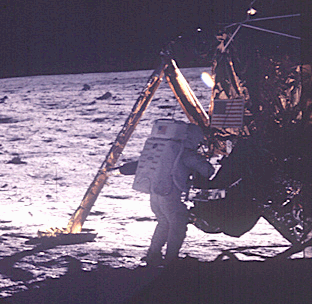
Apollo 11 astronaut Neil Armstrong is seen packing lunar samples he had collected at the Modular Equipment Stowage Assembly (MESA) on the lunar module in one of the few photographs showing him on the Moon. Armstrong took most of the photographs on the Moon, Aldrin took this picture as part of a series of panoramas of the area around the Tranquility Base landing site. Armstrong is in the shadow of the lunar module, details can only be seen with processing, making the sunlit surface directly behind the LM appear very bright. (Apollo 11, AS11-40-5886)
To: dhuffman@awod.com
Exploration enables science.
To: Straight8
To: dhuffman@awod.com
I am lucky to know someone who was hand picked by Rickover to command one of the Skate class subs. He still shakes his head and grins at the mention of his name. Rickover took the Nautilus from plans to commissioning in less time than filling out the environmental impact forms would take today. Definitely one of a kind.
19
posted on
10/31/2005 4:18:43 AM PST
by
CrazyIvan
(If you read only one book this year, read "Stolen Valor".)
To: Cincinatus' Wife
I think I was eight when I watched this on television. It was about the only thing on television that I watched for several years. I was enthralled.
I went out to the Udvar-Hazy Annex to the National Air and Space Museum at Dulles a while ago- and who was there but Fred Haise- one of the three Apollo astronauts on the ill-fated Apollo 13 mission.
These guys rocked. They're entitled to as much or as little post-career notoriety as they want, AFAIAC.
20
posted on
10/31/2005 4:25:24 AM PST
by
Riley
("Bother" said Pooh, as he fired the Claymores.)
Navigation: use the links below to view more comments.
first 1-20, 21-40, 41-42 next last
Disclaimer:
Opinions posted on Free Republic are those of the individual
posters and do not necessarily represent the opinion of Free Republic or its
management. All materials posted herein are protected by copyright law and the
exemption for fair use of copyrighted works.
FreeRepublic.com is powered by software copyright 2000-2008 John Robinson