
Posted on 03/21/2005 11:31:23 AM PST by BenLurkin
A recent report by the Government Accountability Office that labels the F-35 joint strike fighter program "unexecutable" does not take into account changes already made to the program plan, officials say. The report by Congress' investigative arm is the first of five annual reviews of the JSF program required by Congress.
The F-35 is intended to be a stealthy, relatively low-cost, high-performance aircraft for use by the Navy, Air Force and Marines, as well as by Britain's Royal Navy and Royal Air Force and other U.S. allies.
The fighter - a portion of which is produced by Northrop Grumman Corp. in Palmdale - is to replace a variety of aircraft, including the Harrier, A-10, F-14, F-16 and F/A-18.
According to the GAO, the F-35 is the Pentagon's most expensive aircraft program with estimated life-cycle costs approaching $600 billion: $245 billion for development and procurement and $344 billion to maintain and operate the aircraft over its lifetime.
The report criticizes the JSF program decisions that led to cost increases, reduced orders and delayed delivery dates.
"Continued program uncertainties about the aircraft redesign, software development, flight test program, and procurement quantities make it difficult to estimate the total amount of resources needed," the report stated. "Given the uncertainties, the program needs more time to gain knowledge before committing to a new, more accurate business case."
Recognizing problems in the design development phase - particularly the issue of excessive weight in the Marine Corps' short-takeoff-vertical-landing variant - JSF program officials last year initiated a replanning effort, delaying the program by about a year.
"We feel the replan effort captures the concerns raised in the (GAO) report," said Kathy Crawford, spokeswoman for the Pentagon's JSF program office.
The replan provides a balance of technological, cost and schedule risks, she said.
The program had started replanning when the GAO initiated its report, a fact acknowledged by investigators.
"The current pause to replan JSF development and production provides the program this opportunity (to gain knowledge before committing to a new, more accurate business case)," the report stated.
Lockheed Martin Aeronautics Corp. was selected as the aircraft's prime contractor in 2001 following a competition pitting two design teams against one another.
Lockheed's entry, the X-35, was a concept demonstrator to prove the technologies, not a prototype of the fighter. Additional engineering and designing was needed to come up with the operational design.
As the numerous operational systems were added to the basic airframe, designers encountered problems in exceeding the weight limit for the airframe.
During the replanning effort, engineers addressed the weight issue, making numerous trade-offs to bring the design within performance and weight requirements.
"They have done an excellent job at that," Crawford said.
Due to the accelerated nature of the program, the weight issue was found and addressed much earlier than in traditional development programs, Lockheed spokesman John Smith said.
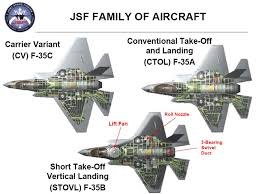
The JSF program is unusual, with three variants of the same basic airframe and an accelerated process.
"We're breaking new ground," Smith said. "There's really no precedent for what we're doing."
The first F-35 aircraft - an Air Force variant intended to be used for flight test - already is under production at three different sites, including Northrop Grumman's facility at Air Force Plant 42 in Palmdale.
Northrop is the subcontractor responsible for the center fuselage of the fighter. The first of the fuselages will be sent to Lockheed's Fort Worth facility this spring to be mated with the rest of the aircraft, Northrop spokesman Jim Hart said.
Program officials decided to continue production of the first aircraft while working on the replanning effort in order to keep the rest of the program on track, Crawford said. Therefore, it will not incorporate the weight-saving changes that the remaining aircraft will feature.
Work on the second aircraft is expected to begin later this year, Smith said.
The first flight is expected for the first time in August 2006. The first flight of the STOVL version is scheduled for 2007.
Flight testing will take place at Lockheed's Fort Worth facility, Edwards Air Force Base and Naval Air Station Patuxent River, Md.
The first operational squadron - the STOVL version for the Marine Corps - is scheduled to be fielded in 2012, with the first Air Force and Navy squadrons becoming operational the following year, Crawford said.
Three airframes: basic, carrier-landing, and... ???
The technological advances, ability to successfully incorporate seemingly contradictory requirements, and repeatedly meettin challenge after challenge, all make this the most incredible aircraft program ever. Of course the problem with most of these congressional investigative committees is that they don't have anyone on the committe that understands engineering, manufacturing, cost analysis, program management, or economics. It's a wonder anything has ever been developed for our military.
I thought both entries were excellent machines. The Boeing had the advantage of using some more proven methods and technology, but I agreed with the Pentagon's assessment that the Lockheed Martin X-35 had the cutting edge advantage with its new propulsion system design and VTOL fan.
All in all, in the long term we're looking at a fighter that will kick butt for 30-40 years, barring advances in anti-gravity, and artificial intelligence. (A touch of humor. Relax.)
I do think the Boeing team should be considered seriously for inclusion in the mix. They have a solid design team for working out the kinks in systems. Lockheed has a flair of innovation that Boeing lacks. Together, they'd probably build a spanking nice fighter.
basic fighter for the USAF
carrier landable for the USN
and VTOL for the USMC
Basically you have an Air Force version, a Navy version, and a Marine version. The Marine version is STOVL (short take off / vertical landing). I'm not sure if the Navy version for carrier landings has STOVL capability or not, but one would think that STOVL would be pretty advantageous for use on carriers.
Probably one each for bombing, aerial combat, and close in ground support?
OTOH, the boeing version was so butt ugly that no self-respecting pilot would ever admit to flying the thing. Plus, boeing never even attempted to develop a demonstrator that incorporated the multiple roles. With Boeing's entry it was always an either/or scenario.
BTW, flew the F-35 simulator two years ago. If it's anything like the real McCoy....schweet!
I saw the Boeing entry (pictures of) and yes it was ugly. But according to what I heard, it was a basic airframe for demonstrating what they could do. It was not an attempt to try and sell the look of the aircraft, since the airframe had not been finalized.
Lockheed did good by choosing to fit their prototype with a sleek fighter's airframe and cosmetics. It gave the Pentagon a better idea of what to expect in the final product, but nowhere near a final spec.
From the article: "The JSF program is unusual, with three variants of the same basic airframe and an accelerated process."
It is essentially ONE airframe with three variants.
Nah, STOVL isn't really handy for today's carriers. That's what the Gator Freighters are for.
Military spending does help the economy.
The Engineering and Science that goes into a fighter is immense.
Actually it isn't; the Marine version with STOVL sacrifices quite a bit of range for the extra weight of the STOVL stuff. The Fleet carriers are plenty big enough and the arrestor wire/catapult system works fine.
If I remember correctly, the Abrams had a lot of problems early on.
Don't hear a lot complaints now.
Disclaimer: Opinions posted on Free Republic are those of the individual posters and do not necessarily represent the opinion of Free Republic or its management. All materials posted herein are protected by copyright law and the exemption for fair use of copyrighted works.