
Posted on 11/15/2004 4:01:56 AM PST by Arkie2
A EUROPEAN spacecraft powered by a Star Trek-style thruster has flown through a “lunar gateway” that puts it on course to reach the Moon on Monday. Smart-1 has fired its revolutionary ion engine to reach a point at which it can be captured by the Moon’s gravity.
Yesterday morning the washing machine-sized probe cleared the “Lagrangian point” at which the gravity of the Earth and the Moon are in perfect balance. The craft is now assured of orbiting the Moon.
“Smart-1 has passed through the gateway to the Moon,” said Bernard Foing, of the European Space Agency (ESA), the probe’s chief scientist. “It’s an important symbolic day.”
Had the ion drive fallen just 5 per cent short of maximum thrust, Smart-1 could have collided with the Moon.
The probe is about 37,000 miles (60,000km) from the Moon. Shortly before 6pm GMT on Monday, when it will be about 31,000 miles away, mission control will start up the engine again for 4½ days. This will guide Smart-1 into a final orbit between 185 miles and 6,200 miles above the lunar surface. It will then begin at least nine months of observations that will shed light on what the Moon is made of and how it formed.
Smart-1, which cost £77 million to build, was designed primarily to test an ion drive propulsion system that has the potential to cut years off the flight time to Mercury and Mars and other planets.
The engines are ten times more efficient than standard chemical rockets. They work by using electricity from solar panels to charge atoms of the noble gas xenon, which are then fired into space at 1,000mph to power the probe.
This stream of ions accelerates Smart-1 at just 0.2millimetres per second. In space, this builds up over time to generate speeds of up to 10miles per second, or 36,000mph.
Because its initial speed was so low, Smart-1, which was launched last September from Kourou in French Guiana, has taken 14 months to reach the Moon.
The journey time to more distant targets will be significantly shorter. BepiColombo, a European probe that will fly to Mercury in 2009, will arrive there in 2½ to 3½ years if it can use ion propulsion, rather than in 6 to 7 years using conventional engines.
Lunar missions such as Smart-1 have the potential also to reveal what the Earth was like in its youth.
One of Smart-1’s most important instruments for gathering this information will be D-CIXS, an X-ray spectrometer built mainly by British scientists that will show the elements that exist on the Moon.
I think NASA explored the future of ion engine long ago. While the outputs were lower than normal engines, if my memory is correct, it seemed to be energy saving.
How is deceleration achieved one the probe arrives at Mercury?
Look up Deep Space One. Its a lot farther out than the moon
It wasn't that long ago. Deep space 1 was the first use of an ion engine and it flew about 3 or 4 years ago IIRC.
This engine is still in the development stage by NASA and ESA and will only get more efficient and more powerful. IIRC one of the X prize teams even had plans to use an ion engine.
It's more than energy saving, it's ten times as efficient as chemical rockets. Plans are to marry this engine up with a small nuke powerplant to provide unheard of capability to future probes. We've been in the horse and buggy stage of space exploration. This engine will make the solar system our backyard.
the washing machine-sized probeIn 1969, the USA landed the first of several teams of brave explorers on the lunar surface.
Forty-five years later, the Europeans sent up a washing machine.
LOL! OK. However, I was talking about the real deal here. not some movie. The title is deceptive but that's what The Times of London had so I used it.
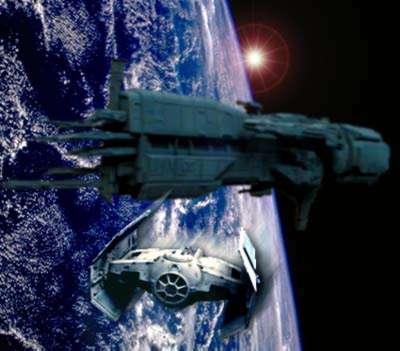
...D*mn F'n Lawyers/Enviro-Wackos., the USA could've been using this/similar (nuclear) tech. 10-15 years ago.
...more people have died, driven off a bridge by a Drunken US Senator in Mass., than have died by a USA-designed Nuclear Reactor.
BTW, Ion engines weren't used in "Star Trek." Those were impulse drives (Matter/Antimatter annihilation energy forced out the rear).
NASA has already flown the Ion engine on Deep Space One a few years ago.
NASA is the one doing the planning for the nuke engine. In fact they subcontracted the development out last year to the folks who build nuke powerplants for the Navy.
Sigh. I didn't put that stupid title on this piece. I wish I'd changed it. Blame the Times for confusing Star Trek with this engine.
Personally, I'm offended by the Europeons throwing trash at *our* moon. (It's ours, right? We stuck a flag in it after all....)
BTW, again.....
Yes. I am a dorkburger.
I knew that. Never blamed you.

Once in orbit, they could be attached to a re-usable, chemical booster launch platform..
The Launch Platform would provide initial thrust to get the package up to say, 25,000 mph, then dis-engage and return to the launch facility...
The Ion engines would then take over..
An initial heavy booster would decrease travel time significantly, at least one way, in the beginning..
The return flight would be longer, until an additional launch site could be set up at station 2..

Disclaimer: Opinions posted on Free Republic are those of the individual posters and do not necessarily represent the opinion of Free Republic or its management. All materials posted herein are protected by copyright law and the exemption for fair use of copyrighted works.