
Posted on 08/22/2004 6:53:47 AM PDT by expat_panama
|
News Home - Help |
 Forget the Experts; Consider the Crowd Forget the Experts; Consider the Crowd
By Samuel Fromartz WASHINGTON (Reuters) - Donald Trump gets a lot of mileage by lifting his hand, pointing his finger and uttering the words "You're fired!" on his reality TV show, "The Apprentice." The disgraced competitor leaves the boardroom and takes an elevator to the street, no longer in the running for an executive spot in Trump's empire. But does The Donald know best? According to "The Wisdom of Crowds," the answer would be no. In the Doubleday book, author James Surowiecki, a columnist for New Yorker magazine, argues that groups of people have far more smarts than any one individual, even though people tend to put their faith in leaders or prognosticators or promoters like Trump. "Chasing the expert is a mistake, and a costly one at that," Surowiecki writes. "We should stop hunting and ask the crowd (which, of course, includes the geniuses as well as everyone else) instead. Chances are, it knows." Surowiecki began to explore this idea by looking at markets, which through trading arrive at the "best" value for an item. They also act as uncanny predictors. For example, he mentions that of all the companies that helped build the Challenger space shuttle, it was Morton Thiokol whose stock took the biggest fall the day of the 1986 explosion. No trader knew that a component made by the company - O-ring seals - would later be blamed. Yet the crowd had voted, "an unmistakable sign that investors believed that Thiokol was responsible, and that the consequences for its bottom line would be severe," Surowiecki writes. Academics still don't understand how the market made this judgment, he notes. Surowiecki comes up with many examples of masses of people solving a problem better than any expert. In one case, a naval officer was trying to locate a sunken submarine. Data about its final moments were sparse, so where it rested on the ocean floor was open to conjecture. Rather than ask a group of experts to work out the answer, the officer assembled a team of people with diverse skills and had them wager on various scenarios for the ship's demise. The officer whittled the theories into a collective judgment and then projected where the submarine was. It turned out to be only 220 yards from where the group scenario found it would be. SMART CROWDS, DUMB CROWDS Why does group problem-solving work? The wide extremes of opinion tend to cancel each other out, Surowiecki writes, so the group as a whole returns to the mean. This is why a group of people will probably make a better average guess on the number of jelly beans in a jar than any single person. Four key elements should be in place for a crowd to function wisely. First, the group must be diverse. Those whose members have various skills and intelligence levels tend to be smarter than groups of experts. Second, a group should be decentralized, so that each participant has a channel to say what they think. Third, the participants must be independent enough to avoid conforming to a supposed norm. Finally, there needs to be a mechanism - a market, an aggregator of information, or an open-minded leader - to combine these diverse opinions into a single answer. The best thing a wise crowd can do is to avoid the stupidity of a despot. It must also avoid the urge for a blind stampede -- the stock market bubble, for example. To harness the wisdom of groups, businesses should take into account diverse views without influencing or controlling opinions or trying to reach a consensus. That may mean taking honest input from customers and suppliers -- which readily arrives in the form of business -- and from employees and investors. Start-ups might be better suited to apply this group approach, because they have much less to lose and are ideally always looking to improve. It's key to their survival. For his part, Trump took input in his show, judging contestants by gauging their opinions of each other and listening to two of his lieutenants. But a much more accurate gauge would have come from letting the audience decide which of the contestants should stay and who should go. Trump could have relied on the wisdom of millions rather than his own judgment, which apparently has been less than stellar. Just witness the recent bankruptcy of his Trump Hotels & Casino Resorts Inc. (Other OTC:DJTC - news) and the 97 percent fall in its stock since its initial public offering nine years ago. The crowd, alas, has spoken. (Samuel Fromartz is a Washington, D.C.-based journalist who writes about entrepreneurs and emerging companies. He can be reached through his Web site at http://www.fromartz.com. Any opinions in the column are solely those of Mr. Fromartz.) |
I've seen this theory applied to horse racing. The odds on a given horse are determined by how much is bet on that horse. It turns out that, in the long run, these odds are very good predictors. Horses that go off at even money (you bet two bucks, and if he wins, you win two bucks) win approximately half the time. Horses that are longshots, for example 20-1 tend, in the long run, to win about once every 20 or 21 times.
Of course, this makes sense from a wagering perspective. If a horse that was 20-1 ends up winning every fifth or even tenth time, betting on the underdog would become a profitable strategy. Bettors would follow the profitable strategy, thereby lowering the odds on the longshot and causing the strategy to no longer be profitable, as the former 20-1 shot now becomes 10-1 or 5-1.
The Germans learned this almost 200 years ago while fighting Napoleon. That's why Scharnhorst, who was chief of staff for Blucher, created the German General Staff after the Napoleonic Wars ended. His theory behind the creation of the General Staff was that in any future war a group of very smart individuals would almost certainly end up beating a lone-wolf genius like Napoleon.
Never happens.
The military aspect is really interesting. I remember in the '70's hearing from an army captain buddy of mine how committees are not good in operations planning. That was then. These days every action is followed by a complete critique from subordinates-- kind of the way these threads follow every news article.
Similar devices were used to try and predict the chances of global thermo-nuclear war in the 50's and 60's. A Rand corporation study, iirc, developed a process termed "The Delphi Technique". The idea is to survey numerous experts in the field on an individual basis, collate and review the data, and repeat follow up questions. Lather, rinse, repeat. Kind of a hegelian dialectic on steroids, doubtless computing power plays a role today. The method was later perverted to effect detrimental societal changes in the US, everything from "environmental" issues to city government.
Geez, man, watch how you use that name! Now I gotta get the horses calmed down again!
It's funny how that works. It's so simple and absolutely true.
When people try and force market issues by way of fiat inevitably the market will respond with dangerous results.
In China, the gov't is forcing people to have only one kid. As a result people are having one boy and it's teetering around 120 boys to 100 girls born.
In America, Johnson in an effort to eliminate poverty started giving away money to poor people. As a result people are still poor but now the gov't is broke.
The idea of central control is ultimately a fatal flaw.
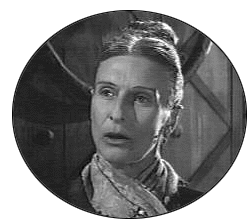
Frau Blucher
Want to join in the fun? Click the logo to donate to Swift Boat Veterans for Truth!
The Horses! The Horses! Have you no mercy?
"My Father's work was doo-doo...class dismissed."
Disclaimer: Opinions posted on Free Republic are those of the individual posters and do not necessarily represent the opinion of Free Republic or its management. All materials posted herein are protected by copyright law and the exemption for fair use of copyrighted works.
