The Penguin Ping.
Wanna be Penguified? Just holla!
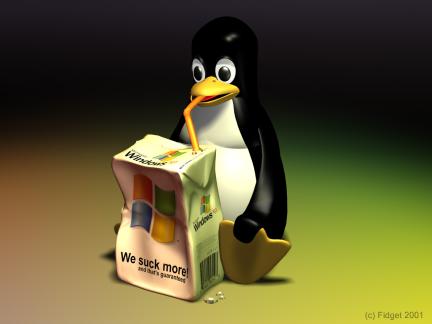
Got root?

Posted on 06/23/2004 7:19:10 PM PDT by ScuzzyTerminator
I've just seen a dispatch from the front lines of the FUD wars, Huw Lynes's report from one of Microsoft's Get The FactsHalloween VII and more recent leaks out of Microsoft. The outlines of the next stage in Microsoft's anti-open-source propaganda campaign are becoming clear. It's a good time to take stock of where we are, what our favorite evil empire is doing, and how best to respond. roadshow in Great Britain. It's a fascinating read, especially when considered in context with
(Writing code that doesn't suck always has to be our base-level and most important response, but the propaganda war matters too. If it's not already obvious to you why, keep reading.)
Let's start by reminding ourselves of the stakes. For Microsoft (or at least its present business model) to survive, open source must die. It's a lot like the Cold War was; peaceful coexistence could be a stable solution for us, but it can never be for them, because they can't tolerate the corrosive effect on their customer relationships of comparisons with a more open system. (Anyone who thinks I'm being perfervid or overly melodramatic about this should review the direct long-term revenue and platform threat
language from Halloween I. Other people may fool themselves about what this means, but Microsoft never has.).
Because coexistence is not a stable solution for them, it cannot be for us either. We have to assume that Microsoft's long-term aim is to crush our culture and drive us to extinction by whatever combination of technical, economic, legal, and political means they can muster. So, in evaluating the Get the Facts
road show, we need to start by asking how it fits into Microsoft's larger strategic plans.
One level is obvious. It seems to me very likely that Microsoft's UK tour is designed as a trial run of themes that they'll take to the U.S. to the extent they look successful. The UK is not a trivial market, of course, but 50% of all IT spending is still in the U.S., so from a Microsoft strategic planner's point of view that's where the main battle is. We can afford to pin some of our hopes on growth in Europe and developing countries and elsewhere, but Microsoft can't — the time horizon on it is too long for a company whose big challenge is to keep beating revenue expectations every quarter in a market where they have 92% share (if they don't beat those expectations every quarter, their stock tanks, the option pyramid collapses, and it's game over).
So, how does this FUD campaign differ from all other FUD campaigns? Let's start by considering the things Microsoft is not doing in this road show.
They seem to have abandoned using the "open source is intellectual-property cancer" argument directly. This follows the advice their own survey group gave them two years ago that this tactic was backfiring badly. Instead they're pushing this line through bought proxies at SCO and elsewhere.
They've quit claiming that Microsoft's products are technically superior. Instead, they talk up transition costs.
Similarly, innovation
, which was every other word out of a Microsoft exec's mouth a year ago, now seems to have quietly exited their voculabulary. It isn't in Huw's report, and it doesn't show up on the Get The Facts page.
Finally, we're not seeing the very recent Microsoft line that actually all software is proprietary because it's owned by somebody, so there's no difference between proprietary and open source.
Like the dog that didn't bark in the night-time, these omissions are significant, because Microsoft marketing is thorough and ruthlessly opportunistic. You can bet money that the reason they're not making these arguments is because they tried them on smaller focus groups, or individually with key customers, and they didn't fly.
Now let's review what Microsoft is doing. Huw gives us five bullet points:
I'll take on all of these, but in reverse, saving the most interesting for last. Do I even need to point out that most of the factual claims are blatant lies brought to you by the same people who got caught faking video evidence in their Federal antitrust trial?
Belittling the quality of the toolset available on Linux actually reduces to a TCO (Total Cost of Ownership) argument, because what a poor toolset means to a manager is that he'd have to hire more administrators to cover the same number of machines. I'll have more to say about winning the TCO argument in a bit.
Use the Forrester report to claim that Linux is insecure. Huw didn't give a link to Red Hat's counterargument. It's a good one, and I'll build some recommendations for action on it later on.
Make a big deal about the migration costs of moving to Linux. Beating this one is easy. All you have to point out is that migration costs money once, but per-seat Microsoft licensing fees are forever. Unless Linux TCO is substantially greater than Windows TCO, the sooner you switch, the more money you save. (Yes, this remains true even given discounting of future expenses, unless you peg the conversion cost absurdly high.)
The really interesting and novel lines are Huw's report of arguments 1 and 2: Claim that Linux isn't free and Pretend that Shared Source is the same as Open Source. Though these have been foreshadowed elsewhere, we haven't seen these used as headline arguments before, and they add up to nearly a reversal of the position Microsoft has taken in the past. Whereas Microsoft has before tried to claim that its products and licensing are different from and better than and more innovative than Linux's, now they're reduced to arguing that you should stick with Microsoft because shared source
is just the same as open source. Really. Ignore the attack lawyers behind the curtain.
Linux isn't free. Hello? If there is actually anyone still left on the planet who thinks the term free software
was a good idea, I hope they're paying attention. Because what Microsoft is doing here is exploiting the old familiar gratis/libre ambiguity of the word free
in yet another way. They're setting up for a claim that free software
advocates are lying or deluded because Linux has a nonzero TCO. Therefore, goes the implication, you can't really trust them about that other freedom thing, can you?
Semantic warfare — struggles over the meanings of words as proxies for political or market positions — is just like other kinds of warfare; you want to fight it on the other guy's turf, not yours. Every minute we spend arguing with Microsoft flacks about what free
means is a win for them and a lose for us.
This is also why we need to attack the shared
in their shared source
rather than defending the open
in our open source
. Fortunately this is easy. We can ask why they call it shared source
when they're not giving up the right to sue people who share
it for IP violations. Are they giving anything away except the opportunity to be hauled into a courtroom the next time you do something that Microsoft thinks is competitive with it?
Notice how defensive a position Microsoft is in now. Trying to neutralize open source by equating it with shared source implicitly concedes that open source is something customers want. Microsoft has given up a lot of ground here. Make them give more. Hammer them without mercy — but do it in a quiet, reasonable voice and keep control of the terms of argument. Here are some sound bites for open-source advocates to use in response to the Get The Facts
campaign:
Migration only costs money once; higher Windows TCO is forever.
Shared source is a poison pill.
Only the Windows boxes get the worms.
The thing not to do is talk abstractions. FSF-style propaganda about freedom
or user's rights
has its uses occasionally, but it will register on this campaign's target audience of bottom-line-fixated IT managers as irrelevant or nutty. And when you look irrelevant or nutty, you hand Microsoft a victory.
To put the Microsofties really on the spot, it's most effective to phrase your counters as questions, especially when you can use them to whack Microsoft with a combination of issues like TCO and security. Like this:
How many Linux machines have been zombied by Netsky, Sasser, MyDoom, or similar worms? Do your Windows TCO estimates include administrator time spent cleaning up after these infestations?
Can you explain why Windows IIS websites are cracked or defaced more often than Apache ones, despite the fact that IIS runs less than a third the number of sites Apache does?
Is Microsoft willing to add a hold-harmless clause to Shared Source licenses that protects shared-source licensees against being sued by Microsoft for alleged IP violations related to the software? If not, then please explain again how Shared Source
is just the same as open source?
We're winning, people. Microsoft has failed to stop us with better software technology or lower prices; they're incapable of the former and their business model wouldn't survive the latter. The SCO lawsuit isn't flattening our uptake curve enough for anyone to notice. The defections are mounting at previously captive customers; good recent examples include the French and Brazilian governments. Microsoft has to be particularly worried about the huge increase in Linux server shipments Gartner reported in 1Q2004; on current trends, we'll pass Microsoft not just in shipped units but in dollar volume early next year. They are not merely feeling the pressure, it has passed their pain threshold.
The choice of arguments in the Get The Facts
campaign is an obvious circle-the-wagons move to defend Microsoft's base of large corporate customers and governments. In itself, it is unlikely to accomplish much; at best, if they're both lucky and persuasive, it may slow down the rate of defections temporarily. But it's not going to do any better than that, and here's why:
Microsoft's underlying problem is that it employs about 22,000 programmers; the open-source community can easily muster ten times that number. That means the capability gap that has opened up between the open-source codebase and Windows is only going to get worse from Microsoft's point of view, not better. Time, technology, and market forces are not on their side — so, to survive, they're going to have to change the game so that market forces and the open-source advantage in technology become irrelevant.
So what is Microsoft going to do to try to claw back control after the Get The Facts
campaign runs out of sufficiently gullible targets? I expect it to involve legal and political shenanigans much bigger and uglier than we've yet seen. We've been expecting an attack using junk patents as weapons for two years, and I think the only thing that has held it off is that a convicted predatory monopolist with 92% market share can't expect to sue a bunch of developers who are giving stuff away for anyone to use without taking a severe drubbing in the court of public opinion.
I don't doubt they'll get desperate enough to do that, though. The emergence of institutions like the Public Patent Foundation and Groklaw gives us weapons of our own, but expect some bruising battles ahead.
Expect Microsoft to ally even more closely with the RIAA and MPAA in making yet another try at hardware-based DRM restrictions — and legislation making them mandatory. The rationale will be to stop piracy and spam, but the real goal will be customer control and a lockout of all unauthorized
software. Two previous attempts at this have failed, but the logic of Microsoft's situation is such that they must keep trying.
I also expect a serious effort, backed by several billion dollars in bribe money (oops, excuse me, campaign contributions
), to get open-source software outlawed on some kind of theory that it aids terrorists. We can only defeat that by making sure that national governments become so attached to open-source code that their military men and bureaucrats will short-stop the bribed legislators, rather than let their vital infrastructure be outlawed.
The most important thing the hacker community does is write better code. Our deeds are the best propaganda we have. Most of us, most of the time, shouldn't be distracted by worrying about beating Microsoft's PR or countering their political moves, because writing good code is in the long run a far more potent weapon than flackery. But some of us, some of the time, do need to be paying attention to the confrontation and propaganda aspects, lest we be blindsided in the shorter term by (say) super-DMCA legislation that instantly makes us all criminals.
Large corporations were the right first target for outreach five years ago, because converting some of them was the most efficient way to change the demand patterns perceived by the rest of the computer and software industry. That trend is self-sustaining now; I think we passed the tipping point about six months back, and the Get The Facts
campaign is evidence of this.
But in the next year, I think we need to focus more on government adoptions, in order to protect our political and legislative flanks. We need to make the cost of suppressing us higher than the sixty billion dollars Microsoft can afford to pay.
Copyright © 2004 by the Open Source Initiative
Send questions or suggestions about the website to webmaster at opensource.org
I like the open source community because it is free. However you can't hold it accountable. Microsoft, being owned by shareholders, can be held accountable.
Please elaborate on your concerns. Accountable for what?
How do programmers get paid if the software is free? Do they code for free? In their free time?
Usually. For a lot of geeks, programming is a compulsive hobby that they're lucky enough to also make a good living at. There is a lot of talent out there that programs for fun.
Wanna be Penguified? Just holla!
Got root?
Content of their software.
Read the EULA - End User License Agreement. What is it you think you can hold Microsoft accountable for?
Tech Ping
Here--I don't know if you've seen this thread or not.
To me, one of the most compelling arguments for open source is the control you have over the software. (Although, I must confess, I am writing these words on a Windows XP Professional machine, using Explorer.)
If you believe that some OSS code is infringing on your IP, it is all right there in clear view for you to check. Every piece of OSS code includes a copyright claim, usually the author, so you know who to sick your lawyer on. Would you risk putting your name on someone else's code and submitting it to Linux? The frequency that infringing OSS code is presented (SCO has not) is a pretty good indicator of the integrety of OSS.
On the other hand, If microsoft is infringing your IP rights, how will you ever know? If you do know, what are your chances of beating them?
In terms of user liability, why is OSS different than propriety? If Windows is found to be infringing on someone's IP it will get fixed and you'll get the update. Same with RedHat.
In addition to programmers doing it on spare time, many companies use their hired programmers to contribute to free software, either out of charity or because they expect that free software to provide ROI (both in IBM's case).
And worldwide socialists are attempting to change the laws of their country forcing governments to choose open source software like Linux. Don't believe it? Search your favorite engine for +Democrats +"open source" +law, look at a few hundred of the thousands of links, then form your own opinion.
That's only part of the story. Remember the story of the three little pigs? I usually classify Windows as the stick house. It's not quite a bad as the straw house, but not as good as the brick house.
There are other OSes, though, that would classify as a brick house, or perhaps between the stick and brick houses as far as security is concerned.
Quality of workmanship has a LOT more to do with virus popularity than popularity of the OS.
Honestly, I'm quite surprised at how durable Windows is, considering all of the hardware it supports. (however, I don't want to go down that road, I'd rather load my own driver, thank you very much)
We have a DEC Alpha at work, running Open VMS. Closed architecture, controlled by HP. Very stable, but if there is a problem, the machine has a tendency to go down very hard. I speak from bitter experience.
Whereas the problem that took down the Alpha the Windows boxes shrugged off and came back up just fine.
What I deal with on a daily basis is rather unnerving at times, but I can honestly say I never know what problem is going to arise next, which keeps things interesting.
Quality of workmanship is all well and good, but as OS's get more and more complicated, there are going to be security holes. Heck, that is one thing I take very seriously and have fought to change the way we do business just to protect ourselves.
When it comes to computer systems, everything is a trade-off. Right now, Windows has the edge when it comes to user familiarity. However, unless an IT manager is watching things closely, Windows comes with to many ways for an end user to get themselves in trouble, and therefore cause trouble on the network. Face it, proper security precautions are what is needed, but unfortunately (I'm in this position) a lot of times it is not possible, due to the lack of interest shown in the computer systems by upper management.
Pardon if I'm rambling, for me, it is late. I look forward to your response. Have a good evening.
Windows has its good (user familiarity), and its bad (off-the-shelf security is horrendous). Overall, though, it's not a bad OS.
VMS is a nice, rugged system. I used it while coding COBOL many years ago, and never had OS problems. It is nice in terms of user security and walling off each user from the rest of the system (something Windows can't do for many reasons). I guess that's one of the things that draws me to Linux--it combines the VMS system of walling off users in the system with openness of Windows.
Since Apache has over 60% of the webserver market, how come most exploits are against IIS?
Disclaimer: Opinions posted on Free Republic are those of the individual posters and do not necessarily represent the opinion of Free Republic or its management. All materials posted herein are protected by copyright law and the exemption for fair use of copyrighted works.