"Col. Joshua Chamberlain and the 10th Maine...":
 :
:Aaah... That would be the 20th Maine Infantry, at the Battle of Gettysburg PA, July 2, 1863. :
The 20th ME took a position at the extreme left of the Union lines, which had been beaten back by the Confederate forces of Robert E. LEE to a defensive position along Cemetary Ridge to the Southeast of the town of Gettysburg. Chamberlain held a crucial position known as "Little Round Top"

against repeated Confederate assaults, until his ammo was expended and his ranks decimated by casualties.
In stead of giving way or surrendering - which probably would have allowed the Confeds to flank and "roll up" the Union line for a repeat of the rout of both Bull Run Battles, and a probable attack by LEE on Washington from there - he ordered a wheeling bayonet charge down the hill and captured most of his presumptive captors.
This heroic scene is depicted in the movie "Gettysburg" and in the book "Killer Angels", as well as a classic work by John PULLEN, "The 20th Maine".
Remember; these weapons were long, 9.5+ lb. 3-banded rifle muskets - a serious hand to hand weapon in themselves - tipped with a 17" long tapering triangular cross-sectioned (to maximize hemmorage) socket bayonet.
Although official Army medical records indicate a relative few combat woundings from bayonettings, the burial detail tasked with disposal of the thousands of rotting, bloated corpses after a Battle didn't take time to document the manner in which their Clients met with their demise.
Soft lead .69 cal. round musket, .58cal. Minie' or smaller yet still lethal carbine or pistol ball, buckshot, cannister shot, shell fragment, saber, Bowie knife or bayonet made little difference; dead was dead.
But Veterans recounted how the bayonet was used with deadly effect a lot more than official records suggest. Napoleanic era Tactics using muzzle-loading weapons included closing with the enemy before he had time to reload and going buttstock to bayonet with him; the fight was often very close-up and personal... not to mention horrendously brutal.
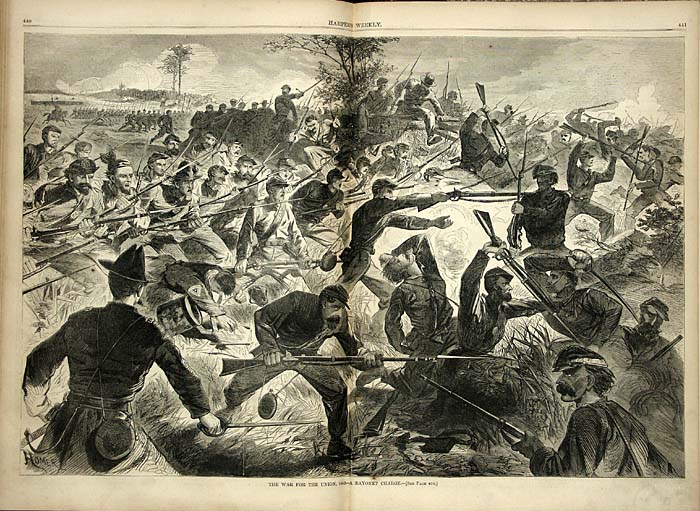
Soldiers told of litteraly pinning a man to the ground with his bayonet, having to put his foot on the dying adversaries chest and twisting the bloodied blade repeatedly in order to withdraw it. Sometimes they just gave up and unfixed in order to get their rifle back, leaving the long, cold steel imbedded in the quivering corpse while they scrounged up another bayonet - which at that point there would be plenty available, their original bearers having no furthur use for them.
With the advent of smokeless powder, accurate, long range repeating small arms and machineguns, the frontal assault by Infantry proved (the hard way, of course) to be of diminishing tactical practicality, if not increasingly suicidal stupidity, and combattants seldom closed with an enemy.
The practice was on the way out by the end of the Civil War, after the horrific losses by LEE in Pickett's Charge at Gettysburg, and GRANT's dreadful slaughter of his Troops at Cold Harbor and Petersburg.
After WW-I some time (I'd have to look the date up), the Geneva Convention limited the length of the bayonet blade to about 8" (I'm not real sure on that figure - anyone know?) and it became essentially vestigial and symbolic; sort of a utility knife that could be, in rare and dire circumstances, stuck on to the end of a weapon.
I think that there was only one U.S. led "bayonet charge" in the Korean "conflict", and I'm not sure how that came out. Of all the Vietnam Vets I know, none of them tell about bayonetting anyone - although one told about being bayonetted in the leg by a VC while his position was being overrun, and had the scar to "prove it" (although I sometimes wondered about his credibility).
When I was in the Army (1967 - 70) we sure trained with the bayonet in Basic - remember;
DI: "What is the spirit of the bayonet?"
Trainees: (as loud as we could roar): "To KILL!!! To KILL!!!"
But then again, the M-14 was a real Battle Rifle, worthy of the bayonet.
I would not try to hit anyone with an M-16, as it might just pi$$ them off and make them want to hurt me. I'd just wrap it around the nearest tree if I could, to prevent them from using it against us prior to surrendering (The French Option). Were that not an option, I would prefer, I think, rocks or sticks to make a last stand with. You'd probably do better just throwing "jamming Jenny" away when the ammo ran out, and using that pathetic excuse for a bayo like the Nicuraguan (?) Corporal did a while back. (there was a post about him on FR).
I guess that they still train with them though, as a fellow Reenactor who joined up right after graduating from HS and is currently serving in the Falluja area with the 1st Armored CAV managed to cut herself on one while in Basic. Oh; BTW:
Joshua Lawrence Chamberlain was grievously wounded at the subsequent Battle of Petersburg, but returned as a General and was prominent in the Surrender of the Army of Northern Virginia at Appomottox in April of 1865.
As the defeated Rebels marched past the ranks of the Union Troops on their way to stack arms and strike Colors for the last time, Gen. Chamberlain brought his men to Attention, "Shoulder Arms" (not like the modern position by that command; almost a "Present Arms" carry with the rifle vertical at the right side) and saluted his former foes.
The Battle-weary Southerners had earned his respect, and he wasn't ashamed or afraid to admit it.
Chamberlain served as the Dean of Bowdoin College in Brunswick, Maine and 4 terms as Maine's Governor.
In the 1880s he returned to the State House as Provisional Military Governor in charge of State Militia during an emergency crisis arising from a hotly disputed election in which factions had taken up arms in the Capital of Augusta and were on the verge of an intrastate Civil War of their own.
The Old General heroicly yet peacefully quelled what might have been a very violent, bloody, and nasty affair until the political mess was ironed out and the Government of the State could be returned to Constitutional Civil Authority.
Chamberlain's tactics are still taught in Military Academys to this day. A true Rennicance man, devout Christian and genius, he taught all but one subject at Bowdoin, spoke 7 languages fluently, and was a virtuoso Cellist.
He wrote at least one book and there were several written about him - at least one of which you would probably enjoy reading.
But he seems to be best remembered for his pivotal role at Gettysburg...
"BAYONETS!;
 FORWARD!"