Skip to comments.
Superstar may be brightest yet
BBC News ^
| 1/13/04
| Dr David Whitehouse - BBC News
Posted on 01/13/2004 5:21:01 PM PST by NormsRevenge
A star on the far side of our galaxy is 40 million times brighter, and 150 times more massive, than our Sun.
Although the star appears to be the brightest yet detected, it cannot be seen with the unaided eye because it is shrouded in a huge gas and dust cloud.
Astronomers at the University of Florida had to calculate its luminosity from its infrared radiation, which can penetrate the otherwise opaque cloud.
Scientists say the size of LBV 1806-20 means it will live a very short life.
Singular proof
The Florida team says the superstar is at least as bright as the Pistol Star, the current record holder for brightness, which was named for the pistol-shaped nebula surrounding it.
But whereas the Pistol Star is between five and six million times as bright as our Sun, the new contender is far brighter.
"We think we've found what may be the most massive and most luminous star ever discovered," says Professor Steve Eikenberry. There is a slight element of doubt, however. The bright star may turn out to be a tight cluster of somewhat fainter ones.
Dr Don Figer, an astronomer at the Space Telescope Science Institute, who led the team that discovered the Pistol Star in 1997, says the high-quality data collected by the Florida team reduced but did not eliminate this possibility.
"The high-resolution data prove that the object is not simply a cluster of lower mass stars, although it is possible that it is a collection of a few stars in a tight orbit around each other," he said.
"More study will be needed to determine the distance and singularity of the object in order to establish whether the object is truly the most massive star known."
'Really kind of weird'
Astronomers have known about LBV 1806-20 since the 1990s. At that time, it was identified as a "luminous blue variable star"; a relatively rare, massive and short-lived star.
LBV 1806-20 is a relatively young, estimated at less than two million years old. The Sun in our Solar System, by contrast, is five billion years old.
Typical stars, such as the Sun, live 10 billion years but stars like LBV 1806-20 have "short and troubled lives," says Professor Eikenberry.
"The more mass you have, the more nuclear fuel you have, the faster you burn it up. They start blowing themselves to bits."
One of the mysteries about LBV 1806-20 is how it got so big. Current theories of star formation suggest they should be limited to about 120 solar masses, because the heat and pressure from such big stars' cores force matter away from their surfaces.
Eikenberry says one possibility is that the big star was formed in a process called shock-induced star formation, which occurs when an exploding star slams gaseous material in a molecular cloud on to an already massive star.
The star's size is not its only distinguishing characteristic.
Its position is strange as well. It is located in a small cluster of highly unusual stars, including a so-called "soft gamma ray repeater", a magnetic neutron star that is one of only four so far identified in our galaxy.
Textbook example
The cluster also apparently includes an infant or newly formed star.
"We've got this zoo of freak stars, all crammed together, really nearby, and they're all part of the same cluster of stars," Professor Eikenberry says. "It's really kind of weird."
Eikenberry says the presence of the infant star, the luminous blue variable and the soft gamma ray repeater are vivid examples of an important emerging fact about stellar evolution: all stars in a single cluster do not form at the same time.
"We're seeing what I think is going to become a textbook example of the fact that stars aren't all born in an instant, even in a small cluster," he says.
Dr Figer says the research makes an important contribution to astronomers' understanding of the star formation process.
"The findings are significant because such massive stars are very rare and define the upper limits of the star formation process."
TOPICS: News/Current Events
KEYWORDS: brightest; lbv180620; pistonstar; superstar
To: NormsRevenge
2
posted on
01/13/2004 5:24:45 PM PST
by
PatrickHenry
(Everything good that I have done, I have done at the command of my voices.)
To: NormsRevenge
I wonder if the star registry has it named yet?
3
posted on
01/13/2004 5:30:49 PM PST
by
Bogey78O
(Why are we even having this debate?)
To: PatrickHenry
Thanks! Here's to sending some more folks thru that thread . :-]
This sucker outshines the Piston Star. Wow!
4
posted on
01/13/2004 5:31:22 PM PST
by
NormsRevenge
(Semper Fi Mac ...... FoR California Propositions/Initiatives info.. Check Muh Profile.. Developing)
To: Bogey78O
I wonder if the star registry has it named yet?Yes. It's name is now Timmy.
5
posted on
01/13/2004 5:35:36 PM PST
by
TomServo
("Why does the most evil man in the world live in a Stuckeys?")
The Piston Star
The previous "Brightest" Star detected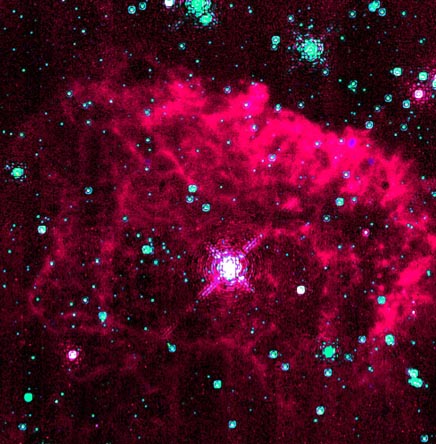
FRom APOD October 8, 1997
Star light, star bright, a new brightest star has been discovered in the night. This new brightest star is so far away and so obscured by dust, however, that it took the Hubble Space Telescope to confirm it. In 1990 a star named the Pistol Star was known to lie at the center of the Pistol Nebula. In 1995 it was suggested that the Pistol Star was so massive it was throwing off the mass that actually created the Pistol Nebula. Now, observations from the Hubble Space Telescope released today confirm the spectral relation between the star and the nebula. Dramatic implications include that the star emits 10 million times more light than our Sun, and is about 100 times more massive. Astronomers are currently unsure how a star this massive could have formed and how it will act in the future.
6
posted on
01/13/2004 5:36:03 PM PST
by
NormsRevenge
(Semper Fi Mac ...... FoR California Propositions/Initiatives info.. Check Muh Profile.. Developing)
To: NormsRevenge
TO be able to see a nova with the naked eye would be neat but considering the energies involved it's good thing that a supernovas or nova be VERY far away.
7
posted on
01/13/2004 7:15:05 PM PST
by
BenLurkin
(Socialism is Slavery)
Disclaimer:
Opinions posted on Free Republic are those of the individual
posters and do not necessarily represent the opinion of Free Republic or its
management. All materials posted herein are protected by copyright law and the
exemption for fair use of copyrighted works.
FreeRepublic.com is powered by software copyright 2000-2008 John Robinson