M1, the Crab Nebula
| Right Ascension | 05 : 34.5 (h:m) |
|---|---|
| Declination | +22 : 01 (deg:m) |
| Distance | 6.3 (kly) |
| Visual Brightness | 8.4 (mag) |
| Apparent Dimension | 6x4 (arc min) |
The Crab Nebula is the most famous and conspicuous known supernova remnant, an cloud of gas created in the explosion of a star as supernova.
The supernova was noted on July 4, 1054 A.D. by Chinese astronomers, and was about four times brighter than Venus, or about mag -6. According to the records, it was visible in daylight for 23 days, and 653 days to the naked eye in the night sky. It was probably also recorded by Anasazi Indian artists (in present-day Arizona and New Mexico), as findings in Navaho Canyon and White Mesa (both AZ) as well as in the Chaco Canyon National Park (NM) indicate; there's a review of the research on the Chaco Canyon Anazasi art online. In addition, Ralph R. Robbins of the University of Texas has found Mimbres Indian art from New Mexico, possibly depicting the supernova.
The Supernova 1054 was also assigned the variable star designation CM Tauri. It is one of few historically observed supernovae in our Milky Way Galaxy.
The nebulous remnant was discovered by John Bevis in 1731, who added it to his sky atlas, Uranographia Britannica. Charles Messier independently found it on August 28, 1758, when he was looking for comet Halley on its first predicted return, and first thought it was a comet. Of course, he soon recognized that it had no apparent proper motion, and cataloged it on September 12, 1758. It was the discovery of this object which caused Charles Messier to begin with the compilation of his catalog. It was also the discovery of this object, which closely resembled a comet (1758 De la Nux, C/1758 K1) in his small refracting telescope, which brought him to the idea to search for comets with telescopes (see his note). Messier acknowledged the prior, original discovery by Bevis when he learned of it in a letter of June 10, 1771.
This nebula was christened the "Crab Nebula" on the ground of a drawing made by Lord Rosse about 1844.
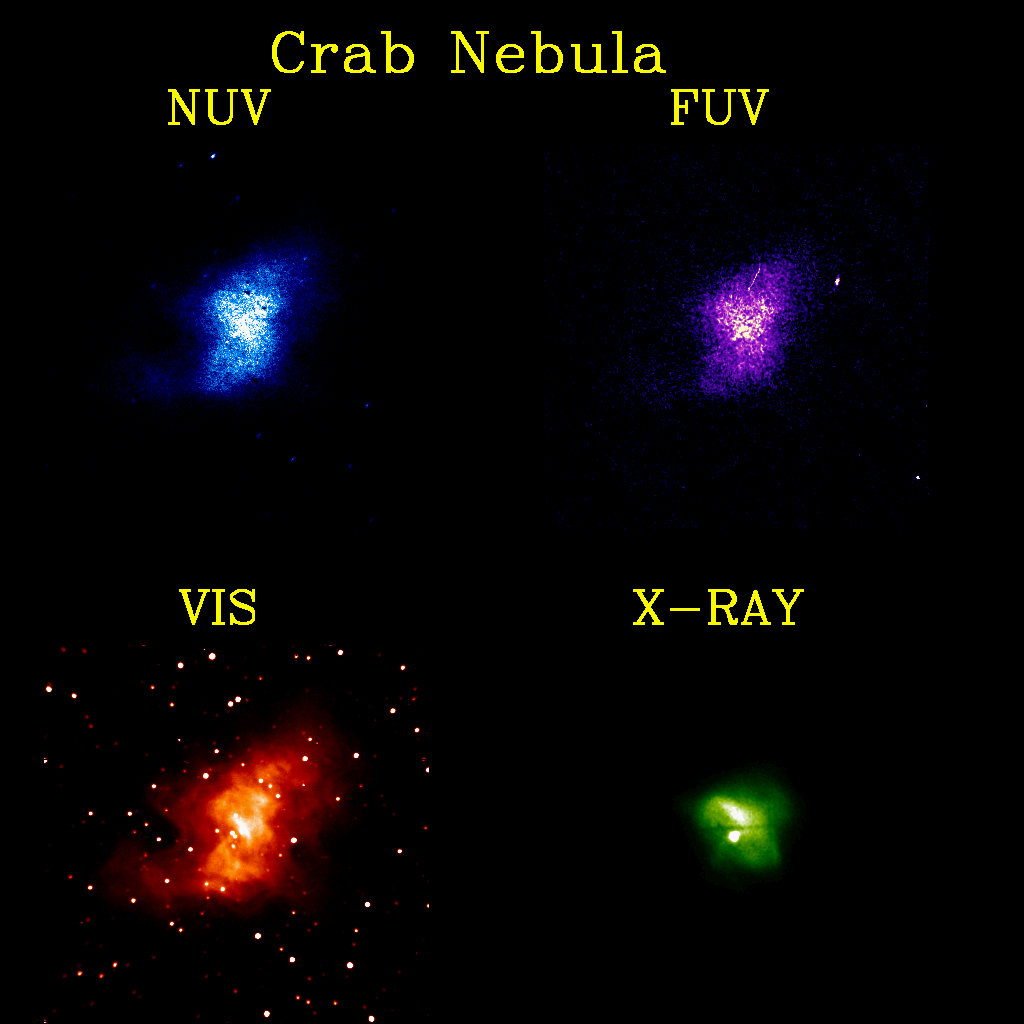
Below are images of M1 in different wavelengths. Clockwise from upper left: Near ultraviolet, far ultraviolet, x-ray, and visible light.
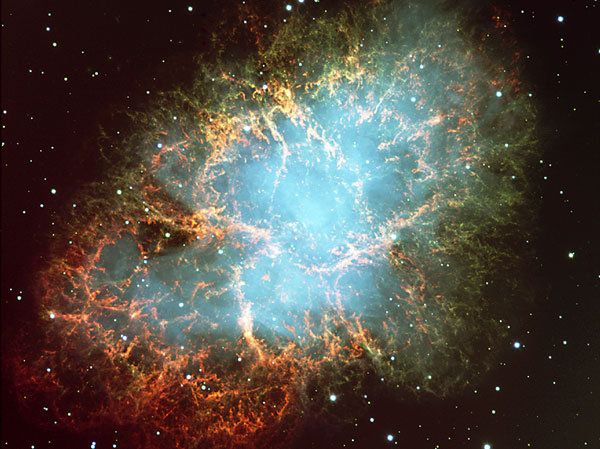
Below is a VLT image of the Crab.
The Crab Nebula is located in the constellation Taurus.


