
Click here: to donate by Credit Card
Or here: to donate by PayPal
Or by mail to: Free Republic, LLC - PO Box 9771 - Fresno, CA 93794
Thank you very much and God bless you.
Posted on 11/23/2026 11:51:16 PM PST by UMCRevMom@aol.com
NEW YORK (OSV News) — “God’s truth will prevail” over past and present Russian atrocities in Ukraine — and people of goodwill are called to do their part through prayer, awareness and advocacy, said Metropolitan Archbishop Borys A. Gudziak of the Ukrainian Catholic Archeparchy of Philadelphia. The archbishop joined Archbishop Daniel of the Western Eparchy of the Ukrainian Orthodox Church of the USA in presiding over a Nov. 21 prayer service at St. Patrick’s Cathedral in New York honoring the victims of the Holodomor famine. Also on hand for the memorial — which saw the cathedral’s pews filled — were Ambassador Andrii Melnyk, Ukraine’s permanent representative to the United Nations; Denys Sienik, chargé d’affaires at the Embassy of Ukraine in the U.S.; human rights lawyer Oleksandra Matviichuk, chair of the Nobel Prize-winning Center for Civil Liberties; and Michael Sawkiw Jr., president of of the Ukrainian Congress Committee of America and chair of the U.S. Committee for Ukrainian Holodomor Genocide Awareness.
Prior to the gathering, several hundred participants processed more than 2 miles to the cathedral from St. George Ukrainian Catholic Church in the city’s East Village section, carrying signs along with symbolic stalks of wheat, which they laid on a table before the cathedral’s sanctuary. Two wounded Ukrainian soldiers, Valentyn and Artur, solemnly traversed the cathedral’s aisle in military attire.
STALIN'S STARVATION CAMPAIGN KILLED MILLIONS
‘Panakhyda’ is memorial for the deceased The prayer service — a “panakhyda,” or Eastern Catholic and Christian memorial for the deceased — took place ahead of the Holodomor Remembrance Day, which will be marked Nov. 28 this year. Named for the Ukrainian words signifying “hunger” and “death,” the Holodomor was a 1932-1933 starvation campaign orchestrated by Soviet dictator Joseph Stalin as part of a brutal Soviet policy of collectivization, theft, terror and abuse that sought to erase Ukrainian cultural and political identity. According to analysts, the famine claimed approximately 4 million Ukrainian lives, with some estimates counting 7 million to 10 million slain. At its height in June 1933, the Holodomor saw approximately 28,000 Ukrainians die each day, according to the U.S. Committee for Ukrainian Holodomor Genocide Awareness.
The Holodomor has officially been recognized as a genocide by more than 30 countries, as well as by over 30 U.S. states. And, said speakers at the Nov. 21 prayer service, genocidal aggression against Ukraine continues as Russia’s war on that nation — initiated in 2014 and accelerated by a 2022 full-scale invasion — approaches the 13-year mark.
LONG-RUNNING BLOCKADE HAS LEFT RESIDENTS STARVING IN OLESHKY
A long-running blockade in the Russian-occupied town of Oleshky, located in Ukraine’s Kherson Oblast, has seen residents resort to eating soup made from weeds, with starvation deaths and a lack of basic necessities triggering sanitation and humanitarian crises, according to the Institute for the Study of War, or ISW. In September, the Ukrainian Council of Churches and Religious Organizations appealed for urgent action to address “the humanitarian catastrophe in the city of Oleshky.” While still in Rome’s Gemelli Hospital following his October lung cancer surgery, Pope Leo XIV called Russian President Vladimir Putin to urge a ceasefire and the delivery of humanitarian aid to the besieged community.
DESPITE the Oct. 27-Nov. 1 CEASEFIRE AND EVACUATION of some 800 civilians, conditions in Oleshky have CONTINUED to erode, with an estimated 1,300 residents again facing “critical shortages of food, medicines, and firewood for heating,” said ISW in a Nov. 19 update. “The HISTORIC PARELLELS are impossible to ignore,” said Sawkiw. Archbishop Gudziak echoed that observation.
CHILDREN ARE BEING 'REDUCED TO FRAIL, SKELETAL, FIGURES PERISHING IN SILENT AGONY’
“Chills went down my spine as these children came up, placing symbols of God-given life and sustenance … on this table, when I thought of children like them reduced to frail, skeletal figures perishing in silent agony,” he said. “And the chills continue when I realize that every hour of every day in Ukraine, children are being bombed, children are being abducted, brainwashed, stripped of dignity, identity … of their very life.” Action must accompany the lament for and remembrance of human suffering, the event’s speakers stressed. Sienik said that Russia’s current attacks on Ukraine constitute “genocide unfolding again before the eyes of the world,” warning that “unpunished evil always returns” and that “appeasement only feeds its appetite.” Melnyk quoted from the Book of Obadiah, in which the prophet condemns the inaction of those who witness suffering but fail to intervene. Even amid the horrors of the Holodomor and the anguish of Russia’s current aggression in Ukraine, hope prevails, said speakers.
Matviichuk — who shared she was the descendant of Holodomor survivors — said the famine is “a story about pure horror, but also the unbelievable strength to continue,” she said. Archbishop Gudziak described Ukraine’s survival as “a miracle.”
“It’s the grace of God,” he said. “It’s God’s will to protect the innocent.” Urging those present to “pray, advocate and help,” he quoted from St. Paul’s Letter to the Romans: “Hope does not disappoint, because the love of God has been poured into our hearts through the Holy Spirit” (Rom 5:5).
“The Holy Spirit is in your hearts,” he said. “Feel it, and his hope will prevail.”
|
|
Click here: to donate by Credit Card Or here: to donate by PayPal Or by mail to: Free Republic, LLC - PO Box 9771 - Fresno, CA 93794 Thank you very much and God bless you. |
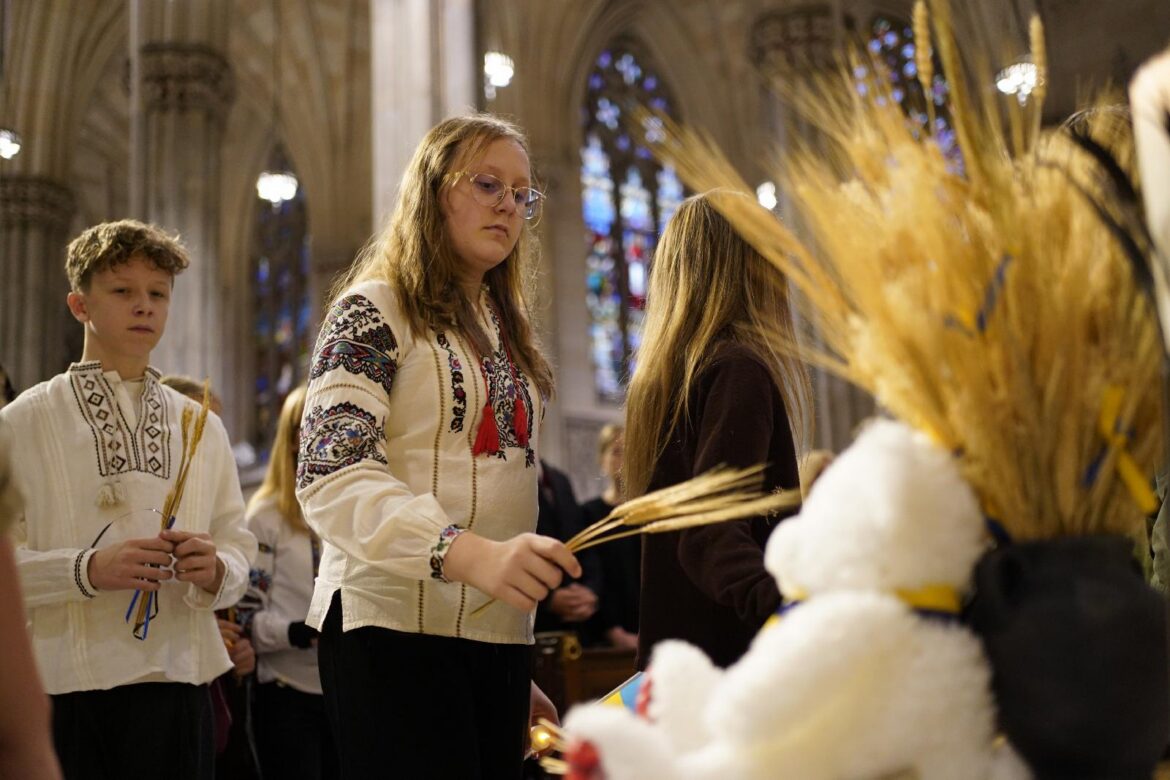
These Children participated in a Nov. 21, 2026, prayer service at St. Patrick’s Cathedral in New York City commemorating millions of Ukrainians killed in the Holodomor, a starvation campaign orchestrated by Soviet dictator Joseph Stalin in 1932-1933.
Speakers at the service reflected on the past and also addressed the horrors of Russia’s current war of aggression against Ukraine.
How much humanitarian work did the banned churches do in Ukraine?
Google AI:
The banned Moscow-linked Ukrainian Orthodox Church (UOC / UOC-MP) conducted substantial humanitarian work in Ukraine following Russia’s 2022 full-scale invasion, though exact figures come primarily from the church’s own reporting rather than independent audits.
Reported Scale of Aid (2022–2025)
According to figures released by the UOC Kyiv Metropolia and cited by the Union of Orthodox Journalists, the church reported providing over 240 million hryvnias (roughly $6–$8 million USD, depending on exchange rates over the period) in combined civilian and military relief:
• Civilian Relief:
Roughly 8,000 tons of food, medicine, clothing, hygiene items, generators, fuel, and drinking water—valued at approximately 175 million hryvnias—distributed across Ukraine, including frontline regions.
• Support for Armed Forces:
Over 65 million hryvnias in vehicles, equipment, medical supplies, and targeted assistance for Ukrainian soldiers.
• Shelter & Evacuation:
Parishes and monasteries across the country operated as reception centers housing tens of thousands of internally displaced persons (IDPs) and assisted with evacuations from combat zones.
Broader Context & Limitations
• No Independent Verification:
Because aid was distributed across thousands of individual parishes, dioceses, and church-affiliated charities—such as the Vadym Novynskyi Charitable Foundation, which donated ambulances and supplies alongside the UOC—there is no comprehensive, third-party audit verifying the total financial value.
• Grassroots vs. Leadership:
Independent observers and researchers, including those published via George Fox University Digital Commons, note that UOC parishes and volunteers were heavily involved in grassroots relief and IDP support even as Ukrainian security services prosecuted individual UOC clergy for alleged collaboration with Russian forces.
• Russian Orthodox Church (ROC):
While the Moscow-based ROC officially claimed to provide humanitarian aid to civilians in Russian-occupied territories, Ukrainian authorities and human rights organizations like Archons of the Ecumenical Patriarchate report that the ROC primarily operated alongside Russian occupation authorities to consolidate control and displace non-Moscow religious groups.
Disclaimer: Opinions posted on Free Republic are those of the individual posters and do not necessarily represent the opinion of Free Republic or its management. All materials posted herein are protected by copyright law and the exemption for fair use of copyrighted works.