Posted on 07/28/2026 4:10:40 PM PDT by Angelino97
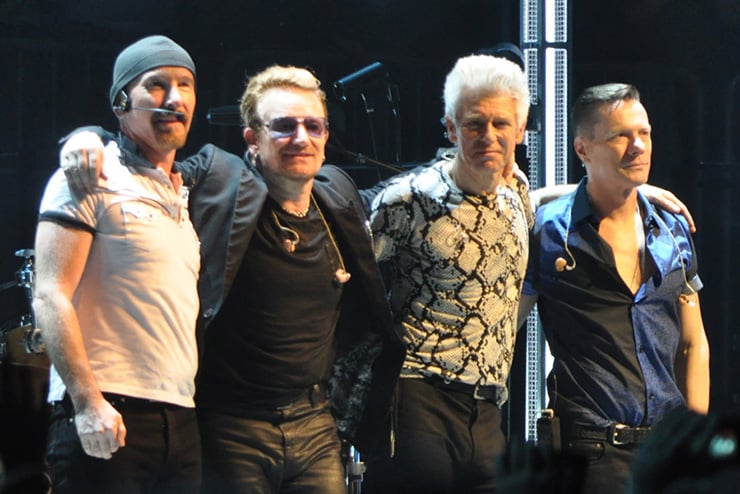
“Street of Dreams,” the new single from U2, is a perfect piece of Christian joy. This year marks the 50th anniversary of the band’s formation in 1976, and in the popular culture it’s hard to name many superstars who have so powerfully preached the gospel.
“Street of Dreams” is recognizably Catholic. The video was shot in Mexico City, with the band performing their new song atop a school bus graffitied by Mexican artist Chavis Mármol. Images included a statue of the Virgin Mary, a street procession including a large cross, and a huge picture of Our Lady of Guadalupe. Comments on the lyric video say things like “Psalm 61!” And “Praise the Lord!” The opening lyrics:
God, hear me shout
Lend Your ear to my prayer
When I’m far from anywhere
Down to my last breath of air
God, hear me shout
Lend Your ear to my prayer
When I’m far from anywhere
Down to my last breath of air
La calle, calle de los sueños
All the doors are open on the street of dreams
La calle, calle de los sueños
Broken are the chosen on the street of dreams
As teenagers, band members Bono, the Edge, and Larry Mullen, Jr. were part of a charismatic Christian community that held weekly Bible studies and prayer meetings (bassist Adam Clayton declined to join). That spirit has never left them, despite global fame, dabbling in excentric politics, and a period where their music was ripe with irony and self-consciousness. Writing in The New Yorker in 2014, Joshua Rothman described the band’s spiritual dynamic well:
Most people think of U2 as a wildly popular rock band. Actually, they’re a wildly popular, semi-secretly Christian rock band. In some ways, this seems obvious: a song on one recent album was called “Yahweh,” and where else would the streets have no name? But even critics and fans who say that they know about U2’s Christianity often underestimate how important it is to the band’s music, and to the U2 phenomenon.
The result has been a divide that’s unusual in pop culture. While secular listeners tend to think of U2’s religiosity as preachy window dressing, religious listeners see faith as central to the band’s identity. To some people, Bono’s lyrics are treacly platitudes, verging on nonsense; to others, they’re thoughtful, searching, and profound meditations on faith.
I’m in the latter camp. In the 1980s Bono kept me in the Christian communion when there were strong forces working against it. The lure of sex, drugs, and rock ‘n roll were part of it, sure, but just as insidious was the corruption within the Catholic Church of the time. There had been a massive influx of homosexual men into the priesthood during the period between the 1960s and 1980s, and the ensuing abuse, along with the leftist politics of orders like the Jesuits caused a lot of cradle Catholics to reject the Church.
But for those of us who knew in our bones that the faith was true, whatever abuse that bad men might bring down upon it, U2 became role models and heroes. Here were four powerful, talented, and spirit-filled heterosexual men from Ireland, a place of earthiness, booze, and poetry.
In his book The Last Supper, which I reviewed for Chronicles, Paul Elie explored how many artists and musicians in the 1980s were “crypto-religious.” They had inherited Christianity from their parents and their respective cultures but they weren’t necessarily pious in using Christian imagery to create new art.
U2 were not in that category. They were not crypto-religious, but actually religious. They named a song for Psalm 40. Bono defended the literal resurrection of Jesus and talked about visiting Golgotha, “the place where death died.” U2 also wrote one of the most powerful songs I’ve ever heard about the priestly sex abuse scandal, “Sleep Like a Baby Tonight.”
Though not what anyone would call a conservative, Bono also has always shown a willingness to go against some liberal nostrums. In one interview he praised capitalism:
I ended up as an activist in a very different place from where I started. I thought that if we just redistributed resources, then we could solve every problem. I now know that’s not true.
There’s a funny moment when you realize that as an activist: The off-ramp out of extreme poverty is, ugh, commerce, it’s entrepreneurial capitalism.…I didn’t grow up to like the idea that we’ve made heroes out of businesspeople, but if you’re bringing jobs to a community and treating people well, then you are a hero.
In his book Becoming What We Sing: Formation Through Contemporary Worship Music, David Lemley, a Christian and the assistant professor of religion at Pepperdine University explores the spirituality of U2 live.
In “The Ordo of U2,” Lemley argues that U2 “provides a unique case study of the pop ordo in practice.” The term ordo describes “the basic structure of Christian worship that centers on table, font, and pulpit, and the shape of Christian living that flows from these centers. It is a commitment to that which grounds and guides our lives in the world.”
In Lemley’s assessment, a band like U2, led by a believing Christian named Bono, and their spirit-infused concerts, are a pop version of the ordo of Christian worship. “In some of their signature songs, the theological language used by the band is effective in casting broad visions of hope and human connection.” In songs like “I Still Haven’t Found What I’m Looking For,” “Beautiful Day,” and “Mysterious Ways,” Lemley believes: “U2 offers an affective alliance where a better world is possible and in which the listener is valued unconditionally.”
The audience, both secular and religious, partakes in this pop ordo:
This is a system in which consumers are caught up in more than a simple financial transaction. American worshippers take roles in a society that communicates norms of believing, belonging and behaving through aesthetic choices, like popular music—music that is a “language” beyond lyrics….Buying and selling material goods establishes people and institutions in a network of cultural values, ethical commitments, daily practices, and social identities.
The audience forms its own type of faith community, goaded on no doubt by Bono’s own brand of cajoling to stop AIDS, forgive debt, and welcome refugees. Although I think Bono—like many in the West—has been scammed into believing far too many so-called “refugees” deserve the designation, his debt forgiveness advocacy should be more interesting to conservatives interested in keeping those numbers down.
Bono envisions a solution that empowers the poor in other countries to help themselves which, in theory, ought to discourage them from attempting to come here—preventing a lot of problems that come with the struggle for resources and culture clashes. Does this any of this artistry or advocacy lead to lasting Christian conversion?
Lemley is doubtful, arguing that music like that of U2 avoids the hard work of love thy neighbor, converting the skeptic, and doing daily, sweaty chores like raising a family or fostering real community. Outside of this sphere, pop music “functions as a means of breaking away from daily domesticity, transcending by encountering a reality that is entirely out of reach and experience that does not require achievement to be effective.”
In conclusion, Lemley writes this:
Pop stars are notoriously effective at advocating for humanity as a whole while publicly serving as a cautionary tale of domestic tragedy. Pop music offers a compelling invitation to become what we hear. But we cannot receive what we are; it does not enact what it signifies. It does not make disciples. That is not the trajectory of the liturgy … if you want to come into ethical alignment with pop music, you don’t have to love, you have to dance.
Whatever merit Professor Lemley’s argument may have with respect to pop music in general, he is wrong about Bono. Bono is not an example of any “domestic tragedy.” He’s been married to the same woman, Ali, since 1982, and they have four children together. Unlike other rock stars, you never hear scandals about U2 members.
And in that sense, they were much better role models for us teenagers in the 1980s than were the TV preachers and the politicians of that age—even if their politics and theology, on paper, were better. The reality U2 sang about was never “out of reach” for us; to the contrary, it was founded in the real world.
“Street of Dreams” is part of a new forthcoming album. Bono described the new record this way: “More songs of celebration than lamentation. The LP/album we’ve been working on has a very different kind of musical mood and narrative, a more of a defiantly joyful kind of feel to take on these anxious times, almost a carnival vibe.”
Marking.
Never knew that about U2, but then I’ve always heard Bono’s political views, and tuned them out. If Bono has wised up, maybe I could give them a chance.
Feels like the author is selling an idea.
Does Bono talk about the true the Gospel of Christ?
Bump for later reading...
I think he used to.
Bookmark.
pretty sure that Bono follows the pope
which means different things to different people
bflr
Disclaimer: Opinions posted on Free Republic are those of the individual posters and do not necessarily represent the opinion of Free Republic or its management. All materials posted herein are protected by copyright law and the exemption for fair use of copyrighted works.