To: Dr. Sivana
Now, carb adjustments and points can be a nuisance. The old single cavity master cylinders were a bona fide safety hazard And on Mopars, the voltage regulator (separate from the alternator) liked to fry every so often. Cleaning and gapping points isn’t very hard or time consuming, and you can keep a set of points and condenser in the glove box just in case they crap out on you while driving, it is easy to swap out on the side of the road. If an electronic ignition goes out you will be calling for a tow truck. I wanted to keep my 64 Dodge as close to stock as possible but am changing out my single for a dual master cylinder after the pedal went to the floor.
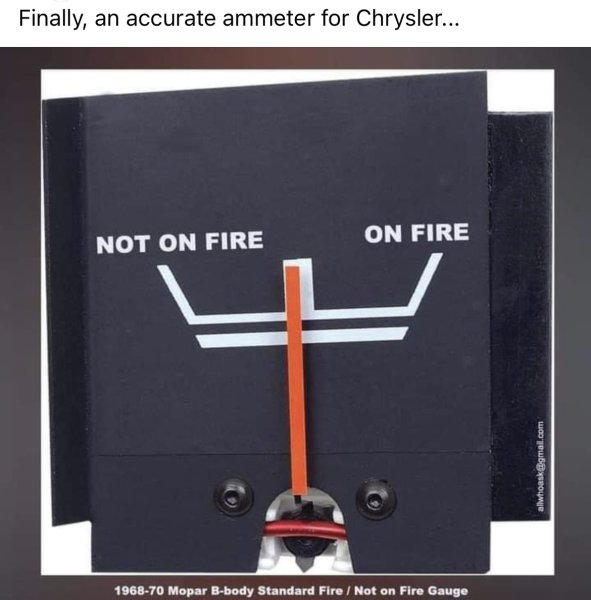
The charging systen is the Achilles heel of old Mopars.
67 posted on
06/05/2026 9:18:27 AM PDT by
dznutz
To: dznutz
I had to explain to a young mechanic who didn’t think that alternator gauges were useful. I have a 2004 Chevy Venture that has a needlessly complex electrical system, and an alternator gauge would have been useful in diagnosing the problem. He had confused the Mopar alternator gauge with the comparatively worthless GM Battery gauge. I had to explain to him that the gauge didn’t measure voltage as much as it was describing whether the battery was being recharged or not.
The downside is it worked by “running hot”, so when the gauge fails, so does the car. Fortunately, I had a cheater cable with alligator clips on hand to bypass the gauge altogether. That was on a ‘66 Dart.
69 posted on
06/05/2026 9:28:56 AM PDT by
Dr. Sivana
("Whatsoever he shall say to you, do ye." (John 2:5))
To: dznutz
Ignition systems were problematic in the late 70’s Some genius decided to put the hot ceramic ignition coil ballast resistor in a spot where water on the hood would pour down and crack it if you opened the hood, We kept s big box of them below the front parts counter. I can’t begin to guess how many I sold.
81 posted on
06/05/2026 1:44:47 PM PDT by
Clay Moore
(My pistol identifies as a cordless hole punch. )
FreeRepublic.com is powered by software copyright 2000-2008 John Robinson