
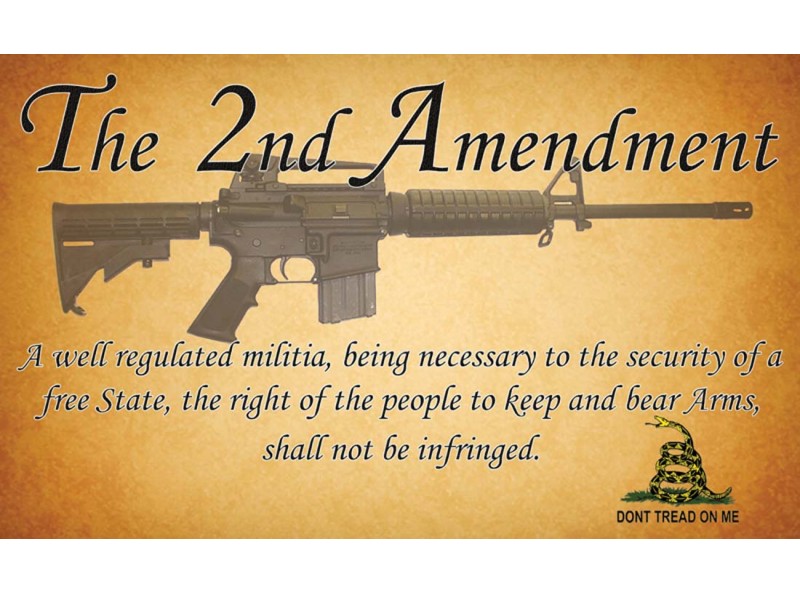
This Ping List is for all news pertaining to infringes upon or victories for the 2nd Amendment.
FReepmail me if you want to be added to or deleted from this Ping List.
More 2nd Amendment related articles on FR's Bang List.
Posted on 05/12/2026 5:12:46 AM PDT by MtnClimber
Last week, the Department of Justice (DOJ) and the Bureau of Alcohol, Tobacco, Firearms and Explosives (ATF), now under the leadership of newly confirmed Director Robert Cekada, rolled out a lengthy list of final and proposed rule changes to a wide range of federal firearms regulations. They contain some noteworthy developments for Second Amendment advocates.
The Trump administration’s rule changes are a welcome announcement – particularly since there has been a bit of a gap in Second Amendment action since the President’s February 2025 executive order on “Protecting Second Amendment Rights.” As of this week, several of both the final and proposed rules have now been officially published in the Federal Register.
For those who may not be up to speed on these recent actions, the spectrum of issues addressed via this regulatory rollout is wide and diverse. The package includes everything from reducing the paperwork burdens for Federal Firearms License (FFL) holders, to simplifying the background check paperwork (namely the 4473 form) for gun purchasers, to clarifying gun and component definitions, to modernizing how records are kept, to reversing unnecessary bans on certain firearms components – just to name a few significant changes.
Of note, in its initial announcement of the package last week, DOJ indicated that this slate of proposed and final rule changes is “only the first batch of incoming changes that the Administration has planned.” So, we may be in store for more reforms down the line.
Importantly, ATF has provided the public with the rationale, statistics, metrics, and arguments for why it is making these changes. In a stark reversal from the Biden administration’s assault on the Second Amendment, the Trump administration’s reasoning is rooted in the reality of lawful gun ownership, a greater respect for individual liberty, and the facilitation of lawful commerce.
For Americans concerned about preserving and protecting their Constitutional right to keep and bear arms, not only is it worth the time to become familiar with what the administration has put forth in this package, it is also worthwhile to help shape the final form of these regulations via open comment. After all, several of these regulations will have a direct impact on gun owners – such as the rules focused on streamlining, easing, and clarifying processes to purchase or sell firearms. Any American can freely offer their support or thoughts on how to improve the proposed rules.
At the same time, other issues that the Trump administration has addressed drill down to more profound concerns about liberty and government overreach. For example, one of the proposed rules seeks to reduce the time that FFLs must retain 4473 paperwork, which contains personal information on firearms purchasers.
Prior to the disastrous Biden years, FFLs only had to keep the 4473 forms on hand for 20 years. Records older than that could be destroyed, which meant that paperwork linking buyer to gun type wouldn’t run the risk of being eventually collected by the government (all FFLs that go out of business have to turn in all of their transaction records to the ATF). In 2022, the Biden administration took a hard left from past practice and forced FFLs to keep their records indefinitely, almost guaranteeing that all firearms transaction records would eventually get into the hands of the federal government without a rule change.
Now, under the new proposed Trump rule, the period will either be set at the old 20-year mark (which worked fine for decades) or 30 years.
Incidentally, the rules package also proposes placing a sunset on how long the background check records are to be kept by the ATF for firearms tracing purposes. The ATF admits in its proposed rule justification that most issues related to gun crime that require law enforcement tracing requests involve guns purchased within that 20-year timeframe – so there is little reasonable or logical reason to keep records beyond 20 years. For a lot of reasons – not the least of which being concern about our government keeping tabs on what firearms we own – reducing this requirement makes sense.
It is important to note that with official publication, the clock now ticks on the sequence of actions to finalize the proposed rules. This process starts with a time-limited open comment period where the citizenry can review the information and submit formal comments. For these proposed rules, the comment period is 90 days. Once this period closes, the agency will complete its review of everything on hand and make final determinations.
In a statement last week, the ATF indicated that “the agency is committed to reviewing input in a timely manner and ensuring consideration of significant feedback into the final rules.” With luck, once the comments are closed, the agency will move swiftly to finish and promulgate these final regulations.
For the first time since Trump left office in 2021, Second Amendment advocates and law-abiding gun owners have tangible reasons for optimism again. While more work needs to be done, after four years of relentless assault under the Biden administration, the Trump administration is finally correcting those errors.
That website is as clear as mud.
An inadvertant admission of the ATF doing what was long suspected when the NICS checks were put into place under Clinton: a defacto registry of sorts.
Review
Bookmark
More bull shit while the useless SC sits by and allows the rights of people in dem States to be taken away for YEARS.
That ATF exists=infringement. 🤔
After reading this I have no idea what these noteworthy developments are and how they support my second amendment rights.
So, is there any hope that some FFL’s would re-appear here in CaCaLand? Just to get ammo an FFL must be involved. Going on line 5 years ago there were hundreds listed. A year after Beijing Biden took power there were less than a handful.
Rules at will are not law. Congress can’t transfer that job to others. The ATF needs to be eliminated.
This Ping List is for all news pertaining to infringes upon or victories for the 2nd Amendment.
FReepmail me if you want to be added to or deleted from this Ping List.
More 2nd Amendment related articles on FR's Bang List.
Disclaimer: Opinions posted on Free Republic are those of the individual posters and do not necessarily represent the opinion of Free Republic or its management. All materials posted herein are protected by copyright law and the exemption for fair use of copyrighted works.