Posted on 04/16/2026 7:18:58 AM PDT by MtnClimber
Consider a thought experiment. Imagine the US Congress paid a freshman representative his full salary, gave him immunity from criminal prosecution, and then quietly arranged for him to skip 98% of all floor votes so that no voter could ever discover what he actually believed. Now imagine that same representative ran for governor on the promise that he was “just like the incumbent, minus the corruption,” while powerful institutions spent billions creating the conditions for his victory. You would call that election interference. When the European Union did precisely this in Hungary, the Western press called it democracy.
On April 12, 2026, Péter Magyar and his Tisza Party won 138 of 199 seats in the Hungarian parliament, ending Viktor Orbán’s 16-year tenure. Within 17 minutes of the result, European Commission President Ursula von der Leyen declared that “Hungary has chosen Europe.” Alexander Soros, chair of the Open Society Foundations, posted that “the people of Hungary have taken back their country.” The speed of those statements tells you something important. Brussels was not reacting to the election. It was receiving confirmation of a project years in the making.
The project had 3 interlocking components: weaponize tens of billions in frozen EU funds to create unbearable economic pressure, build and sustain an ecosystem of EU-funded NGOs and media outlets that functioned as a de facto opposition infrastructure, and shield the chosen replacement candidate from any accountability that might reveal his true positions to Hungarian voters. Each component is documented. Together they constitute the most ambitious case of institutional election engineering in modern European history.
Start with the candidate himself, because Magyar’s European Parliament record is the single most revealing data point in this entire story. According to WheresMyMEP.eu, Magyar participated in just 36 out of 1,945 roll-call votes during his tenure as an MEP, an attendance rate of 1.85%. Brussels Signal confirmed on April 1, 2026 that this was the lowest attendance rate of any MEP in the current parliamentary term. The average MEP participation rate sits between 82% and 87% depending on political group. The European People’s Party, Magyar’s own faction, averages 87.5%. Magyar collected his full salary, enjoyed his full benefits, and exercised his full parliamentary immunity, which shielded him from 3 separate Hungarian legal proceedings. He simply did not vote.
For context, consider Ioannis Lagos, the Greek Golden Dawn neo-Nazi who is currently serving a 13-year prison sentence. Lagos still managed to attend approximately 38% of votes during his term. A man behind bars outperformed Magyar by a factor of 20. This was not laziness. This was strategy. EU Matrix analyst Doru Frantescu observed that Magyar’s participation was low even before his domestic campaign intensified, noting it had been “around 21% since the beginning of the term. This means that he focused on internal politics not only recently, but even before.” Magyar never drafted a single parliamentary report, signed only 1 resolution, and submitted just 1 written question across his entire tenure.
The pattern extends beyond Magyar himself. 4 of the 10 worst-attending MEPs in the current term are Tisza Party members: Magyar at 1.85%, Zoltán Tarr at 20.9%, Gabriella Gerzsenyi at 32.6%, and Kinga Kollár at 36.3%. This is not a coincidence. It is a coordinated strategy to keep an entire party’s positions off the record. When Tisza MEPs did occasionally vote, the European Policy Centre’s February 2026 analysis found they showed tactical alignment with Fidesz on politically sensitive issues, converging with Orbán’s Patriots for Europe group in 44% of votes, well above the EPP average. In more than half the cases where Tisza diverged from the EPP to align with Fidesz, it did so through abstentions rather than active opposition votes. The EPC stated explicitly that “this convergence is strongest on issues where Magyar is vulnerable to Orbán’s central campaign narrative portraying him as Brussels’ puppet.” In other words, when forced to choose, Magyar voted like Orbán. The rest of the time, he hid.
This matters because Hungarian voters were told a very specific story: Magyar is just as conservative as Orbán, just without the corruption. That framing depended entirely on the absence of a voting record. No voter could check whether Magyar supported the EU migration pact, because he never voted on it. No voter could verify his stance on Ukraine accession, because he skipped those votes too. The EU’s own parliamentary immunity rules prevented Hungarian prosecutors from forcing him to answer for alleged crimes, while the EPP tolerated his unprecedented absenteeism because an EPP victory in Hungary was the higher institutional priority. The system was not failing. It was functioning exactly as designed, to produce a candidate with no paper trail who could be marketed as whatever Hungarian voters wanted him to be.
Now consider the financial architecture that made Magyar’s rise possible. Beginning in late 2022, the EU froze approximately €30 billion in funds owed to Hungary across 3 mechanisms: €22 billion in cohesion funds under the 2021 to 2027 multiannual financial framework, €6.3 billion under the Rule of Law Conditionality Regulation, and roughly €5.8 billion in Recovery and Resilience Facility grants. The formal justifications spanned judicial independence, anti-corruption measures, academic freedom, LGBTQ rights, and asylum policy. The conditions were bundled into 27 “super milestones,” structured as an all-or-nothing package. Hungary could not unlock funds for bridge repairs without also satisfying conditions on its asylum courts.
Critically, the EU required Hungary to establish an Anti-Corruption Task Force in which 50% of members must come from independent NGOs. The 10 NGO seats were filled by organizations including Átlátszó, Transparency International Hungary, and K-Monitor, all of which have received funding from George Soros’s Open Society Foundations. This is the point that supporters of Hungary’s sovereignty compress into “NGOs controlling the courts.” The compression is imprecise, but the underlying dynamic is real: EU-mandated civil society participation in governance oversight, staffed by Soros-funded organizations, was a non-negotiable condition for fund release. Hungary could not access its own money without accepting this arrangement.
The frozen billions became the single most powerful weapon in Magyar’s electoral arsenal. His core campaign argument was devastatingly simple: only a pro-EU leader can unlock the money. That argument was unanswerable precisely because it was true. The EU had structured the conditions so that compliance required political alignment, not merely technical reform. Von der Leyen’s team signaled through diplomatic channels that “important signals” would include unblocking the €90 billion Ukraine loan and lifting vetoes on Russia sanctions. These are foreign policy positions, not anti-corruption benchmarks. The money was the lever, and the lever was calibrated to produce regime change.
Meanwhile, the EU built the media and civil society ecosystem in which Magyar’s message could resonate. The CERV programme directed approximately €12.2 million to politically active Hungarian NGOs that contributed annually to the Commission’s Rule of Law Reports, the very reports that formed the evidentiary basis for freezing €18 billion. EU media funding through Creative Europe supported projects involving independent Hungarian outlets: 444.hu received €318,172 through the TEFI consortium, Telex participated in the GenEU project worth up to €2.71 million, and 444.hu was also part of the SPHERA Movement worth up to €1.66 million. These outlets provided the critical coverage ecosystem in which Magyar’s anti-corruption narrative took hold. The Hungarian government documented that politically active NGOs in Hungary received at least €62.4 million in direct EU funding since 2014.
When Hungary tried to create transparency about this funding through a law modeled on America’s Foreign Agents Registration Act, the EU Court of Justice struck it down. In Case C-78/18, decided June 18, 2020, the CJEU ruled that Hungary’s requirement for NGOs receiving more than €24,000 annually from foreign sources to register and disclose their donors violated EU law. The court held that the law created “a climate of distrust” toward affected organizations. Hungary was forbidden from even knowing who was funding the organizations that were, in turn, informing the Commission’s decisions to freeze Hungary’s money. The circularity is breathtaking: the EU funds NGOs, the NGOs produce reports criticizing the government, the Commission cites those reports to freeze funds, and the government is legally prohibited from tracking the funding chain.
The final piece of the architecture is the most brazen. Less than 24 hours after Orbán’s defeat, von der Leyen publicly called for moving EU foreign policy decisions from unanimity to qualified majority voting, stating this was “an important way to avoid systemic blockages” and that the EU should “use the momentum now.” This was not a new idea. Von der Leyen had called to “break free from the shackles of unanimity” in her September 2025 State of the Union. EU foreign policy chief Kaja Kallas urged member states in January 2026 to “dare to consider the word starting with Q.” But the timing of the post-election statement was a confession. The EU did not merely want a compliant Hungarian government. It wanted to ensure that no future Hungarian government, regardless of how its people voted, could ever exercise the veto power that EU treaties guarantee. The message to every small nation in the EU was unmistakable: dissent, and we will change the rules.
What happened in Hungary was not an election. It was a leveraged buyout. The EU froze the money, funded the opposition ecosystem, blocked transparency about that funding, shielded the replacement candidate from accountability, hid his voting record, and then, the moment he won, moved to strip the structural power that had made Hungarian sovereignty possible in the first place. Every individual component has a bureaucratic justification. Taken together, they constitute a pattern that no honest observer can describe as anything other than institutional interference in a sovereign nation’s democratic process.
@amuse
The EU put the final nail in the coffin of democracy today after it defeated Viktor Orban in Hungary. The authoritarian regime in Brussels froze billions from Orban’s government and promised voters they unfreeze the money if he was defeated. They took the bribe.
I thought the EU would become just as terrible as it is.
Oh but you see its OK when the EU and George Soros and Barak Obama and Hillary Clinton and various Leftist Globalists interfere in elections. Its only a problem if others do so.
EU = Europe’s deep state. Just as corrupt, just a pedo.
“the EU froze approximately €30 billion in funds owed to Hungary”
Hungarians should shun non-Hungarian products until the funds are released.
Thanks for posting this. It is an interesting counterbalance to the pro-Magyar articles recently posted here.
I’m taking a wait-and-see attitude. Great if Magyar continues Orbán’s staunchly anti-immigration and EU-skeptical stances. Not so great otherwise.
And as a side point, too often this topic is colored by one’s view of the Russia/Ukraine conflict. The question should be what’s best for Hungary, not what’s best for Russia or Ukraine.
If you take The King’s Coin, you do The King’s Bidding.
The Obama candidate
So much different view than that in conservative press.
Why would a MEP need immunity and why would the people want them to have immunity?
Memebers of Congress have very limited immunity from arrest while on the floor and when traveling to and from sessions of Congress.
> If you take The King’s Coin, you do The King’s Bidding. <
Well said. The EU is not some benevolent charity organization. They will offer aid and funding to Hungary. But they will most definitely want something in return.
If that involves accepting even a trickle of Muslim invaders, then we’ll see just how conservative Magyar is.
And now a word from the EU’s top negotiator:
“Some day, and that day may never come, I will call upon you to do a service for me.”
- Don Corleone
So THAT is what happened.
This is the first thing I’ve seen that explains it.
Thank you Mountain Climber!
waiting for Cronos and all the EU-bots to again come out in unison to tell us how wonderful and conservative Magyar is.
Grooming a legislator to become the leader of a country…… 🤔🤔🤔 where have I heard that one before? 🤔🤔🤔 oh yeah Obama!
Thus illustrating a problem inherent to democracy, and why our Founders wanted a republic instead.
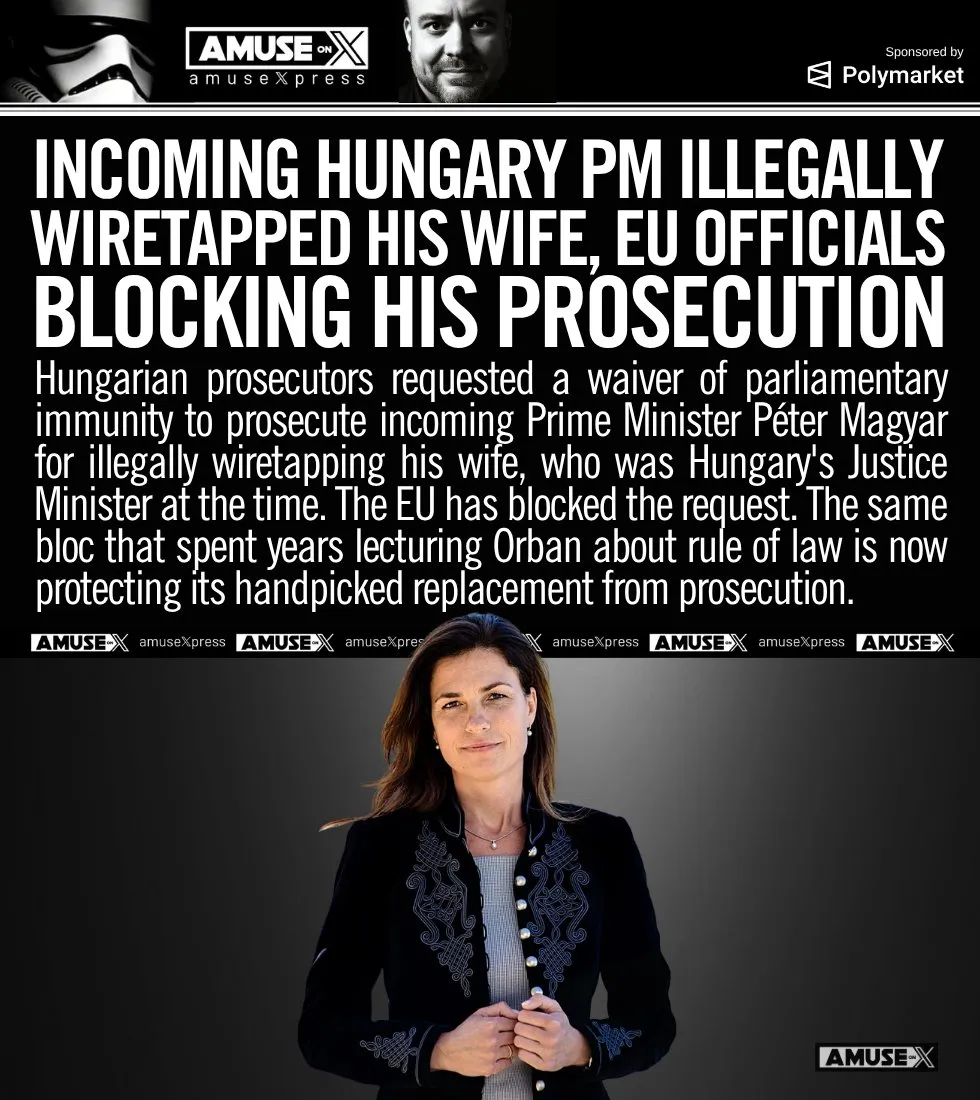
LOL, funny how it doesn't mention WHY Magyar tapped his wife, Judt Varga, who just happened to be in Orban's Party and was the Justice Minister. She had approved a presidential pardon trying to cover up a child abuse scandal.
A political scandal arose in Hungary on 2 February 2024, when it became public that in 2023 the then president Katalin Novák had pardoned Endre Kónya, the former deputy director of the Kossuth Zsuzsa Children's Home in Bicske, who had been convicted of helping to cover up child sexual abuse by his superior, by forcing one of the victims to withdraw their accusation. The case caused a major public outcry, and led to Novák's resignation as president of Hungary on 10 February 2024. Judit Varga, who was serving as minister of justice in 2023 and had countersigned the pardon, also resigned from her parliamentary seat and withdrew from her leadership of the Fidesz list for the 2024 European Parliament election in Hungary. Following Novák's resignation, Tamás Sulyok became her successor on 26 February.
https://en.wikipedia.org/wiki/Katalin_Nov%C3%A1k_presidential_pardon_scandal
BTW, why wasn't all of this covered before the election?
In summary, the Hungarian funds are conditional EU development money withheld under established internal rules to safeguard values and the budget; the Russian assets are external sanctions assets held against an aggressor state. The EU's approach to Hungary rests on solid legal legitimacy (with political controversy) and has been largely transparent procedurally, though implementation has drawn valid critiques of consistency and openness. With the post-election transition, the Commission has signaled readiness to release funds swiftly upon verifiable reforms.

If there is a good reason, I would sure like to hear it.
Disclaimer: Opinions posted on Free Republic are those of the individual posters and do not necessarily represent the opinion of Free Republic or its management. All materials posted herein are protected by copyright law and the exemption for fair use of copyrighted works.