Posted on 03/13/2026 8:06:27 AM PDT by Angelino97
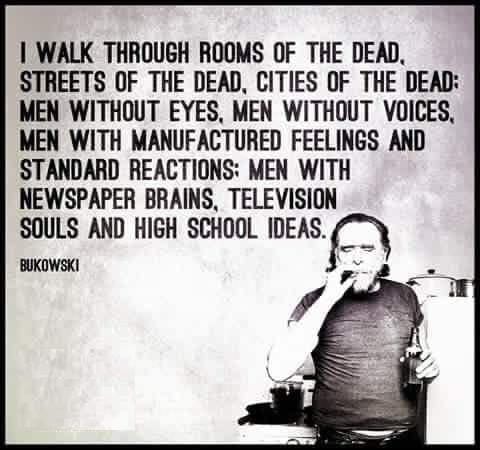
Monday marked the 32nd anniversary of the passing of Charles Bukowski from leukemia at age 73. Considering the life he lived, it is remarkable he lived as long as he did. Bukowski, whose rough but strangely captivating visage was best described by Paul Ciotti as “a sandblasted face, warts on his eyelids and a dominating nose that looks as if it was assembled in a junkyard,” was an author who defined outsider American literature in the 1960s and 1970s. Unlike his wholesome contemporaries, Ray Bradbury and E. B. White, Bukowski was a notorious womanizer with an aura of stale aftershave, Chesterfield cigarettes, and cheap wine.
Bukowski was a poet of considerable genius whose influence stretches from Tom Waits and Kurt Cobain to Hubert Selby Jr. and Chuck Palahniuk. His finest poems, like “Bluebird,” are steeped in whisky-soaked melancholy. Though he chronicled the bars, brothels, and shadowy hours of Los Angeles, he was still capable of sudden, startling beauty.
Today, Bukowski would probably struggle to get published. The new generation of literary gatekeepers would be inclined to reject his work outright. A major study of the American publishing industry found that women hold 74 percent of editorial roles, 78 percent of literary agent positions, and 71 percent of publishing jobs overall. Six of 10 executive-level positions in publishing are held by women. This chromosomal cartel has fostered a monoculture, leaving young male writers increasingly sidelined in an industry that often demonizes masculinity.
Few who enter the profession are poor Americans who grew up in the Rust Belt, but instead are mostly young white women, often from privileged backgrounds. While they may be intelligent and ambitious, publishing has long relied on unpaid internships that are accessible mainly to the affluent. This creates barriers to entry for those without generational wealth or a high-earning partner, as entry-level jobs (and often even more senior roles) tend to pay subsistence wages. New hires tend to be graduates of elite liberal arts colleges with degrees in English or creative writing.
For Bukowski, a writer’s real education came not from academia’s ivory towers, but from living “in the raw.” In Ham on Rye, his 1982 semi-autobiographical novel, he called the campus “a place to hide” where professors “crammed you with theory” and never told students “how hard the pavements were.” In an interview with The New York Quarterly, he summed up his anti-academic stance: aspiring poets should “stay the hell out of writing classes and find out what’s happening around the corner.”
Throughout his life, Bukowski worked a series of low-paying menial jobs—pickle factory, slaughterhouse, dog biscuit factory, truck driver, gas station attendant, and stock boy at Sears-Roebuck. He eventually secured steady work as a mailman for the U.S. Postal Service, a job he held for 14 years. During this time, he penned the column “Notes of a Dirty Old Man” for the LA Free Press. After Black Sparrow Press publisher John Martin offered him $100 a month to write full-time, Bukowski quit in 1970. He captured the drudgery and repetition of the daily grind in his first novel, Post Office, which he wrote at the age of 49.
Chuck Palahniuk takes a similar blue-collar approach. In Consider This—a mix of memoir and practical advice—he argues that most writing programs produce generic standardized voices. Chasing a degree, he says, strips away the uniqueness that connects writers to readers. Craft, for Palahniuk, is honed through repetition, much like any trade.
Were he alive today, Bukowski would have little respect for modern writers lounging in Starbucks, flashing their new laptops as they stare at blank screens over $10 lattes. He didn’t seek validation and hated crowds, calling them inauthentic. “I dislike real people … I hate them,” he wrote in Factotum. Secluded in his rundown apartment, he typed into the early hours, cigarette ash constantly falling onto his old Underwood typewriter. Despite, perhaps even because of his heavy drinking, he was productive, publishing six novels and at least 19 poetry collections in his lifetime. Since his death, roughly 60 volumes of his poetry and prose have been published.
Bukowski did not live to see the insidious rise of censorship strangling creativity in literature. For the laureate of American lowlife, writing should come from the heart and the gut—words bursting onto the page, not redlined by the censorious glare of sensitivity readers, fiction’s new moral guardian. Perhaps he was the last of his kind: a voice unafraid, burning bright against the darkening page.
Writing a tribute to Bukowski is fraught with contradictions. I own 30 of his books, poetry collections, and story anthologies, yet I hesitate to call him a literary hero. He loathed idolatry, detested sycophants and groupies at his readings, but above all, he despised mediocrity. “If you write dull shit, it doesn’t matter what you die from.”
I have noticed, when I browse bookstores, that almost all new fiction books are highly feminized. Either female themes by female authors, or if it's a male writer, the description promises a "strong, independent woman" main character.
” Either female themes by female authors, or if it’s a male writer, the description promises a “strong, independent woman” main character.”
I have a good friend who makes great money writing pre-teen books he readily admits are updated versions of essentially Tom Swift books with a female lead, which he writes under a female nom de plume (his wife’s name). He changes them enough to avoid outright plagiarism.
He struggles by with really good original books under his own name.
She has no involvement other than giving interviews, pretending to be the author, as she is too busy raising their kids.
Her maiden name also happens to be Hispanic, and she is distantly paternally Hispanic (grandpa).
Got to play the game.
I don’t read much.
I reread a lot.
Bukowski is worth rereading.
One of his strengths was he could write in the shorter form of poetry.
The 21st century has passed poetry by.
Poetry used to be a good start for writers of fiction.

With few exceptions, science fiction has been poisoned by an intolerant, woke gynocracy.
I don’t think I ever saw him, but in the mid 70s, I went to a couple of live readings in Boulder,CO and saw Ginsberg, Anne Waldman, Gregory Coso and William Burroughs.
That was a lifetime ago
That's why there's nothing good to read these days.
“It’s not that I’m antisocial
I just Feel better when
No one’s around. “
.
Bukowski
That's why there's nothing good to read these days.
He thinks like I do. My definition of Academic:
ACADEMIC (ak-uh-DEM-ik) An individual educated beyond his intelligence and unable or unwilling to provide anything of value to others who, while hiding out in a college, university or think-tank pontificates and expects to be paid for it, usually from public funds.
How is his realism different than that of Tolstoy? Is Bukowski merely a master of description? Or can he face the question of "What is man" as a problematic. Do you know? The Chronicles essayist doesn't say, so I presume neither he or Bukowski does either. It's a serious question for me as I just finished reading an essay by Walter Kaufman on Tolsoy where fingers the very essence of Tolsoy's characterization: they hide from themselves, on purpose. "He did not realize it, because it was too terrible to him to realize his actual position....[He] did not want to think at all about his wife's behavior, and he actually succeeded in not thinking about it at all . . . . He did not want to see, and did not see. . . . He did not want to understand, and did not understand. . . . He did not allow himself to think about it, and he did not think about it; but all the same, though he never admitted it to himself . . . in the bottom of his heart he knew. . . . "
And somehow it seems perhaps Bukowski makes peace with himself with the mass of a cigarette and a drink in his ability to describe the scene, but remains alienated from the imago dei because he cannot go face to face.
We'll try to stay blindWe badly need sex drugs and alcohol to forget ourselves, mostly all the time. Anna Karennina takes the long way home.
To the hope and fear outside.
Big publishing is in trouble, just like Hollywood and Big Media. If people are still reading in the future, what they read won’t come from the oligopoly.
The word of the Lord endures forever.
Bookmark
It was a portrait of a lowlife. Just the wanderings of a ne'er-do-well as he went from job to job (either getting fired because of poor performance or pilfering, or quitting because of laziness), bar to bar, and slut to slut. Occasionally he'd get into a bar fight, or spend a night in jail.
I suppose what you'd call "street realism."
I'm surprised this article praises Bukowski so much. But it's a trend I've noticed. The "underground" writer of a generation or so ago is celebrated as "really a conservative" today.
I've come across many articles about leftist writers of the past, whom some critic will celebrate as "really a conservative" (e.g., Jack London, Frank Herbert, Kurt Vonnegut).
Too bad he was a neo Marxist.
And I really didn’t find much of his writing that interesting.
The Movie BAR FLY seemed a waste.
Disclaimer: Opinions posted on Free Republic are those of the individual posters and do not necessarily represent the opinion of Free Republic or its management. All materials posted herein are protected by copyright law and the exemption for fair use of copyrighted works.