Posted on 12/08/2025 11:01:10 AM PST by MtnClimber
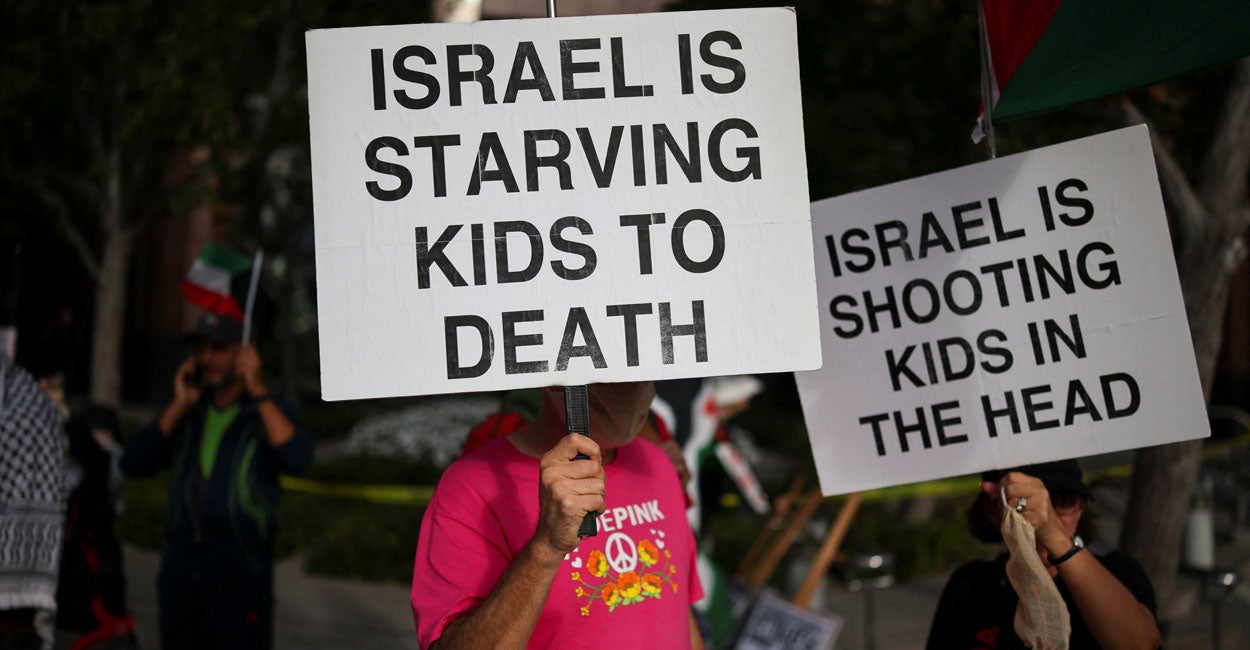
Pro-Palestinian demonstrators protesting outside the Consulate General of Israel in Los Angeles, Calif., Oct. 2, 2025.
There are two kinds of antisemites in the world: Those that hate Jews and know it, and those that promote the hatred of Jews and don’t. I learned about both one tragic October day in 1983. And on another tragic October day 40 years later.
I was the editor-in-chief of my college newspaper at the largest private college in New Jersey — Fairleigh Dickinson University—and my grandfather was of Lebanese descent, having come to America seeking a better life for his family. When 241 U.S. military personnel (including 220 Marines) were murdered in their barracks in Beirut in October of 1983—the deadliest day for U.S. Marines since the Battle of Iwo Jima — I had the temerity to defend America and Israel in print. And in classrooms and with my peers.
The terrorist group responsible for the attack had recently been formed with funding from Iran’s newly formed Islamic dictatorship. It was Hezbollah’s debut and put the little-known terrorist group on the map. I thought I was on solid ground when I called it what it was: a vicious attack against America for supporting of our ally in the region, Israel. It was an attack against the West. And all the West holds dear.
For taking that position in public and print, I felt the immediate wrath of my Arab peers, something I expected because antisemitism is so ingrained in the Arab world—Israel being the scapegoat for all that ailed the Middle East, with all the usual tropes. The kind propagated in Arab culture, literature and even comic books. Jews as devils. Jews as thieves. Jews as running America and the world. Ancient tropes that have haunted Jews through the centuries. I was soon ostracized by many Arabs on campus upset that I’d called out Arab antisemitism in public. I was tagged an “Uncle Ahab” by some, and a “Jew lover” by others.
The American casualties were tragic, my peers rationalized, but the real problem was American foreign policy. My Arab friends never said as much, but their underlying message was clear: America should stop defending and supporting Israel. Or face more attacks. That they had no such disgust for any of the Middle Eastern countries—or the ways those countries treated their own women or gays or Christians—was immaterial to them. Israel was their special obsession.
What surprised me most were the rebukes from white students and faculty, most from a small but growing hard-left contingency in the college’s liberal arts department. I’ll never forget the day they sat me down, intervention-style, and explained that taking sides with Israel and America reflected my own colonial mindset. My own white mindset. Both of which my family adopted without knowing it.
It started, they explained, with my grandfather’s choice to leave Lebanon for America. And to allow the folks at Ellis Island to change the spelling of his birthname from Habib to the less Arabic looking name, Habeeb. Did I not understand the subtle violence of that exchange? My dad, they continued, doubled down on the commitment to become more American, and less Arab.
They urged me to read a book that explained how the West had colonized not just my family and our minds, but how brown and black people around the world have been mistreated by the same forces. Forces that kept them poor and powerless.
“The Wretched of the Earth” by Frantz Fanon—recommended with the zeal a Christian would recommend the Bible to a nonbeliever—was popular on campuses across America at the time, and it was easy to see why. Susceptible readers were left by books’ end to choose sides: You’re with the oppressed or against them. With capitalism or for massive wealth redistribution from rich white colonial powers to poor brown and black colonized ones.
Fanon’s world was devoid of nuance, let alone human agency. Life happened to us, and there was little to do but overthrow existing power structures. Or become part of them. But this was real force and appeal in his work: A young person was granted instant and unearned moral superiority in Fanon’s neatly constructed universe, a kind of sanctification that in real religions requires work and sacrifice. This was heady stuff for young white suburban college kids away from their parents’ authority for the first time. His emphasis on psychology—and his use of religious language and metaphors—made his work especially attractive to rebellious young people in search of purpose and meaning.
My peers wanted me to join this quasi-religious cause, filled with primal passions and fears. Sin wasn’t the enemy in their sacred text—or Satan. Western civilization, capitalism, imperialism—and the Bible itself—were humankind’s enemies.
This worldview had the effect of promoting a new kind of antisemitism: hatred of Israel, not Jews. It was a very different—and dangerous—form of antisemitism than the virulent form Jews had experienced for millennia. One I believed then to be on the fringes of academic thought.
Then came the Oct. 7, 2023 savagery by Hamas that took the lives of over 1,200 innocent Jews—40 years after the October attack on America’s troops in Beirut. Many Arabs around the world celebrated the savagery, as expected. But it was the response to Israel’s military response—a strong show of military force in Gaza—that displayed how the oppressed/oppressor anti-colonial mindset of Fanon’s had metastasized in the West.
Watching college-aged students, aging faculty members and progressive warriors from across the social justice world lead chants calling for the destruction of the state of Israel, chants like “From the river to the sea,” shocked the world. They, like my friends and peers back in 1983, were quite confident that their efforts weren’t grounded in antisemitism. Their beef, they would tell you (and themselves) is not with Jewish people, but the state of Israel.
That it was the Jewish people’s scared texts—and ethical monotheism itself—that inspired Western civilization is lost on them. As is the fact that Israel itself has played a central part in the formation of the Western world and mind. It’s impossible to separate the reality of the world’s only Jewish state from its own Jewish roots.
Equally disturbing is a new strain of antisemitism on the Right, much of it masked in a muscular “America First” policy. Embedded in this new strain is the belief that some of America’s problems—especially in the Middle East—have the state of Israel as its source. Like the new strain from the hard Left, this form of antisemitism from the isolationist wing of the GOP promotes antisemitism unwittingly. Believers insist that Isreal is no different from any other nation in crisis—think Ukraine or Haiti. And that there should be no scared bond with America and anyother nation—including Israel.
Add to that a strange form of antisemitism arising from within a younger generation of evangelical Christians—and some older ones too—who believe the birth of Christ somehow invalidated the Old Testament. It’s an absurd idea, one that most Christians of every denomination refute. If anything, the bond between the vast majority of America Christians and the state of Israel has never been deeper.
So, what do we do about these two forms of antisemitism—old and new? From the Left and to a lesser extent the Right? The answers aren’t simple. The old and persistent kind of antisemitism—the ancient variety of deliberate and willful antisemitism—will probably be around another millennia if history is any judge. Though at least in the Arab world—thanks to the Abraham Accords—there are real glimmers of hope.
The new kind is best approached through ongoing debate, discussion and education. Maybe even a grand national debate and public relations project on the subject. There’s never been a better time—or reason. And never have there been more able and talented people on the Left and Right—and Christians too—to do it. Any takers?
Lee Habeeb is a Newsweek columnist, vice president of content at Salem Media Group, and host of “Our American Stories.”
The left always sides with evil.
Aantisemitism is a general term used to describe prejudice against Jewish people.
The word was coined in 1879 by German journalist Wilhelm Marr. It is a historical and widely used term with a common definition. As a part of the public lexicon, the word can be freely used by anyone in speech, writing, and publications.
While the word itself is not copyrighted, specific organizations may have trademarks on their names or slogans that use the word.
The Anti-Defamation League (ADL) holds trademarks for phrases like “ADL GLOBAL 100 AN INDEX OF ANTI-SEMITISM”.
Various organizations and governments, including the U.S. Department of State, use a non-legally binding “working definition” of antisemitism for monitoring and educational purposes, but does not restrict the use
of the word itself.
ADL’s Copyrights and Trademarks
The following are registered trademarks of the Anti-Defamation League: ADL. ANTI-DEFAMATION LEAGUE. CURRENT ADL LOGO TREATMENT. NE...
Anti-Defamation League
“The Origin Story - Understanding Antisemitism
The Big A.” Let us help you unpack the realities of antisemitism—what it is, how it manifests, and why understanding it is essentia...
SEE-—Maas Center for Jewish Journeys
Defining Antisemitism - United States Department of State has used a working definition, along with examples, of antisemitism since 2010.
Why not simply say anti-Jewish?
The citizens of Saudi-Arabia are semites.
She is Arab and there are “Christians” who think she is subhuman even if she shares the faith, yet she fails to mention that category.
There are also Israelis and Jews who don’t cheer on every single policy of their government’s.
He* is Arab and there are “Christians” who think she is subhuman even if she shares the faith, yet she fails to mention that category.
There are also Israelis and Jews who don’t cheer on every single policy of their government’s.
The term “antisemitism” was coined in the late 19th century by German journalist Wilhelm Marr to give a seemingly “scientific” and modern name to traditional Jew-hatred.
It was specifically intended to refer to prejudice against Jews as a supposed race, not as a religious group, which made it distinct from older forms of religious anti-Judaism.
Key Reasons for the Terminology
Shift from Religious to Racial Prejudice: Traditional hostility toward Jews was often religious in nature (anti-Judaism), meaning conversion to Christianity could resolve the prejudice. In the late 1800s, new pseudo-scientific racial theories, influenced by Social Darwinism and eugenics, began to classify people into distinct “races”. Proponents of this new ideology, like Marr, viewed Jews as an unchangeable, inferior, and dangerous “Semitic race,” regardless of their religious beliefs or level of assimilation.
A “Scientific” Sounding Term: Marr used the new term Antisemitismus in 1879 to replace blunter terms like Judenhass (Jew-hatred), hoping the academic-sounding word would lend intellectual legitimacy to his political movement and appeal to a secular, modern audience.
Political Agitation: Marr founded the “League of Antisemites” (Antisemiten-Liga), the first German organization dedicated to opposing the alleged “Jewish spirit” and influence in Germany. The term became widely used by other anti-Jewish political movements throughout Europe.
The Misnomer of “Semitic”
It’s important to note the technical inaccuracy of the term:
Linguistic Roots: The word “Semitic” actually refers to a family of languages (including Hebrew and Arabic) and the peoples who speak them, not a single race or group.
Exclusive Application to Jews: Despite the broader linguistic definition, from its inception, the word “antisemitism” was used exclusively to mean prejudice against Jews. The people who coined and popularized the term focused solely on Jews, largely divorcing the word from its original linguistic context. The term has never been used to describe prejudice against Arabs or other Semitic-speaking peoples.
Today, the unhyphenated spelling, antisemitism, is preferred by many scholars and institutions (such as the International Holocaust Remembrance Alliance and the Anti-Defamation League) to emphasize that there is no such entity as “Semitism” that it opposes, and to treat it as a unified, specific term for anti-Jewish hatred.
“antisemitism ... as a unified, specific term for anti-Jewish hatred.”
In plain modern English, anti-Jewish.
Disclaimer: Opinions posted on Free Republic are those of the individual posters and do not necessarily represent the opinion of Free Republic or its management. All materials posted herein are protected by copyright law and the exemption for fair use of copyrighted works.