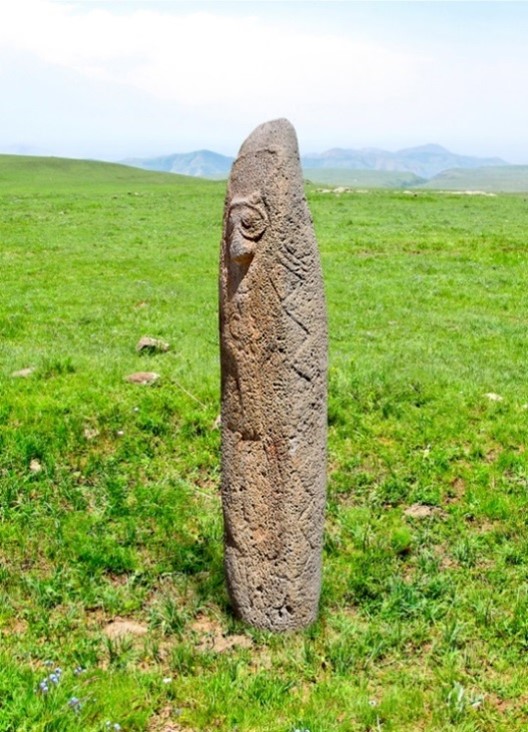
Standing vishap at the site of Sakhurak 5, ArmeniaV. Gurzadyan & A. Bobokhyan 2025, npj Heritage Science
Standing vishap at the site of Sakhurak 5, ArmeniaV. Gurzadyan & A. Bobokhyan 2025, npj Heritage Science
Interesting
“This led them to conclude that they must have been associated with ancient water cults and rituals that celebrated water as a life-sustaining force. Frequently clustered at high altitudes, specifically at either 6,200 or 8,800 feet above sea level, the monoliths were likely placed symbolically near sources of the snowmelt that provided water for agricultural communities in the valleys below. In the past, it had been difficult to determine exactly how old these monuments were, but new radiocarbon dating ...”
—
led them to conclude ... they must have been associated ... were likely placed ... symbolically ... radiocarbon dating
Stone is dated with optically stimulated luminescence (OSL) - very expensive, but far better that radiocarbon dating which only dates carbon, leading to massive assumptions that are usually proven wrong later.
They still have no idea when or why the stones where made and placed there - but they are now eligible for more grant money having “solved” a major problem. Archeology and many scientific disciplines are riddled with this sort of thinking - fitting some facts into a per-existing theory and ignoring all others to look great and get ahead of other people in the discipline.
Decades from now, someone is going to look at my rock encircled flower bed that has a granite post in the middle of it, and decide it is connected to an ancient religious ceremony.
It’s just a flower bed and I thought the granite post looked neat in the middle of it.
“the monoliths were likely placed symbolically near sources of the snowmelt that provided water for agricultural communities in the valleys below.”
Or they were actual snow gauges that helped them predict how much run off they would would have for the upcoming growing season or flooding risks.
Maybe they had practical reasons for placing them.
4200 to 4000 B.C. would be before Armenian had emerged as a distinct language. It’s part of the Indo-European language family, which seems to have been spoken in what is now southern Ukraine and southern Russia about that time, but some experts have argued that the ancestral language to Proto-Indo-European might have been spoken further south earlier, so it may have included the area of Armenia.
Awesome image. Bump for later.