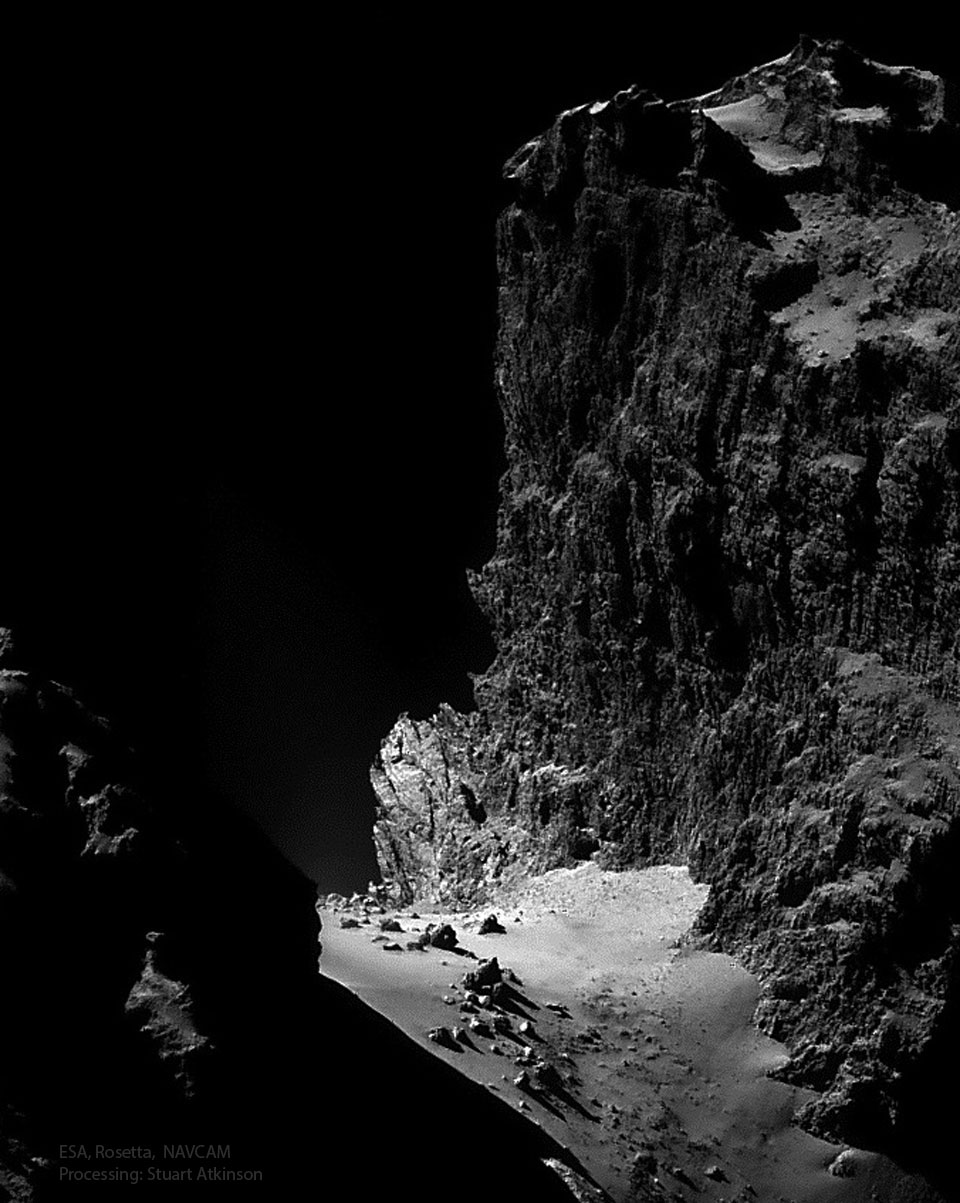
For more detail go to the link and click on the image for a high definition image. You can then move the magnifying glass cursor then click to zoom in and click again to zoom out. When zoomed in you can scan by moving the side bars on the bottom and right side of the image.
Looks like a great place to practice my free fallin’
Data from Rosetta indicates that the ice in Comet CG has a significantly different deuterium fraction — and hence likely a different origin — than the water in Earth’s oceans.
—
The novel theory that our oceans formed from comets continues to be challenged by the observational evidence. It seems that water was an abundant compound during the formation of the planets and moons.
After the Sun went through its T-Tauri phase and the Earth’s volatile primordial atmosphere was blown away, subsequent outgassing from increased volcanic activity would have injected ~100 bars (atmospheres) of water vapor into Earth’s atmosphere. Once the atmosphere cooled to saturation vapor pressure, the water vapor would have rained out to form our oceans. The oceans provided a crucial component for a habitable planet and the emergence of life.
The oceans continue to stabilize Earth’s climate to ensure that the environment does not become hostile to life. The presence of a large moon and a strong magnetic field are important too. That and the fact that the Sun emits a significant amount of light in the visible region of the electromagnetic spectrum. The oceans are most transparent to light in the visible range of the electromagnetic spectrum, an inherent property of water. We really do live on a Goldilocks planet.
But the pseudoscientists prefer to propagate their precious theory that the oceans came from comets; most likely to push their ad-hoc theory that life came from comets too (panspermia). If a theory does not agree with experiment, the theory is wrong. I don’t care who thought of it, what his name is, or how beautiful the theory is. If it does not agree with experiment, it’s wrong. In that simple statement is the key to science. [1]
1. See Richard Feynman