Moon landing denialism is so tiresome. The "petrified wood" story, for example ... all of the moonrocks given by NASA to foreign countries were embedded in lucite blocks and looked like this:

(I have personally seen one of these.)
So what happened? The "petrified wood" is either someone's idea of a joke, or the real sample was stolen and replaced by a counterfeit. It was apparently given personally to the Danish PM by the American ambassador, and went to the Danish national museum on the PM's death. It's fake, but it doesn't follow that all of them were fake, especially since this looks like an obvious (and poor) counterfeit.
The "pen-like" object is the OPS actuator. It didn't detach from the PLSS umbilical (rectangular box). I've seen them in black, and also in metallic:
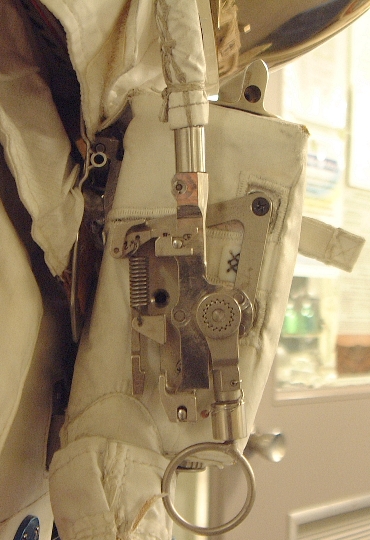
I don't know where your white one came from. Photographic distortion, or a different suit, possibly on a different mission? Can you point me to the right-hand picture on an actual NASA photo archive site for Apollo 11?
There is copious evidence of NASA's fakery with regard to the claimed lunar landings. It doesn't befit respectful debate or a scholarly response to be lumped together and swept away on the basis of a pejorative such as yours, that it's "so tiresome." NASA being a (DEI) "muslim outreach" more befits its activities.
Here's proof positive of photo imagery manipulation by NASA or its contractors, as seen when one merely manipulates the contrast on an original Apollo 11 image:
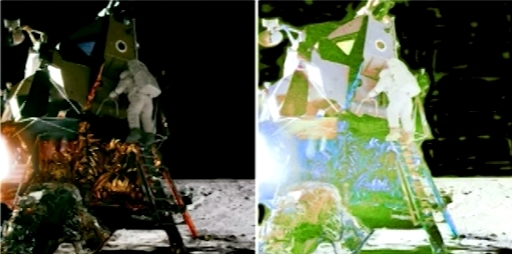
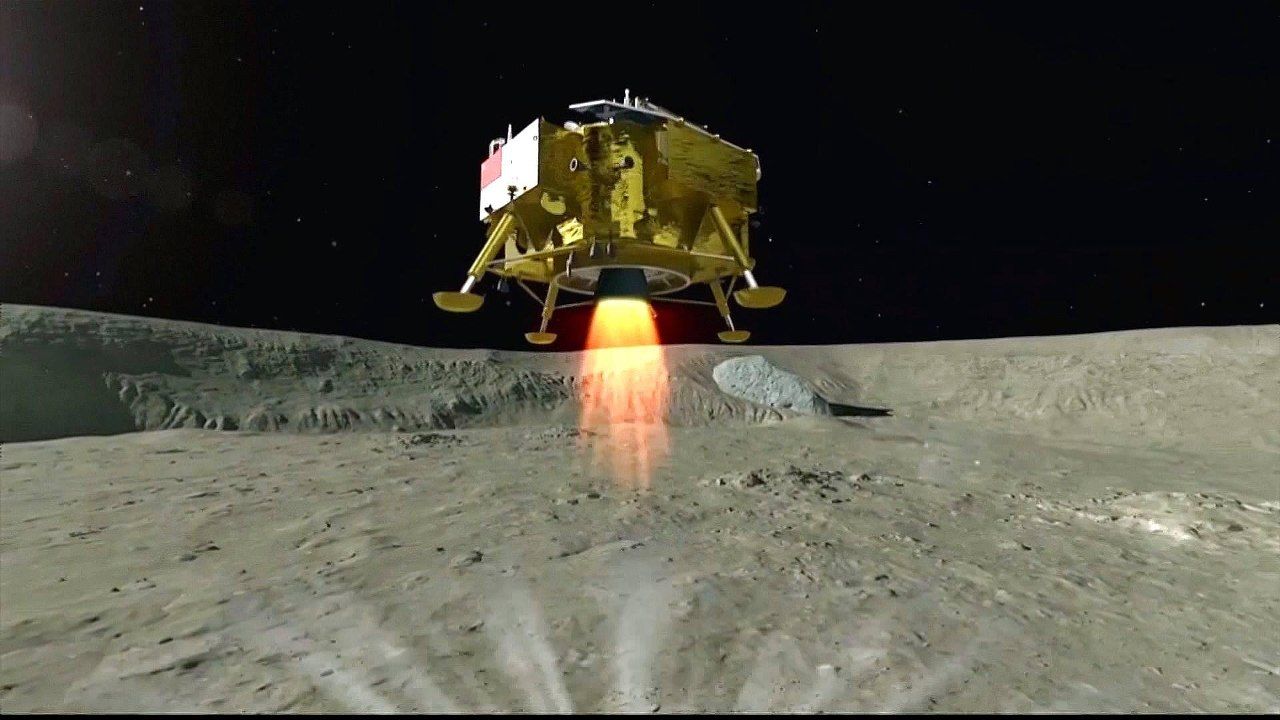
One dared not have any interior wall reflections being mistaken for stars that the Apollo 11 astronauts claimed they couldn't see, even though such were plainly visible to the Chinese lunar lander's camera. (Its photo #:x720-AGs-d2fefe8a-1489658296)
With regard to the mechanical mounting of the OPS actuator, one can see from your photograph that no unidirectional vertical shifting is possible relative to the structure to which it's attached, yet that's what one clearly can see as one of the differences in the two Aldrin images.
What's your authoritative source to claim all lunar material shared was encased in a rounded Lucite block?
Here's an official NASA astronaut and spokesperson giving the company's puerile response for what happened to the technology that allowed it to go to the moon and why it hasn't gone back to the moon in 40 years:

Here's the official number of that photo: AS11-40-5873.
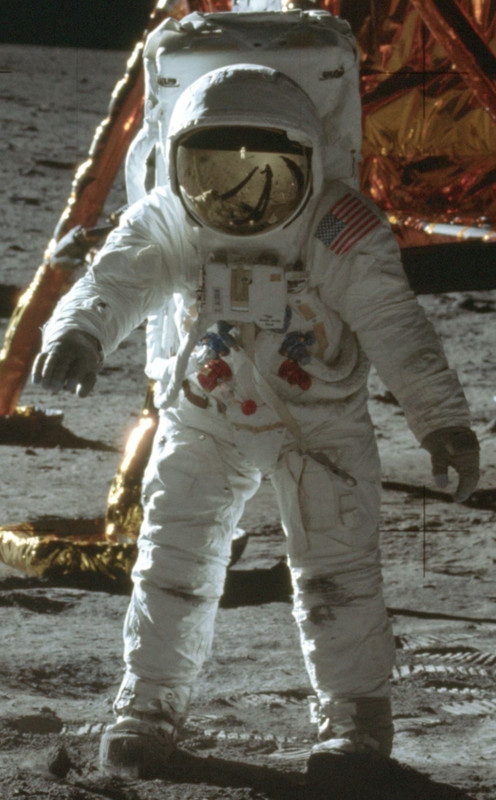
Furthermore, there isn't enough moisture in lunar regolith to cohere as those footprints above would appear to demonstrate. Despite NASA claiming to have several kilograms of regolith, when NASA tried to demonstrate Neil Armstrong's supposed "first step" in an Apollo 11 documentary, it had to use what the video's narrator called "simulated regolith." Actual regolith, devoid of moisture, would have made footprints appear as do footprints in the desert: