Posted on 11/08/2023 11:12:57 AM PST by nickcarraway
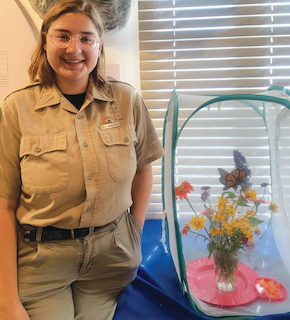
Lily Aravanis is fielding visitor questions, selling butterfly paraphernalia and on this Wednesday afternoon talking to a reporter all at once—still, she doesn’t skip a beat as she says that there are an estimated 3,500 monarch butterflies at Natural Bridges State Beach.
It’s the busiest time of the year for the small visitor center according to Aravanis, a marine biologist who works behind the desk at Natural Bridges.
From the end of October to December, people from around the world come to see the monarch butterflies that are flying around Santa Cruz, concentrated in a few groves around the city. It’s only 1pm and the Natural Bridges gift shop and visitor center has been open for an hour, but already Aravanis says she has helped around 130 customers.
This is the best time of year to see the butterflies, Aravanis says, as they are still out flying from plant to plant as they try and stock up on food before going into hibernation.
“They’re still in their stage where they’re trying to fatten up as much as they can, so you’ll see some clusters, but you’ll also see them flying,” Aravanis says.
The butterflies will continue to arrive in the city and gather in groves up until the end of November, when they go into hibernation. Last year around this time there were an estimated 7,000 monarchs, but Aravanis is optimistic with the number of butterflies staff has counted in the groves so far—especially considering the storms earlier this year.
Before January of this year, Santa Cruz had around 8,000 monarchs hibernating throughout the city. After the series of storms that began New Year’s Eve last year, that count dropped to around 2500. Aravanis says that the drop in numbers could have been attributed to various factors, not all related to death: some monarchs could have blown to different areas, for instance.
Still, overall trends show the monarch population declining—largely as a consequence of climate change causing weather extremes, like wildfires and storms.
“Monarch butterflies are kind of like Goldilocks,” Aravanis says. “They really need an area that’s not too hot, not too cold. So if you start getting areas with more extreme weather patterns, then there’s going to be less places for them to survive.”
When Monarchs go into hibernation in winter months, Aravanis explains, they do so to conserve their energy to continue their trek down the state and into Mexico. More extreme weather likely means more movement—which, when considering that the butterflies migrate from as far north as Canada to central Mexico, can mean life or death.
“They have huge migrations, it’s a lot for a person to do that distance, and they’re butterflies,” Aravanis says. “They have a lot of environmental factors that are working against them, but they persist anyways.”
The other challenge is habitat loss, she says.
“We need to be protecting our groves making sure that they’re not being cut down, or the trees when they fall down that they’re replaced,” she says.
Aravanis, who graduated from UC Santa Cruz and would spend her spare time examining the tide pools at Natural Bridges, says that before she worked at the visitor center, she didn’t appreciate the butterflies as much.
“I didn’t realize just how cool it was. But the butterflies are really special. There’s something about them and like I have a science brain I don’t use the term magical lightly,” she says. “But there’s something about hanging out down the grove and watching the butterflies and it really kind of is magical.”
i was living on St.Croix when one morning all you could see where white butterfly’s everywhere
i thought they were migrating but found they are natives
“the ones here – Ascia munuste eubotea – are homegrown and not migratory. But they are definitely seasonal.”
it truly was beautiful though
Butterflies eat rotting fruit, dung, carrion and mud. Perfect! The streets are paved with dung

Ping
Butterflies are also pollinators.
Saw them this past weekend in Carmel
Carmel or Pacific Grove?
I barely had any Monarchs this year. Also had fewer milkweed plants come up this year. Probably was the reason I saw so few Monarchs.
I’ve been plating milkweed and other plants that attract butterflies this year.
I had planted some several years ago, and it would keep coming up every year on its own. The last two years haven’t been very good, but this year was the worst. I will probably have to buy new milkweed plants next year when it’s time. I have sure enjoyed watching the Monarchs go from egg to butterfly in past years. They are a fascinating species.
Crossroads in Carmel and the lighthouse in PG
“Butterflies eat rotting fruit, dung, carrion and mud.”
__________________________________
Indeed they do. I just installed a butterfly pond in the garden at my church. The ingredients are sand mixed with steer manure and a few pieces of fruit (bananas amd oranges). Then just add water and the butterflies flock to it.
Great to see!
Of course, the author just HAD to get this in: “overall trends show the monarch population declining—largely as a consequence of climate change causing weather extremes, like wildfires and storms.”
“Monarch butterflies are kind of like Goldilocks,” Aravanis says. “They really need an area that’s not too hot, not too cold. So if you start getting areas with more extreme weather patterns, then there’s going to be less places for them to survive.”
For five years, there were declining monarchs at Natural Bridges and Pacific Grove, and it got to the point there were almost none. The last year or two there are many.
It probably has a lot more to do with declining habitat than anything else. I understand they are pretty fussy about their diet.
I wonder where they overwintered before eucalyptus were introduced.
The history of eucalyptus in CA is interesting. I remember going on a ranger hike in Golden Gate Park when I first arrived in SF in 1973 and learning about it. The ranger popped a nut in his mouth and said it was good for soothing sore throat. Good summary from the Santa Barbara Independent...
...the California Gold Rush of the late 1840s and early 1850s created high demand for wood for constructing buildings and for fuel. Deforestation had become a serious concern, so much so that the California Tree Culture Act of 1868 was created to encourage people to plant more trees, particularly along roads. Many entrepreneurs rushed to capitalize on the situation.I remember that ranger at GG Park telling us the wood was brittle and shattered when the trees were cut down.Ellwood Cooper’s role in spreading eucalyptus: Ellwood Cooper, educator, entrepreneur, and one of the key individuals who helped the eucalyptus take off in California, is a local legend here in Santa Barbara. After seeing eucalyptus in the San Francisco area, Cooper settled down in Santa Barbara in 1870. On his ranch, among many different types of produce trees (including olives, walnuts, and figs), he grew over 200 acres of eucalyptus. The eucalyptus forest he started lives on to this day at the Ellwood Bluffs. Cooper became a vocal advocate for the eucalyptus, emphasizing its unique, aesthetically pleasing appearance, as well as its useful qualities. He even wrote the first book in the U.S. on the trees. Eucalyptus became very appealing to foresters in the 1870s and 1880s as native hardwoods were being severely depleted.
Starting in the 1870s, the first large-scale commercial planting of the blue gum eucalyptus (E. globulus) began. The blue gum, a mid-sized eucalyptus reaching around 150 to over 200 feet tall, is the most common eucalyptus in California. These trees are easily recognized by their waxy blue leaves and a grayish bark which reveals a smooth, contrasting yellowish surface when the bark sheds off in long strips. As with many other eucalyptus species, sprouts can grow back from a fallen tree stump.
By the early 1900s, the get-rich mindset had caused many aspiring forest tycoons to plant countless acres of eucalyptus in hopes of selling the timber for a tidy profit. It’s estimated that there were over 100 companies involved in the eucalyptus industry at this time, and they changed the landscape of much of California.
But investors were soon to discover that the eucalyptus weren’t all they’d hoped them to be.
Sadly, most of these schemes went the way they infamously did for Frank C. Havens. Havens was an Oakland developer who opened a mill and planted eight million eucalyptus trees in a 14-mile-long strip from Berkeley through Oakland. But when he came to sell the timber, it was found that the trees were too young to make suitable wood; the young wood had an irregular grain and it bent, cracked, and shrank when dried. It is true that eucalyptus trees from Australia could make good timber, but those trees were decades or sometimes centuries old. It was soon found that eucalyptus trees would need to be at least 75 or 100 years old for good lumber. The young wood didn’t even make useable fence posts or railroad track ties, both of which decayed rapidly. Havens closed shop.
Other options for selling California-based eucalyptus products were grim. In the early 1920s, it was realized that California eucalyptus oil wasn’t nearly the same quality as foreign-made oil, again mainly from Australia. The wood became increasingly sold just for fuel, but cheap electricity and gas soon replaced it. By 1950, eucalyptus trees were primarily grown in California as ornamentals or windbreaks. The trees had failed to live up the many premature claims and hopes.
To answer your question, I found this in "Bay Nature"...
Why Do You Find So Many Monarchs on Eucalyptus Trees?
By Liam O'Brien
January 16, 2018Monarch butterflies seem to prefer roosting in eucalyptus trees (like the wintering butterflies at Ardenwood Farm and Pacific Grove). Do they actually prefer them as a roosting spot, and if so, why? – Beth S.
First off, points to you for using the word “prefer” instead of the anthropomorphic “like.”
Even better is “show a preference for” eucalyptus trees. Beth, it’s generally believed that it comes down to their legs — long and the perfect length to hold onto the sickle-shaped eucalyptus leaf.
Researchers have concluded that Monterey pines and cypresses were probably the monarchs’ original roost trees here in California. Other native conifers as well. (I once witnessed a handful sleeping up in a palm tree! ) But if this celebrated butterfly has shown us anything, it’s that it’s got a magnificent ability to adapt. Back when blue gum (Eucalyptus globulus) flooded California and was planted as an ill-conceived lumber commodity, many of our pines had been milled away, left only in patchwork portions of the state. The butterfly made a remarkable shift then to the towering, Australian non-native.
Thanks for the information. Best discussion I’ve seen on the topic. Euc is some of the best firewood I’ve run across. Lights with a match and less ash than madrone. My father in law used to cruise the parking area near stanford stadium and load his ‘60 ranchero with branches and feed their fireplace.
Those are smart butterflies. They got thrown out of their Monterey Pine homes and they didn’t go homeless. They got right to work and found new homes in the Eucalyptus. Unlike some other species we know about.
Disclaimer: Opinions posted on Free Republic are those of the individual posters and do not necessarily represent the opinion of Free Republic or its management. All materials posted herein are protected by copyright law and the exemption for fair use of copyrighted works.