The simple cryptograms we use here are called monoalphabetic ciphers. Every letter is mapped to another arbitrary letter, though usually not to itself. While much more secure than a simple Caesar Cipher, they are not really very secure.
An alternative is a polyalphabetic substitution, where sequential letters were mapped to different letters, but the pattern repeated after a number of cycles. Thomas Jefferson designed a device useful to implement such ciphers.

In the illustration, A is replaced by Q in the first character, of the cipher text, H in the second, J in third and so on, returning to Q for 12th character. Our monoalphabetic ciphers are equivalent the Jefferson Cipher, if we only used one base wheel and one code wheel. This form of encryption is more secure than monoalphabetic, but with enough cipher text, it can be broken. The Confederate Army used a form cipher, which was based on a Caesar cipher, but changed the shift in a repeated pattern based on a key phrase. but tended to reuse the same keys. ("Manchester Bluff", "Complete Victory", "Come Retribution"). The key indicates the first letter of the associated Caesar code. In the case of "Manchester Bluff", A would be replaces by M in the first letter of the cipher text, A in the second, N in the third, and so forth.
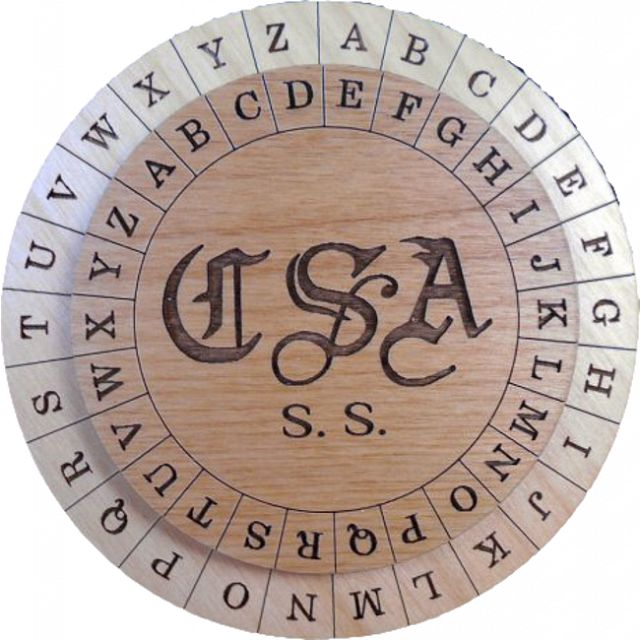
The CSA form of cipher is inferior to the Jefferson cipher, but far easier to implement. However, its effectiveness was limited by repeated use of the same keys.