
Posted on 04/09/2023 7:59:24 AM PDT by Jim W N
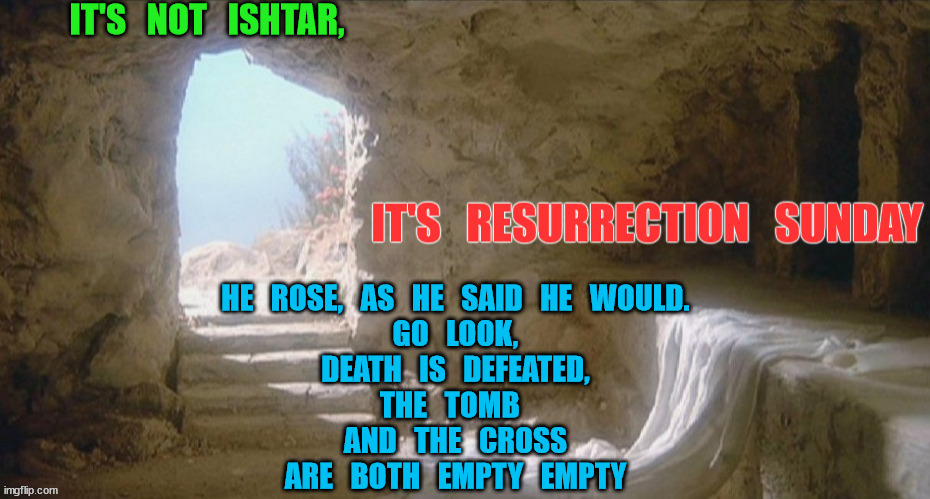
Happy RESURRECTION SUNDAY.
For those in Christ every day is resurrection day in our new life with Him as new creations by Him.
we are buried with him by baptism into death: that like as Christ was raised up from the dead by the glory of the Father, even so we also should walk in newness of life. For if we have been planted together in the likeness of his death, we shall be also in the likeness of his resurrection: knowing this, that our old man is crucified with him, that the body of sin might be destroyed, that henceforth we should not serve sin.Romans 6:4-6.
Death is behind us and before us is continuing resurrection life in him here now and later, after we are raptured, in Heaven.
O DEATH WHERE YOU STING? O GRAVE, WHERE IS YOUR VICTORY? 1 Cor. 15:56.
Amen 🙏🏻!!!!
Bump.
Isaiah 53
Like a Lamb that is led to Slaughter...
.
And Yet He’s Alive for Evermore!

As a side note, this photo is of the NY City skyline on Good Friday, 1956
How far we have fallen as a nation. It will be a miracle if we escape the fate of Sodom and Gomorrah
Wow......
Far indeed.
An Easter Sunday School Lesson
St. Peter’s Basilica
How did Peter, an ordinary Galilean fisherman and religious Jew become the namesake for the beautiful and historic church that dominates Rome today? Peter was Jesus’ foremost student; that could account for a lot. But, shortly before Jesus’s death, Peter denied he knew Jesus three times. What happened that changed and transformed this broken and weeping man?
A clue could be found in Paul’s letter to the church at Rome written about 30 years later. Paul explains, in his own inscrutable style, that Peter, as a believer, was somehow actually united with Jesus in his death and resurrection and was to consider himself “dead to sin.”
“For if we have been united with him in a death like his, we shall certainly be united with him in a resurrection like his...So you also must consider yourselves dead to sin and alive to God in Christ Jesus.” Romans 6:5, 11 (ESV)
Dead to Sin
What does it mean to be “dead to sin?” Historically, man’s problem with sin began all the way back in Genesis when Adam disobeyed God in the Garden of Eden. Sin and its consequences have plagued man ever since. It is an easy doctrine to demonstrate. G. K. Chesterton wrote in Orthodoxy that “the ancient masters of religion…began with the fact of sin—a fact as practical as potatoes. Whether or no man could be washed in miraculous waters, there was no doubt at any rate that he wanted washing.” And, one of the main consequences of sin is the feeling of guilt.
For example, a little five year old boy, when it was his turn, would always bless the food at the family dinner table. But one day, for two nights in a row he couldn’t do it. It wasn’t that he wouldn’t do it, it was that he couldn’t do it. Later that night as his dad put him to bed, the boy told his dad he had taken what was a very inconsequential little toy from his best friend’s house. No one knew he had done it and very likely no one would have ever known it was missing. What was the boy feeling? Guilt. Not surprisingly, the next night, after the boy returned the toy to his friend and asked for forgiveness, he easily blessed the food. Until he had received forgiveness, the boy was weighted down under guilt—he was under the penalty of sin. Once his friend forgave him, he became “dead to sin.” What a simple but powerful demonstration of what sin can do. It can prevent a young boy from being able to say a simple prayer. And what a demonstration of what forgiveness can do.
Peter Becomes Dead To Sin
On that first Easter morning, when Mary Magdalene told the disciples that the tomb was empty, Peter and John immediately ran to the tomb. John got there first but did not initially enter; when Peter got there he went straight in. When John did go in, he saw and believed. The Bible doesn’t say Peter believed at that time. Sometime later that day Jesus met privately with Peter but it is not recorded what they talked about. That evening Jesus appeared to many of the disciples, including Peter. After Jesus’ resurrection, Peter was never the same. The tremendous guilt that he had borne for the couple of days since he denied Jesus was gone. In fact, as in Paul’s words, the old Peter had “been united with him in a death like his” and a new Peter had “been united with him in a resurrection like his.” Peter was no longer a prisoner of his guilt; he was dead to sin. He was still an ordinary Galilean fisherman and religious Jew. But, it was the new and transformed Peter that the Romans honored with their beautiful church that dominates their city to this day.
Harris Teeter Supermarkets have a new add today.
It features a lyric, Come on get Happy, Get Ready for the Judgement Day!
https://www.youtube.com/watch?v=2U-rBZREQMw
He is risen indeed.
Amen, thank You Lord!
Thank you for sharing that.
I’m not much on religion but these passages seem to hit the mark.
In Christ, we are ALL dead to sin. Then why do some like “new” Peter seem free from guilt and condemnation while others like the “old” Peter seem still bound?
The answer is receiving the grace of Christ and I think Hebrews, Paul’s letter to the Jews, tells us how God’s grace is fleshed out as it was with Peter.
It has to do with our conscience which demands a satisfactory answer and will not take a lie as an answer. A conscience of sins is an “evil” or “guilty” conscience. A good conscience has no more conscience of sins.
The word “conscience” is mentioned five times in Hebrews.
- The blood of Christ purges our conscience from dead works and “sprinkles our hearts from an evil conscience” (Heb. 9:14, 10:22).
- “[N]o more conscience of sins.” Heb. 10:2.
- “a good conscience” Heb. 13:18.
The word “perfect” is mentioned 12 times and “perfect” and “conscience” are linked.
- “perfect as pertaining to conscience” Heb. 9:9.
- Made “perfect” because of “no more conscience of sins” Heb. 10:1-2.
The issue in the church today is a nod to “grace” while still trying to “be good” or “keep the law” or “must do right”, not realizing that we have already been made the righteousness of God through Jesus’ fulfilling the law with a perfect work as a gift to us by faith, not our works or self-effort (Rom. 5;17; 2 Cor. 5:21). Trying to keep the law is symptomatic of an evil or guilty conscience of one who has not fully embraced the complete, finished, and perfect work of Christ. That person is trying to perfect a perfect work and finish a finished work. Those efforts are called “dead works”.
Jesus is our righteousness (2 Cor. 5:21). Our freedom does not depend on our efforts but his effort on our behalf.
Condemnation (guilt on steroids) is the root of the problem. Once we accept Jesus’ perfect work, complete forgiveness forever, and his gift of NO CONDEMNATION EVER, “conscience of sins” will melt away and we can live victorious lives with a “good” conscience knowing God NEVER holds any of our sins against us. Peter does not have a corner on this market. WE are free!
God bless.
Disclaimer: Opinions posted on Free Republic are those of the individual posters and do not necessarily represent the opinion of Free Republic or its management. All materials posted herein are protected by copyright law and the exemption for fair use of copyrighted works.