Skip to comments.
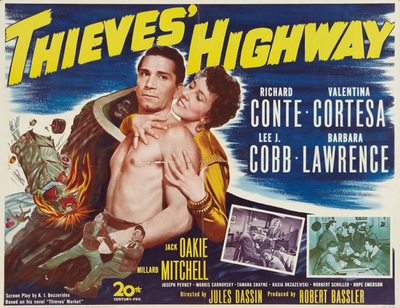
Grimmer by the Pound: Jules Dassin and Thieves' Highway
Steyn Online ^
| 26 Mar 2022
| Rick McGinness
Posted on 03/26/2022 3:27:54 PM PDT by Rummyfan
It's easy to forget that the years after the end of World War Two in America weren't just a quick change of gears from the arsenal of democracy to the economic boom. This uneasy, decade-long period might have been forgotten if weren't for film noir. Even though it had its genesis in pictures like The Maltese Falcon (1941), Shadow of a Doubt (1943) and Double Indemnity (1944), it was a genre in search of an era, and it found it with the return of the first demobbed G.I.
Former soldiers appreciate Nick Garcos in Thieves' Highway, director Jules Dassin's 1949 story about wildcat truckers hauling produce to markets in big cities like San Francisco. When we first see Richard Conte's Nick, he's getting out of a cab outside of a ramshackle house in a working class suburb carrying a duffle bag and a pile of boxes. He's just returned from sea – a stint working as an engineer on a freighter in the Far East, though we learn later that he served in North Africa and Europe, and that this probably isn't his first homecoming.
These homecomings were a recent memory for millions of Americans, enshrined in Norman Rockwell paintings and analyzed in movies like The Best Years of Our Lives (1946). It's a moment of real joy for Nick and his family, shattered when he gives his father a pair of slippers, only to discover that the old man, an independent trucker, lost his legs in an accident while he was away.
(Excerpt) Read more at steynonline.com ...
TOPICS: Miscellaneous; Music/Entertainment; TV/Movies
KEYWORDS: movies; steyn
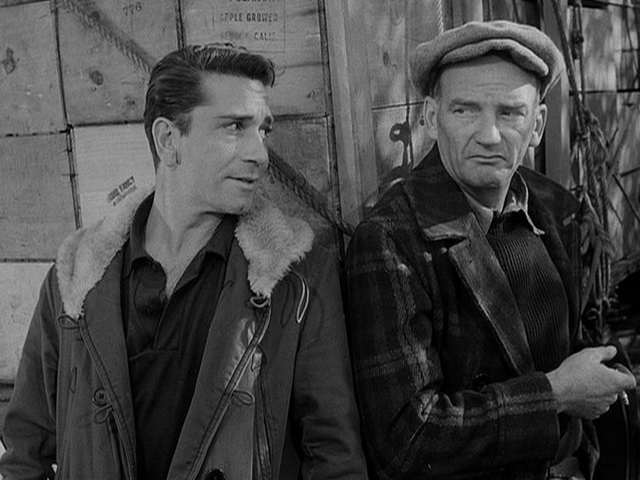
To get his not-great plan rolling, Nick has to buy the truck back from Ed (character actor Millard Mitchell, one of those quintessential "hey - it's that guy" actors, because you've seen him in Twelve O'Clock High, Winchester '73, The Day the Earth Stood Still and Singin' In The Rain.)
One of my favorite character actors....
1
posted on
03/26/2022 3:27:54 PM PDT
by
Rummyfan
Disclaimer:
Opinions posted on Free Republic are those of the individual
posters and do not necessarily represent the opinion of Free Republic or its
management. All materials posted herein are protected by copyright law and the
exemption for fair use of copyrighted works.
FreeRepublic.com is powered by software copyright 2000-2008 John Robinson