Posted on 07/22/2021 7:34:30 AM PDT by SJackson
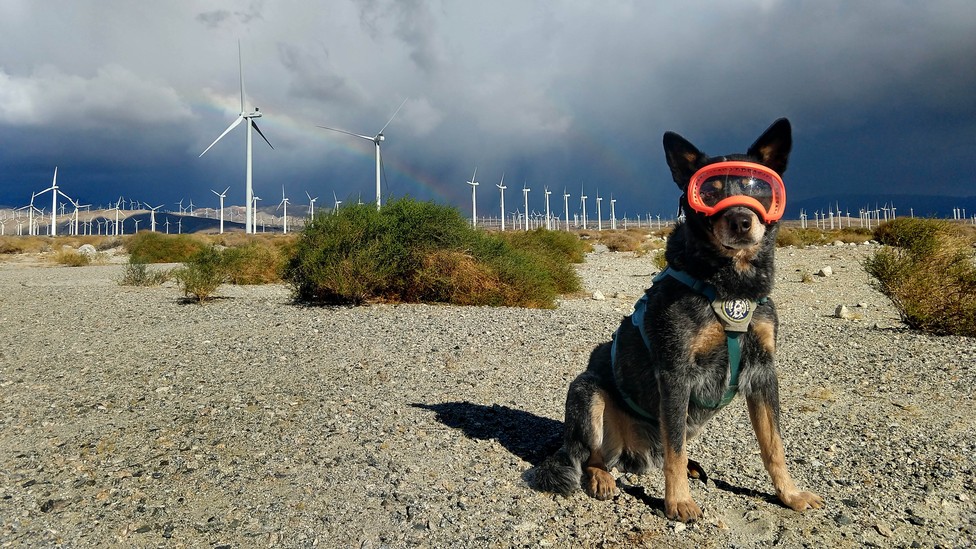
Humans are terrible at finding bats and birds killed by wind turbines. Dogs are great at it.
Kayla Fratt began preparing for her summer job in March, when a package of frozen bat carcasses arrived for her in the mail. Well, actually, the bats were for her border collies, Barley and Niffler, and it is really their summer job too. They needed to learn the scent of a dead bat, because they would be spending three months on wind farms, looking for bats killed by spinning turbines.
To teach them, Fratt, who worked as a dog trainer before getting into the bat-detection business, began by hiding the carcasses around her living room (in Tupperware, lest their smell linger on the furniture). The dogs soon graduated to hunting for dead bats in the yard, then in parks. Fratt took to carrying bat carcasses around when she left the house with Barley or Niffler, just in case they found themselves with free time to practice in a new location. All three of them reported for duty at a midwestern wind farm earlier this month. When we spoke last week, Fratt told me their orientation was starting the next day. Then, she said, “we hit the ground running.”
Barley and Niffler are just two of the many conservation-detection dogs now employed by the growing wind industry. As turbines proliferate across the country, understanding their effect on wildlife is more important than ever. In the early days of turbines, scientists had focused on the danger they posed to eagles and other raptors—but it turns out those big bird carcasses were simply the easiest for humans to spot.
“Truth was, people are terrible at finding bats and small birds,” says K. Shawn Smallwood, a biologist who has worked wind farms in California.
(Excerpt) Read more at theatlantic.com ...
People I know have encountered the activists doing these studies. They openly mock them.
The studies are junk science of the highest order. In order to get the numbers they make up most of the numbers.
They pick a wind turbine (supposedly at random, but possibly preselected over a bat colony and seeded area), search for and document bat carcasses found in a 2 mile radius (gee those windmills are powerful!), count natural deaths, assume they only found one in 30 so they extrapolate higher numbers, assume that scavengers have eaten most, so they extrapolate higher numbers. Since they only searched around 1 turbine, they then multiply by the number of turbines in the range to get a huge number. A number based on bad assumptions made by biased activists.
Its all made up science. And we have no bat shortage here in WV.
The massive house sized concrete and steel footing for each turbine has to be killing something also.
An acre of good farmland and the view of the landscape for starters.
The dog is identified by name in a caption. The article is about these dogs in general not the woman and Border Collies in particular.
It probably would have been clearer if they’d have started the article with a more generic description of these type search dogs.
Disclaimer: Opinions posted on Free Republic are those of the individual posters and do not necessarily represent the opinion of Free Republic or its management. All materials posted herein are protected by copyright law and the exemption for fair use of copyrighted works.