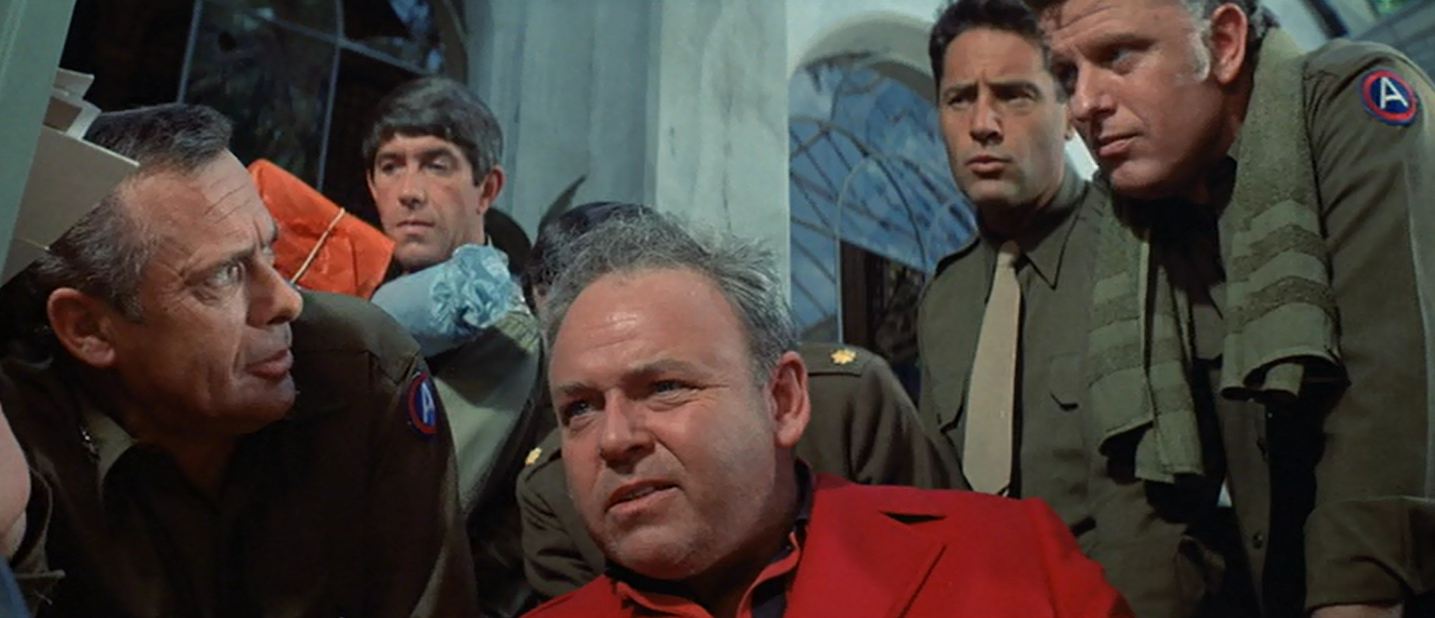
"Go Team!"
Posted on 03/07/2020 3:42:03 AM PST by Bull Snipe
American soldiers of 27th Armored Infantry Brigade, 9th Armored Division, let by Lt. Karl Timmerman cross the Ludendorff Bridge at Remagan Germany. The will be the first hostile troops to set foot Germany since the Napoleonic wars.
Need to see the movie “Bridge at Remagen” about his story. Great movie.
Is that the bridge General Patton famously took a leak off of? Har!
This bridge, The Ludendorff Bridge, was repeatedly bombed by the Allies to trap the German troops on the eastern side. This stopped when the US 9th Armored was able to reach it from the German Seigfried (defense) Line against ‘light’ opposition. The Germans had the explosives in place to destroy the bridge but waited too long in order to allow more of their troops and civilians to cross.
The first men to reach the bridge quickly started to remove the explosives so when the Germans activated the demolition, only about half worked. In spite of an astounding and fanatical German effort to destroy this last bridge into Germany, up to V2 bombardment, it remained passable for 10 days, allowing some 25k Allied troops to cross and establish a firm beachhead before collapsing from its demolition wounds.
That depends on how one counts Alsace-Lorraine, which France invaded in 1914. The French claim to the territory rests on the belief, unquestioned among those of froggish disposition, that the imperial aggressions of Louis 14th are sacrosanct. The German case was historical, ethnographic and linguistic. The Germans were in possession in 1914, having reclaimed the territories in 1871.
At this point, the main historical lesson to remember is that France in 1914 was probably more eager for war than was Germany, which recognized the perils of a two front war. The Germans were the last of the Great Powers to mobilize though the first to strike. The German mobilization was better planned and faster because German planning had been dominated by the imperative of seeking a quick knockout in the West before the Russian giant could fully engage in the East.
Ok I’m getting confused a little but I think I may have figured it out, In the movie “A Bridge to Far” they actually didn’t cross the river in Arnhem but retreated, I really don’t know the troop movements of WWII that much when you get close to the heartland of Germany, but from the comments it appears that the “Bridge at Remagen”was crossed first before the bridge at Arnhem was crossed which so happens to also cross the Rhine, So if I’m correct the Market Garden operation though it was successful except for taking the last bridge ended up in a with the Allies being camped out for awhile until troops came up from the south west and crossed the River Rhine.
I have watched so many war movies over the years. I don’t even know how many. I’ve known of this movie, but had never seen it. Saw it as I was scrolling Amazon Prime, and finally got around to watching it.
You’re right: Damned fine movie. George Segal was really good in it.
The bridge at Remagen was crossed after the failure of the British Airborne to cross the Rhine. Several months after, I believe. The bridges crossed by the Americans in Market Garden were in the Netherlands.
The American Army had been fighting in Germany since September, 1944. Aachen, Huertgen Forest, Siegfried Line, etc. The 27th Armored Infantry Battalion managed to seize the last standing bridge over the Rhine River, a significant feat, but their achievement was not the first attack into Germany.
Patton took a leak in the Rhine from a just-completed pontoon bridge near Oppenheim about two weeks later.
No, Patton crossed an engineer pontoon bridge some time later. The Allies were planning crossings at two points across the Rhine north of Remagen, when an American patrol quite unexpectedly happened on the Ludendorf Bridge almost intact. The Germans delayed blowing it because a retreating Luftwaffe detachment with infrared anti-aircraft missiles was late arriving. It probably didn’t make any difference, it is unlikely the Germans would have been able to make a second attempt to blow the bridge after the first attempt failed because the Americans were advancing so rapidly. When word got out of the crossing, the Americans threw every available unit across the bridge before the Germans could retake it.
The commander of the Luftwaffe unit and the officer in charge of blowing the bridge were both executed. Their inaction and incompetence probably saved thousands of German as well as American and Allied lives.
Arnheim was in the Netherlands. If the Allies could cross the Rhine in the Netherlands, Germany would have been open to them, as the Rhine was the only natural barrier.
The allies in the West had a seven to one advantage in artillery and five to one advantage in tanks. (Most German tanks were not Tigers, and were decidedly inferior to the Sherman. The Tiger was a logistical nightmare and only about 10% of the total Panzer force anyway.)
So historically wrong, one would expect it from a modern college professor.
World War II - American troops were on German territory from the Autumn of 1944. (For example, the hard fought battle of Aachen was in October, 1944 and lasted almost 3 weeks; the Battle of Hürtgen Forest ran from September to December, 1944. Some troops crossed into Germany during to Arnheim offensive (the headquarters near Groesbeek was a few hundred yards from the border).
Depending on the definition of hostile, occupation troops moved into Germany at the end of World War I.
As for the Seven Weeks War (Austro-Prussian War), one would have to decide who was the hostile force - The German Federation (Austria) or the Prussians. But there were definitely hostile troops in Germany to the extent there was a Germany.
Someone else on this thread that knows history. Or perhaps it is geography that most folks here are lacking.
I did slight the French. One shouldn’t forget their invasion of Germany in September, 1939 triggering World War II in the west. (The Saar offensive September 7-16, 1939)
So basically we out gun them big time, shortly after we got a foot hold in Normandy to Germany’s surrender, with probably some very minor exceptions.
Fast forward to 2020.....is Germany still a country?
I’m not sure how long it took to build up, but probably about by a month after Normandy, the Germans were badly outgunned, and the Luftwaffe wasn’t giving them any tactical advantage. Once P-47s started operating out of France, things really went south for the Wehrmacht.
"Go Team!"
There were 4 directed executions as commanded by Hitler's on scene surrogate Lt.General Rudolf Hübner, "Flying Special Court-Martial West". Due to the chaos of the retreat, lack of capability and separation of command structure, these four were more guilty of being available for blame than inaction/incomptence.
Majors Hans Scheller, Herbert Strobel, August Kraft and Lieutenant Karl-Heinz Peters were all executed by a pistol shot in the back of the head, unlike the movie, "Bridge at Remagen", where a firing squad was used (Robert Vaughan). A fifth officer was sentenced in absentia but as he was an American POW, he survived. The area German General in Command, Maj.General Richard von Bothmer, was convicted for losing Bonn and broken down to a rank of Private by Hübner, but he grabbed a pistol in the courtroom and committed suicide.
FYI: The first US Reporter to the scene was Andy Rooney who ranked the bridge capture with Normandy as in the top 5 ETO US Army accomplishments. This bridge was never rebuilt and the western terminus houses the "Friedensmuseum Brücke von Remagen" (Remagen Bridge Peace Museum) since 1980.
Disclaimer: Opinions posted on Free Republic are those of the individual posters and do not necessarily represent the opinion of Free Republic or its management. All materials posted herein are protected by copyright law and the exemption for fair use of copyrighted works.