Posted on 05/09/2015 11:13:37 PM PDT by nickcarraway
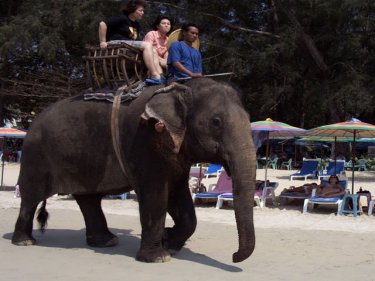
PHUKET: If you wish to help an elephant in Phuket, jump onto its back. Ride it. Buy it some bananas or sugar cane.
If this seems a little demeaning to the elephant, remember its meagre alternatives; begging or going hungry.
In Phuket elephants are sometimes seen in the streets, performing tricks to entertain people, begging and even going to sleep hungry.
The elephants that carry tourists on short treks through the forest - and get sufficient to eat each day - are the lucky ones. These are not just animals in humiliation, they are beasts in real danger.
Some experts predict the Asian elephant could become extinct in the wild within our life spans. Captive breeding of domesticated Asian elephants is slow and, as yet, does not replenish their numbers, putting the survival of the entire species at serious risk.
The forests that once supported some millions of Asian elephants are nearly all gone, and people are still killing the very few left in the wild.
Thailand's forests are so depleted that even a few hundred wild elephants have trouble finding enough to eat in the dry seasons, and often emerge at night to raid the pineapple and sugarcane crops being grown on their old grazing lands.
Human-elephant conflict results in elephants being poisoned and shot in Thailand, Indonesia, Cambodia, Vietnam and Burma each year.
While wild elephants face a bleak future, things are not much better for domesticated elephants in Thailand. For centuries a large population of trained elephants had permanent employment hauling timber out of the forests.
Despite that they labored for man, these elephants lived in a natural environment with free food all around, and lived a reasonable, if captive life.
Thailand, however, banned logging in its few remnant natural forests in a belated effort to save what's left. A few thousand domesticated elephants were thrown into unemployment, and serious hardship by that new law.
Many now wander city streets across Thailand with their mahouts (handlers), selling trinkets and lucky charms, while their beasts perform and beg for a living.
Others have become entertainers, carrying tourists on treks or performing tricks on the beach - neither a dignified nor certain existence for these regal friends of man.
Despite that people everywhere love elephants, that human love does not translate into enough practical help to give elephants a bright future.
Phuket has a significant population of domesticated elephants - every one of them imported onto the island to work in the tourism industry.
Elephant camps are found in most of the major tourist zones. The single biggest concentration, with about four or five camps, is on the high mountain between Kata and Nai Harn in the far south of the island.
All camps offer elephant rides through the rubber plantations (and perhaps a little natural forest), often with beautiful views to sea.
Do go ride an elephant while on Phuket, for as stated, this is a good way to help ensure they get enough to eat each day. The rides do not cover long distances, and the elephants are always given time to rest, or even forage for food along the way.
Carrying a tourist family is not a particularly arduous task for a healthy elephant.
Typically, an elephant ride lasts a half-hour to an hour, and can cost anywhere between 500 and 1000 baht per person.
A mahout generally rides atop the animal's head, with 2 or 3 passengers in the basket behind.
Sometimes, when the elephant is female and docile, the mahout will walk off in front, allowing a passenger to assume the more exciting position on the elephant's head, and try their hand at controlling the beast.
Male elephants are also used for trekking, but not during the periods when they are going through ''musth,'' the occasional times when both their mating hormones and levels of aggression run high.
Happily, this is clearly evidenced by a gland on the side of their faces which oozes fluid. At such times bull elephants will be kept well away from tourists.
Those who want to help elephants can go further than just taking a ride or buying bananas. You can hire an elephant for all kinds of reasons, be it for a guest appearance at a party, a photo shoot or for a beach wedding.
Elephants are often called in for functions related to corporate incentive conventions. Such high-impact elephant rentals can easily be arranged though an elephant camp.
While some critics claim this is a demeaning and inappropriate exploitation of magnificent animals, the day-to-day practicalities suggest the alternatives are worse.
Every bit of precious income helps owners care for their jumbos better, providing healthy meals and paying for the medical attention that is needed quite often.
With elephants suffering dramatic declines all across Asia, and experts warning of their likely extinction within a generation or two, the domesticated elephants of Phuket offer a rare opportunity for parents to give their children hands-on experience with these wonderful, gentle giants.
Here is a safe and fun environment in which we can instil in children an appreciation of some of nature's most remarkable creations.
And perhaps some children will cherish their memories from Phuket and go on to become elephant benefactors of the future.
The elephants are certainly going to need kind human hearts among the coming generations, if they are to survive as a species.
Where personal experience is most powerful of teachers, it makes sense to book some of your family holiday time in Phuket with the island's elephants.
Families who rent their own transport will find it easiest to mix it up with elephants. As said earlier, there are four or five elephant camps along the steep mountain road between Kata and Nai Harn beaches.
The trip over this mountain is a pleasant tour in itself, with other attractions along the way. There are a couple of snakes shows, many ATVs for rent, and even a rubber tapping display.
At the bottom of the mountain on the Nai Harn side a Muay thai training camp can be seen by the roadside. Here youthful foreign visitors can be seen practicing their martial arts skills in the mornings and evenings.
But elephants are definitely the main attraction. The camps typically have up to 10 beasts each, mostly the calmer and easier to handle females.
Some babies can be expected. Aside from riding an elephant, children can get up close and personal with the jumbos, feeding them their favourite bananas and sugar cane.
Familiarity with animals breaks down fears and prejudices, and promotes human goodwill towards our fellow travellers on this beleaguered planet.
Take your kids to an elephant camp. They will love it, and benefit from it. So will the elephants.
It’s better to feed an elephant than a RINO.
There was a young girl who said “Phuket”
It’s where I purchase my fish in a Bucket.
Don’t ride the Elephant’s when in Thailand as their handlers are known to feed them speed so they can work them longer hours.
Giving them your business only contributes to this abuse of these majestic creatures.
A large bull elephant can weigh up to 6 metric tons - that's sixty times as much as a large human male.
How much Speed would such an elephant have to be given to elicit a noticeable effect - maybe sixty times a normal dose for a human? - and how much would that cost the Mahout?
In short: The needle on my B.S. meter is jumping.
Regards,
Something like speed would probably only cost a few pennies to make.
They’re addicted to sugar cane!
Yes, and it costs only a few pennies to make aspirin, methamphetamine, and Coca-Cola.
I wonder if the Mahouts have their own pharmaceutical facilities to make their own Speed, or whether they buy it on the free market, where there is a 10,000% mark-up?
Regards,
Or just Phuket and head for Bangkok...
The elephant has only one purpose in Thailand. If you take their usefulness away the Thais won’t be able to afford them and they’ll end up poached like the African elephants. Some times you need to leave well enough alone and let the locals handle their own business the way they see fit.
Under the circumstances I would expect that the elephants are getting caffeine, not something that it would be more economically attractive to sell on the black market than to give to an elephant so it can give rides.

Better on top of the elephant than behind it.
Maybe if the elephants supported the SECOND AMENDMENT they’d be better able to protect themselves out there.
A Scot sailor, name of McPhie,
Who spoonerized to a degree,
..Once shouted, “A wanker!”
..Instead of “Weigh anchor!”
And spoke of himself as `PhcMie’.
Thailand?
I rode an elephant once, at a local zoo. It was an experience ...I could feel the her enormous power and strength, even at a walk. If she had decided to take off and run...wow.
I would have loved to become an animal keeper, so afterward I was glad to have the time to talk a little with the elephant’s keeper, who clearly adored her. The keeper let me pet her and talk to her.
Yes they are exploited. And the ones who fail to make enough money from being exploited are dead. I'm guessing they would prefer to live.
Very good! When I hear a town name like that one, it’s too great a temptation not to make a rhyme or a quip, even if just in my head.
It’s not an “either/or” proposition.
Elephants that are abused in Thailand are given safe haven.
Working 18 hours a day tweaked to the gills on yabaa is no life.
Disclaimer: Opinions posted on Free Republic are those of the individual posters and do not necessarily represent the opinion of Free Republic or its management. All materials posted herein are protected by copyright law and the exemption for fair use of copyrighted works.