In order to accurately track time, even with benefit of a reference clock, you need to have 2 separate clocks that can be compared and agree on exactly what time it is. We have now officially exceeded the mount of accuracy a clock can have. From an engineering standpoint, it's pretty cool that we can split time up into chunks that small, in my not so humble opinion. However, from a practical standpoint, it's somewhat less than useful.
Of course, time measurement and definitions are completely arbitrary. This is true to a greater degree than most people even realize. Just about all smartphones now have GPS recievers built into them these days. One interesting thing about GPS time... It does not take leap seconds into account. Since there have been about 20 leap seconds (IIRC from the last time I looked that up) added to what are the standard reference time sources that are not reflected in GPS. In fact, there are several different "standards" for what time it actually is. I just took a look at leapsecond.com which has a pretty cool page to show the different time standards out there.
Here's what it showed me for the current time...
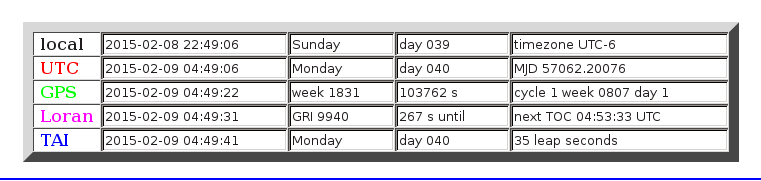
Here's what the different times are...
- Local time is the date/time reported by your PC (as seen by your web browser). If your PC clock is accurate to a second then the other time scales displayed above will also be accurate to within one second.
- UTC, Coordinated Universal Time, popularly known as GMT (Greenwich Mean Time), or Zulu time. Local time differs from UTC by the number of hours of your timezone.
- GPS, Global Positioning System time, is the atomic time scale implemented by the atomic clocks in the GPS ground control stations and the GPS satellites themselves. GPS time was zero at 0h 6-Jan-1980 and since it is not perturbed by leap seconds GPS is now ahead of UTC by 16 seconds.
- Loran-C, Long Range Navigation time, is an atomic time scale implemented by the atomic clocks in Loran-C chain transmitter sites. Loran time was zero at 0h 1-Jan-1958 and since it is not perturbed by leap seconds it is now ahead of UTC by 25 seconds.
- TAI, Temps Atomique International, is the international atomic time scale based on a continuous counting of the SI second. TAI is currently ahead of UTC by 35 seconds. TAI is always ahead of GPS by 19 seconds.
So, when someone asks you the question, "does anybody really know what time it is?"
You can answer: it depends upon what time you are talking about.
Computer time is even worse. Different operating systems have different epoch dates, and thus begin counting seconds from different starting places. There is a really interesting wikipedia article about this that goes into the who/what/whys of this in detail. I read through it a couple of times, and came out of it with the conclusion that what we really ought to do is standardize on the Posix epoch, then apply a lookup table to add/subtract leap seconds as required in order to allow us to actually agree on what number is going to be displayed. Since leap seconds aren't predictable as to when they will be added (we'll be getting one this year on June 30 I believe), the only accurate way to keep track is to have a lookup table that gets updated each time a leap second is added or subtracted.
Time is a funny thing, and how we keep track of it is fascinating IMO. One thing I'd really love to know is how we'll deal with timekeeping once we leave this planet and become interstellar travellers. Various sci-fi authors have had various ideas. None that I know of have looked at it in the detail I think it deserves.