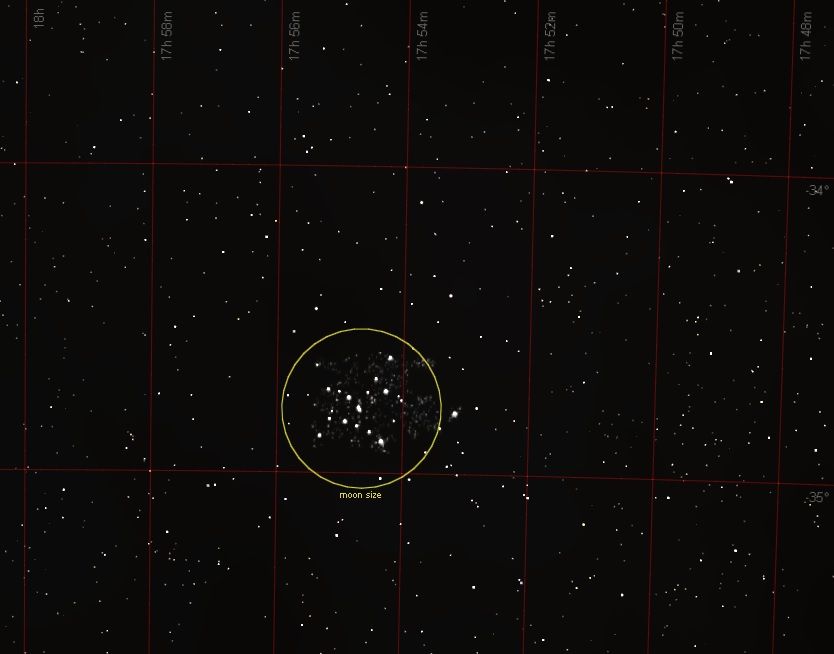
However, a footnote in my copy of the Toomer translation of the Almagest notes that one "Manitius", an early translator, identified this as the star G Scorpio, which shows up in my Starry Night app just south of M7. It is near a globular cluster NGC6441, so the note says that it is "obviously included" as Ptolemy mentions the nebulosity.
This seems specious to me. That cluster is very dim, and could not have been observed by naked eye, I don't believe. In fact, it does not show up in my Starry Night display, even at high magnification.
I feel sure the popular designation of M7 is correct.
Anyway, here is M7 in my Starry Night view as it appears on the southern horizon from mid-northern latitudes. I included my "moon size" FOV (Field Of View) indicator. Note that the APOD shows an orientation rotated clockwise about 90 degrees: