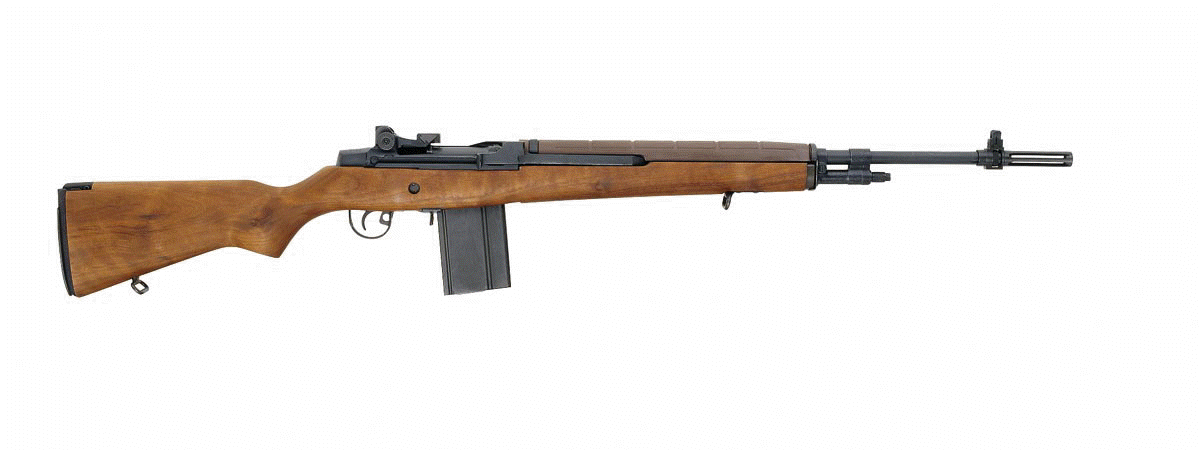
 which fires 7.62x51 or .308 in non military ammo. Civilian version is the M1A .
 M16 replaced the M14 in the mid-sixties  which fires 5.56x45 ammo .308 civilian. The two are completely different platforms.
Well, that doesn’t tell me anything. There are many rifles that use .30-06 ammunition. My daddy hunted deer with a Garand. A bit more detail would sure help.
The M1 is a battle rifle, full powered round (7.62x54 30.06) for longer range engagements.
The M-16 is a select fire rifle (assault rifle) that fires a mid-power load (5.56x45 or, nominally, .223) for high rate of fire at medium range.
The 30.06 is the standard for American big game rifles, the .223 is illegal for deer in most states.
Someone will pick a nit with all that no doubt.
Tell it to the Marines. The M1 does my talking, Mack. This is my rifle. There are many like it, but this one is mine. Fix bayonets!
which fires 7.62x51 or .308 in non military ammo. Civilian version is the M1A . M16 replaced the M14 in the mid-sixties which fires 5.56x45 ammo .308 civilian. The two are completely different platforms.
The M-14 or M1A or Garand fire 30 calober bullets that are about 3 times heavier than a .223 bullet. The M-14 and M1A fire the .308 or 7.62 NATO round while the Garand fires the 30-06 round. They are fairly similar with military loads. The Garand uses a 8-round clip that is inserted from the top and the clip is ejected when empty giving that "Ping" sound. The M-14 and M1A use standard 20-round magazines. I don't think the M1A or Garand recoil much, but definately more than a .223. If I knew I was going into a fight, my choice would be M1A.
A Garand uses a handsomely finished natural hardwood stock whereas the M-16 uses plastic that is colored black like the evil oil it is made of.
A Garand does not have an evil high capacity detachable magazine like the M-16 does.
A Garand does not have an evil handgrip like the M-16 does.
A Garand does not have an evil flash hider/muzzle brake like the M-16 does.
Any newer military and many civilian weapons would be considered a great improvement over the M1, but during WWII the M1 was the best rifle for the regular troops.
The M-16 has whats called a ‘’selector switch’’ which can allow the shooter to fire single shots or fully automatic. The M-1 doesn't have this. The M-1 fires as long as you keep pulling the trigger. The M-16 is a lighter weight rifle where the M-1 is rather heavy. The M-16 is a high velocity weapon. This means the round(bullet) travels fast, I'm not sure of the fps(feet per second) ratio but a high velocity round hits hard, however, as our guys came to find out you could put a few rounds in an enemy and he might not go down right away. The M-1, as far as I know, I could be wrong , is a low velocity rifle however the .30 caliber round it fires is an awesome piece of ordinance. The stopping power and penetration of the M-1 is legendary. You could shoot that thing through a house or a cars engine block and it will do some awesome damage. You just need to hit someone with one round M-1 round and they're taking a permanent ''dirt nap''.
“...There are many rifles that use .30-06 ammunition. ... A bit more detail would sure help.”
Short version:
The M1 was tremendously capable over the longest ranges, so capable it was overdoing the job at more typical (shorter) ranges. The M16 gained military acceptance because it was cheaper, lighter, handier, easier to use (especially by those of shorter stature and lighter training), but still did the job well enough at ranges judged realistic. It’s not the stout example of military hardware deemed mandatory when the M1 was adopted, but then we do not fight as we did nearly 80 years ago. So, fussing about the M16’s inability to stand up to being abused as a club in close combat misses the point: if the situation has devolved to close combat, I’d say the battle is already lost. And when it comes to a close-quarters shootout, a rifle as long and heavy as the M1 is gruesomely ineffective anyway.
More in-depth version:
Many responses helped a little, but nobody mentioned the central differences, nor any reasons *why* the M16 differed from the M1, and - most important - why the nation’s military establishment chose to re-equip with the M16.
I would venture to say those might matter to SatinDoll, and other posters: more than the mostly-correct technical details.
Military leaders and ordnance systems designers realized before 1900 that a self-loading (semiautomatic) rifle was the best arm to issue to troops. Machine guns had been transforming the battlefield for more than 15 years by then - Hiram Maxim perfected his gun in 1884 and had been marketing with vigor - but nobody was able to make a rifle that could handle the powerful cartridges then in military use (7.92x57mm, 303 British, 8x50R Lebel, 30-40, later 30-06). At least, they could not build one that worked for more than a couple shots, didn’t weigh too much, and could withstand field conditions (machine guns, five to ten times weightier than the rifles of the day, could house equally heavy, less fail-prone parts, and did not get dragged through the mud like a rifle would have to).
The Great War (now called the First World War) brought an additional wrinkle: troops rarely engaged targets beyond ranges of 300m (328 yards). Since every rifle cartridge in military use in 1918 was accurate to 2000m or greater, and could deal death at very much greater ranges, tactical analysts saw the excess capability as so much unneeded power: a waste of material and supply effort, of industrial production. If 300m was the limit, why not settle for a rifle still capable of doing the job at, say, 400 to 500m or so? It could be built lighter, use up less raw materials (often sorely needed elsewhere), and lighten the soldier’s load, or let each troop haul more ammunition for any given load.
Re-arming with newer rifles did not proceed smoothly.
The UK, Nazi Germany, USSR, Italy, and Imperial Japan fought the Second World War armed largely with the rifles and cartridges they all used in 1914-1918. The US tinkered about throughout the 1920s and came close to adopting a new shorter “reduced power” cartridge, but the financial constraints laid on by the Great Depression decreed a return to the 30-06; when WWII began, the US alone had adopted a semi-auto as its primary rifle, but was (as always) lagging in re-arming. Good thing it was John C. Garand’s M1.
Many wartime initiatives were undertaken to increase the firepower (as in shots per minute) of individual soldiers, the most numerous being submachine guns: short, light carbines firing pistol cartridges full auto. Every major combatant produced them, sometimes many millions.
The Third Reich made the greatest advances in designing, making and fielding what later came to be known as an “intermediate” cartridge: more muzzle energy and range than a pistol cartridge, but less than a “full power” rifle cartridge. They called it the 7.92x33mm Kurz (”kurz” = Short) and built a number of different rifles. Haenel’s design was ultimately selected and became the MP44, later the StG44 (Sturmgewehr = assault rifle). Capable of semiauto and full-auto fire, it caused a stir among the Allies, but arrived too late and in too few numbers to affect the outcome. The bullet weighed 20 percent less, muzzle energy was cut in half, and effective range was only 1/3 that of 7.92x57.
The USSR quickly designed a counterpart cartridge, the 7.62x39mm o43g, which became standard in 1945 and went on to arm the Eastern Bloc, most other communist-aligned nations, and some Russian neighbors with entire families of weapons.
Perversely, the United States fiddled about for seven years after the war to design its own “short” cartridge, rejecting all competing concepts before adopting the 7.62x51mm NATO (308 Winchester) - performing identically with the 30-06 - and forcing it down the throats of all NATO members, sometimes to their great political cost. And the US dawdled five years further to approve a rifle to replace the fast-obscolescing M1: the finely crafted but otherwise uninspired M14, a weapon firing 7.62 NATO and neither lighter, nor shorter, nor cheaper.
The US may have triumphed politically, but the laws of physics could not be circumvented so easily. Designers ran into just as many problems as ever, making select-fire (semi or full auto at the flick of a switch) weapons small enough for troops to carry, yet big enough to allow control. Compromises, as always, had to be made; results were very marginal, as anyone can attest who has been issued an M14, a G3, or an FAL. The Italians came the closest with their BM59, which is a bit handier than the M14, but still quite beefy (hence weighty), no fun to fire, and (as all others) a very unruly handful on full auto.
By the late 1950s, it was evident that the M14 (touted as an all-purpose gun to replace the M1, BAR M1918A2, M1 and M3 submachine guns, and the ubiquitous M1 and M2 Carbines) was less than ideal. Firepower theories germinated from the work of S.L.A. Marshall had taken root: brought to full flower by the US Army Operations Research Office, the new ideas induced tacticians and doctrine developers to revisit the “smaller-lighter-far-enough” proposal that had spawned the StG44 and AK-47, with their stubby cartridges.
An innovative alternative happened to be waiting in the wings: the AR-15, brainchild of Fairchild engineer Eugene Stoner, firing the spanking-new 222 Remington cartridge (5.56x43mm), which had precipitated a revolution of its own in sporting circles, when introduced in 1950. A gun for the Space Age, built of the latest lightweight materials by aerospace industry manufacturing techniques. After some tinkering, Army engineering talents brought forth the 5.56x45mm cartridge. Semi-experimental use by special forces combat teams in Southeast Asia indicated high terminal effectiveness, especially at short range. The weapon - provisionally designated M16 - weighed 30 percent less than the M14; round for round, each 5.56x45 was half the weight of each 7.62 NATO cartridge. Most pleasing of all, the new rifle could be controlled on full auto. And unit cost was far less than the M14, which was then coming nowhere near meeting any goals set by SecDef Robert Strange McNamara and his crew of “scientific efficiency experts,” who’d arrived full of hope alongside every other Kennedy Administration appointee.
True, the M16 and its 22 cal varmint cartridge put out just half the muzzle energy of the 7.62 NATO, and promised an effective range only half as great. But that was seen as “good enough” for most tactical uses, especially in the broadening jungle warfare of the early 1960s, and the era of greatly enhanced communications coupled with strategic firepower capable of incinerating a city with one shot.
And so, less than 20 years after the US insisted (against all its NATO partners) on a full-power rifle cartridge - 7.62 NATO - it perversely undercut them by adopting a lightweight, somewhat fragile arm derided as the “Mattel gun” and an “assault carbine” or “poodle shooter.”
NATO did follow suit, but only after a newer bullet was designed, a heavier projectile with better long range penetrating performance (interestingly enough, it outdoes the fabled 30-06 at ranges of 850m).
Researchers have worked long and hard to come up with a better cartridge, something that fills the gap, between the two extremes: something of less weight and bulk (also less punishing recoil) than the mighty 30-06, but better effective range and snappier terminal performance than the oft-sneered-at 5.56x45. Bullets of all diameters have been made and tested, and many cartridge case configurations.
Time and geostrategy pause for no one, and the newer combat situations are now demanding small arms able to deal death at ranges beyond what 5.56 NATO can manage.
Interestingly enough, attention has turned to cartridges similar to those introduced over 100 years ago: the 6.8x43 SPC, developed by Army Dept engineers with serious help from USSOCOM and in consultation with Remington, uses a case adapted from the 30 Remington, a rimless “deer rifle” round marketed by Union Metallic Cartridge, to give Remington rifle buyers an alternative to the then very new 30-30. Offering performance identical to the rimmed Winchester cartridge, it found immediate success in Remington’s semi-auto and slide action rifles, declining in popularity only after Remington dropped its earliest models in favor of later designs costing less to produce, chambering more modern cartridges of higher power.
Civilian rifle shooters might follow developments more closely. The 30-30 has not found the favor it has enjoyed for the past 118 years because it was inaccurate or lacked power. And it did not prosper merely because it worked well in Winchester or Marlin lever-actions, good though they are.