Posted on 11/04/2009 8:32:15 AM PST by steve-b
...Part spy adventure, part science fiction dystopia, and part counter-culture influenced social critique, The Prisoner was groundbreaking television when it debuted in the fall of 1967....
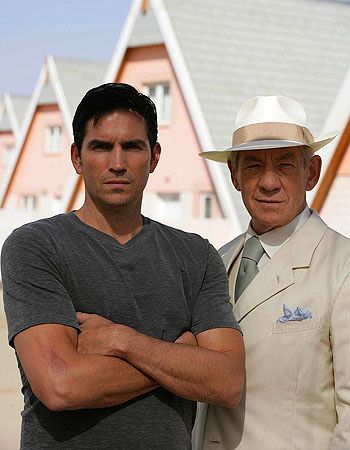
And now, after decades of speculation and anticipation, of deals struck and scrapped, the British cult classic is about to become the latest pop-cultural institution to submit itself to reinterpretation. On November 15, AMC will debut its own version of The Prisoner staring Jim Caviezel and Ian McKellen....
...The question we see playing out on cable news, in blogs, in town-hall meetings, and public demonstrations is "Who do we imagine ourselves to be? What is the soul of America?" As is the case with definitional questions, the answer is typically expressed as a negative: We are defined against the thing that we reject. And, as is the case with family squabbles, the tone is uniformly nasty and ad hominem. Our political lexicon is distended with a list of new terms of invective, Rabelaisian in its length and grotesquerie: We are a nation of wingnuts, moonbats, birthers, FReepers, libtards, Paultards, snow-billies, nObamans, Christianists, liberal fascists....
If Patrick McGoohan, the crusty, misanthropic creator of the original Prisoner, had lived to remake his series, I'm certain he would have recognized this knotted up state of affairs, so ripe for satire--and would have relished jabbing a finger into our aching collective pressure points, sparing the fragile sensibilities of neither right nor left....
(Excerpt) Read more at thefastertimes.com ...
Which means that it’s all just made up, and doesn’t really matter.
It was a short lived series, a mini-series really. And McGoohan has said that there were only something like 13 of the 17 episodes(?) that were essential to the story. I thought there was a conclusion episode.
Just like global warming doesn’t matter because the claims that man is behind it are “made up”. Except there are those trying to put constrictive plans into motion because of a movie.
It’s important to look at the Prisoner with respect to the McGoohan spy series that preceded it, that made McGoohan the dominant TV actor in Britain at the time, and were both groundbreaking and unique that they could not be dramatically copied.
Danger Man (1960-’62), presented the Cold War as a life or death, ruthless struggle between East and West. Originally a half-hour show, it was expanded to a full hour (1964-’66) and retitled in the US as Secret Agent. (Available on Netflix, and worth it).
McGoohan portrayed spy John Drake, and even after The Prisoner, was brought back, as “David Jones”, in essentially the same role, in the movie Ice Station Zebra.
While utterly ruthless, he avoided guns if at all possible, using the same sensibility as the Cold War of, “I’ll kill you, but I won’t shoot you.” Communists were utterly blatant about it, full of dialectic and proud of proclaiming what they were, unlike today, when they will no longer admit to being communists.
At the same time, surrealism was penetrating British culture, with pseudo-spy shows like The Avengers, that were far more glib and less interested in politics.
With the blow up set of The Prisoner, the whole genre was smashed in British TV, leaving only James Bond, who had to leave England for a couple of decades. The serious, dramatic spy TV then migrated to the US, with Mission: Impossible, before American culture changed as well.
So The Prisoner went after several competing premises. To start with, that the Cold War enemies had become identical in their means, if not their ends. That is, nobody actually knew who ran The Village. It was even more likely to be run by the “good guys” as the “bad guys”.
Another premise was found all over both British and US culture at the time: the fear of technology overwhelming humanity. This still exists, but then, there was the idea that technology could be entertaining at the same time it was dehumanizing. People could fantasize about “Rover”, yet realize that it was an injurious, sometimes lethal killing machine.
One episode had the same concept as several original Star Trek episodes, of the super intelligent computer being bested by simple, human paradox. This was very emotionally gratifying to those who felt intimidated by IBM card using computers, with their “near human” intelligence, though nowhere near as powerful as a Commodore 64.
Finally, an undercurrent of The Prisoner is that even this super human, super spy, is quickly being worn down by the efforts of The New Number 2, and his minions. At first, the episodes are serious, but you can tell that perhaps his mind is slipping. The last few episodes are farcical. Perhaps they are just in his mind. Perhaps they finally did discover why he resigned, but in the process leaving behind just a shell of once was.
The whole end credits sequence was a classic. The slow building of the bicycle in pieces with David Tomblin's theme was mesmerizing.
Unless the series is planned for X length and nothing will convince the producer to go "just one more season". Prison Break was bad about that. Season one: work on escaping from prison. Season two: avoid capture. Season three: suck! OK, you've broken out of prison. Now what?
The prisoner escaped in the last show, I know...I saw it.
He blew up the terminal and jumped on a train that busted out into the streets, and he walked away.
Great series, by the way!
Ed
I didn’t like the fact that the main hero of Prison Break was written as having died of cancer in the series finale.
Ed
Why are you posting this? It would be one thing if it were thought-provoking, but it isn’t.
 |
Every day there's another distraction. I wish BHO could stay over there in Asia where he's more at home.
I’m enjoying it. Tonight’s the third episode. It’s not for add sufferers. It moves slowly but the pace has a purpose. Even the violent scenes are in slo-mo. Seems like that’s kind of subliminal way to present violence. I’m waiting to find out why #2’s wife is in suspended animation until she gets 3 pill. I have a feeling she’s thousands of years old.
Last night they said there is no number one because they didn’t want anyone to be superior to the others. However, that was number 2’s explanation and he might be lying. I find it to be a study in collectivism and group thought. Individualism is not encouraged. Individuals become suspects. It’s very much like the current administration including DHS Janet. I don’t know why she didn’t go a guest shot on The Prisoner. She’s clearly into group think and collectivism.
It is thought provoking but maybe not in your opinion.
I watched the first episode last night so I am one behind. As weird as it was I did like it. If there is a newer thread, I would love to know.
Sir Ian’s sexual politics aside, I think he might make a good Number Two. The warden of the Village, not the other. Actually, the image of Sir Ian making the other Number Two is one I’d just as soon not have rattling around in my head.
I live in Minnesota, am I considered a snow-billie?
By now you've seen how it ended. The way it ended, there's room for sequels.
Disclaimer: Opinions posted on Free Republic are those of the individual posters and do not necessarily represent the opinion of Free Republic or its management. All materials posted herein are protected by copyright law and the exemption for fair use of copyrighted works.