Click here: to donate by Credit Card
Or here: to donate by PayPal
Or by mail to: Free Republic, LLC - PO Box 9771 - Fresno, CA 93794
Thank you very much and God bless you.
Posted on 10/31/2026 5:58:05 PM PDT by SunkenCiv
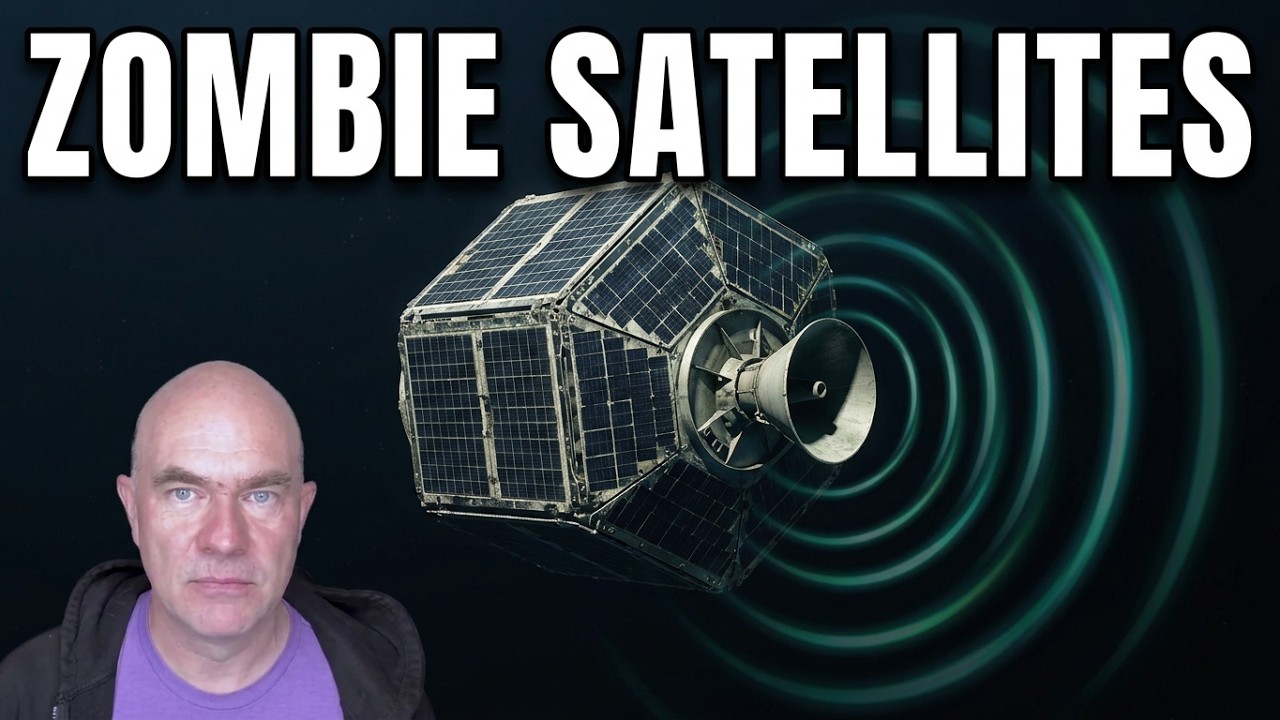
Since it's Halloween - here's a story of spacecraft that returned from the grave, spacecraft which died and were abandoned and then somehow, returned from the dead. Well there's also a story about a hacker bringing a spacecraft back to life, with the help of a 'Frankenstein' satellite model assembled after a grave robbing incident.
(Excerpt) Read more at youtube.com ...
|
|
Click here: to donate by Credit Card Or here: to donate by PayPal Or by mail to: Free Republic, LLC - PO Box 9771 - Fresno, CA 93794 Thank you very much and God bless you. |
Spacecraft That Returned From The Dead! Transmissions From Beyond The Grave | 18:38
Scott Manley | 1.87M subscribers | 71,619 views | October 31, 2026
YouTube transcript reformatted at textformatter.ai *may* follow.
🚀🛰️
Transcript
Hello, it’s Scott Manley here. It’s spooky season, so I thought it would be a perfect time to talk about the undead. Undead spacecraft, specifically spacecraft that died and were abandoned for years, but then someone unexpectedly noticed the dead spacecraft speaking from beyond the grave. Somehow they returned, perhaps due to some supernatural influence, but more likely due to quirks of engineering and the laws of physics.
Our first tale begins with LES1, the first of the Lincoln experimental satellites. It was built by MIT’s Lincoln Laboratory for the US Air Force to test military satellite communications technology. Specifically, it was meant to demonstrate solid band transmitters at X-band frequencies. Uh, so those could serve large numbers of users. Uh, they’re also supposed to demonstrate antenna switching and magnetic spin stabilization. So it launched uh on February 11th, 1965, from Cape Canaveral in a Titan 3A.
And the plan was to put it in a high elliptical orbit so it would spend long periods over the northern hemisphere. But a wiring error in the ordinance system prevented the solid kick motor from firing. So it stayed in a roughly circular orbit about 2800 km high. That orbit was too low and too circular for the communications experiments they wanted to run. But the satellite would stay up there for a long time and it still transmitted for about 2 years before finally going silent in 1967. Then there was nothing for 45 years.
But on December 18th, 2012, a British amateur radio operator in Cornwall picked up a signal on the 237 megahertz frequency. Other amateurs in Brazil and Germany confirmed it within days. The signal was fading and strengthening on a 4-second cycle. Perhaps the satellite was tumbling. So, the satellite had come back to life. But how?
So, the most plausible explanation for this lies with the nickel cadmium batteries. They would have these sealed batteries, which is basically a jelly roll of like positive plates with a nickel oxyhydride and then negative plates of cadmium metal and a membrane between them. And then in between, there is a potassium hydrochloride. Now these batteries obviously have connections to the power system which is generally powered by solar panels and obviously they can store power when the power is being generated by the panels and they can release power when the panels are not generating electricity.
But that membrane in the middle, which is required to have ions flow between the cathode and the anode, it can also let the cadmium sneak through. So these cadmium ions can begin to form a bridge and sometimes this will lead to a bridge forming between the cathode and the anode. You will have a short circuit and now this is a low resistance circuit in the power system. And so that solar power instead of going through those processors, the electronics, the transmitters are generally high resistance but will do actual work. It is now going through this short circuit inside the battery and the satellite dies.
But that’s not the end of things. You see, this is still a chemically active system. It’s having power put through it that will cause ions to move. The cadmium, the ions, they can all redistribute. Or perhaps the link was very small or very very thin and there is uh heating going on, right? Resistive heating in this very small area and that will change things. Sometimes the cells dry out and they die. Sometimes that connection, that bridge breaks and when that breaks suddenly it’s an open circuit again. Suddenly that power that was being absorbed by the battery is now available to flow through the rest of the system.
It’s likely that the other batteries have since died as well. But that power can finally start powering the critical parts of the satellite once again. And that means the satellite can start transmitting. It can start doing everything it was supposed to. But it will only do this when it is in sunlight. And in the case of LES1, if the spacecraft was tumbling, there would be a variation in the amount of power going through the system as it rotated. So this is what we believe happened in this case and is what we believe happened in another case.
[snorts] But before we get on to that, Lincoln Lab, they did set up an automated rooftop antenna at their Lexington campus that would detect LES1 whenever it passed overhead. Now, the satellite’s not doing useful science and it never will again. It’s just an old piece of hardware that refuses to stay quiet and it’s expected to stay in orbit for a very long time.
So yes, the other example of this um battery involved returning to life was AMSAT Oscar 7, right? And this is the one that actually came back and is doing something useful. AO-7 was the second phase 2 amateur radio satellite built by AMSAT. It was designed to provide linear transponders that radio amateurs could talk to each other across continents. It carried a mode A transponder with a 2-meter uplink and a 10-meter downlink and a mode B transponder with a 70 cm uplink and a 2 m downlink. It also had beacons and other stuff.
Now, so it launched in November 1974 on a Delta as a secondary payload with NOAA 4. Uh, the satellite itself is a small ocahedron about 36 cm high, 42 cm across, and it weighed about 60 lb and it went into a near polar sun-synchronous orbit about 450 km up and that’s high enough that it’s going to stay up there for a long time now. It worked for nearly 7 years. That was longer than expected until mid-1981 when those nickel cadmium batteries shorted and took down the entire power system. The satellite was written off for 20 years. Nothing.
And then in June 2002, a British amateur was scanning the 2 m satellite band looking for illegal signals. And he heard slow Morse code, only 8 to 10 words per minute on 145.97 megahertz. It was Doppler shifted downward as the source moved, the way a satellite does. He started copying this Morse code by hand. It began and ended with “hi,” the old AMSAT identifier. And in between were groups of three-digit numbers, things like 100, 176, 164, 178. What was this mysterious signal?
Well, that was a standard Morse telemetry format from the early Oscar satellites. 24 channels of numbers, which were battery voltages, currents, and temperatures designed so that somebody could copy them with a pencil and paper. Right? The amateur recognized the cadence and immediately he knew that it sounded like one of the Oscar satellites, but none of the current satellites were using that format anymore and the frequency matched the old AO-7 beacon. He posted the numbers to the AMSAT bulletin boards that night and within hours others were confirming it.
Yan King, the original project manager, looked at the telemetry and said the only explanation was that if one of the shorted battery cells had gone open circuit, letting the solar panels power the radio whenever the satellite was in sunlight. It was an impossible signal from a spacecraft that had been dead for 21 years, and it stayed alive ever since. AO-7 still works today for voice and other contacts whenever it’s lit by the sun. In eclipse, it goes silent again. AMSAT lists it as an operational satellite as of 2026 and it’s the oldest satellite that is still performing its original function.
Now, there was actually a Polish claim that the Fighting Solidarity Movement used this satellite in 1982. This has appeared in a couple of sources, but there’s no real evidence to support this because amateurs would have noticed this working. So, um, I’ve seen this. I considered it. I don’t think it’s likely to have any credibility to it.
So our next spacecraft is the Imager for Magnetosphere to Aurora Global Exploration and that was the first spacecraft dedicated to imaging Earth’s magnetosphere, the region of space controlled by Earth’s magnetic field that is filled with tenuous plasmas of both solar and terrestrial origin. It was launched in March 2000 on a Delta 2 from Vandenberg and it ended up in a highly elliptical polar orbit going out to 46,000 km and it was designed for a 2-year mission.
Now, it had instead of like the regular particle single particle detectors, it had cameras and ultraviolet detectors, images, and it could see essentially the ghostly plasma in the vicinity of the Earth that was created by the sun interacting with the Earth’s magnetic field. It was much better than the satellites at the time that could just sample the plasma and the particles wherever they happened to be. And so this led to a huge number of uh papers and discoveries. It was an excellent satellite.
But unfortunately, as with many things in space, its time is limited. In December 2005, contact was lost during a routine pass. Eventually, the failure review board concluded that the most likely cause was a single event upset that instant tripped the solid-state power controller feeding the transponder. The spacecraft was designed so that a deep eclipse could drain the battery and force a reset of the computer. The next good opportunity was in 2007. The spacecraft passed through the eclipse, but the satellite stayed silent. The mission was over.
And then in January 2018, Canadian amateur Scott Tilly was scanning high Earth orbit. He was actually looking for the Zuma satellite, which we all know ended up getting deorbited with a Falcon 9 upper stage. In the process, he picked up a strong signal whose Doppler curve matched the imager’s known orbit. Other amateurs quickly confirmed it. Then NASA’s Deep Space Network and Johns Hopkins Applied Physics Laboratory quickly locked on. On 30th of January, they decoded the spacecraft ID and basic housekeeping.
The battery was fully charged and temperatures were normal. This spacecraft had rebooted into the A-side power distribution unit, the side that had been thought dead since a glitch in 2004. NASA began the slow process of recreating the 12-year-old ground software and command sequences. On 5th February, they reported the spacecraft looked healthy. The next step would be to try turning on the science instruments after which an external panel would assess whether they could do any more science with the spacecraft.
Then the signal became intermittent. This in February 2018, the signal broke up and was lost. And then in early March, a weak signal was detected, but wasn’t lockable. In April, they began sending commands in the blind to switch from the medium gain to the low gain antenna, but they got no response. In May, Scott Tilly once again reported a strong signal. Engineers locked on and received telemetry, but only a fraction of the commands were acknowledged. And by May, the spacecraft was not reliably responding. And by August, NASA decided the imager had once again returned to its quiet death seen years ago. So after that brief window, the signal was never reliably recovered.
The original 2005 failure was almost certainly the power controller trip. The 2018 recovery is best explained by a later deep eclipse, probably sometime between 2014 and 2016, that finally drained the battery enough to force the reset the designers had hoped for in 2007. Once power returned, the transmitter came back on. The later 2018 dropouts and ultimate silence are less clear. NASA noted the pattern of signal strength was consistent with the spacecraft’s spin period, raising the possibility that the spin axis had drifted so that the medium gain antenna was only intermittently pointed at the Earth. Attitude control or thermal effects were also suggested.
Some instruments appear to have been offline or damaged by years of radiation. The ground systems needed to fully command and assess the payload no longer existed and would have required substantial reverse engineering. Combined with the intermittent link and the cost of a restarted mission, the practical path to a full science recovery really never had a chance. And so finally, I want to talk about BSAT 1. And this is one where we have a real Dr. Frankenstein on board. Yes. So not every undead satellite is pure luck.
BSAT 1 was a one-year cubat built by a technic university in Berlin and it launched in September 2009 on a PSLV out of India and it was meant to test like reaction wheels and other onboard hardware. It worked for a couple of years past its lifetime but then it began returning invalid telemetry. Operators switched over to the backup computer which temporarily fixed the problem. And then in 2013, the same problem hit the backup. After that, the satellite just sat there sending frames of full zeros. The original software update path had never been finished before launch, so there was no easy way to patch it. And so, operation stopped. And then in 2024, a student known as Piston Miner decided to bring it back. This became his bachelor’s thesis. And he actually presented a great talk at the 38th Chaos Communication Congress in Camber.
Um, so yeah, the radio and the satellite still worked. The zeros were actually valid frames which pointed to a problem in the data collection or telemetry assembly. The frame assembly room routine was running but far too infrequently and that interval was coded into the memory and it could be shortened. And so he figured out that he could send a command to it to shorten this. And he began getting actual telemetry back. The deeper problem was that the NAND memory, the flash memory to write to it, you would have to like send it to zeros and then replace it, write over it, and sometimes a watchdog timer could kick in in between that and you would end up with, you know, empty memory.
And this was apparently happened sometimes during the spacecraft reboot because the spacecraft reboot would update a number in memory to log the number of reboots. And that meant that they had nuked the parameter in memory which stored how frequently the telemetry construction should run. That is why the spacecraft had been writing a bunch of zeros. And so he figured that the satellite was generally healthy and he should try and bring it back to life.
One of the problems was that of course there was no software update sequence and he didn’t actually have the original software source code. He had binaries for it and he had source code for later versions but he had to do a bit of working on the binaries to try to map the symbols so he could start figuring out what was going on. Now he figured out that he could actually send updates to the spacecraft and store them in a 2 kilobyte block of memory and potentially start patching it that way. The problem was there was 300 kilobytes of software on the spacecraft. Also, he could only send four bytes at a time, one packet every 4 seconds. And he could only send those packets during 15-minute passes when it was passing over the university.
Uh, now before you were going to attempt any upgrades or any of this patching, of course, he really needed an engineering satellite to work on. And the problem was the original engineering satellite was no longer around after BSAT had died; they no longer needed it and so grave robbers had come and they’d taken all its parts to put into other projects.
So he assembled his own Frankenstein’s monster from the various parts that he could find using the bits of the source code or the binaries that he thought were right. He got something that mostly worked. It worked enough that it could be brought to life by electricity. It lived once more and he began testing his various update sequences. And yeah, so his development would then proceed from that point onwards.
He figured out an update sequence which would fix the major bugs and let him start moving on to actually, you know, making the satellite live again. Uh, and again, yeah, he would send these things four bytes at a time and he would send a bunch of packets in a single 15-minute pass and then he would have to wait for another pass. And at the end of each pass or after each pass, he would have applied a number of commands, but not every command would have been received and applied. So he then would have to do memory dumps, which did actually work, and he would have to see where the patches hadn’t taken and resend those commands.
And interestingly, as he was doing this, he noticed an interesting feature. The camera had come on. And now, the camera had never actually worked in the original satellite, and they’d written it off as a software problem. But as he was investigating the code, he found that the command to dump the memory. There was supposed to be a break command or line after the memory dump, but that wasn’t there and it would just fall through from the memory dump to the turn on the camera command. So the camera began returning low-quality images of Earth which had never been seen by the original satellite developers.
Yeah. He eventually managed to go through this process with his Frankenstein test satellite. He managed to basically rewrite the code of the satellite and take possession of the satellite. He possessed this satellite’s soul. His talk is literally like I wanted to own this satellite completely and that’s what he did and so it’s brought back to life which is absolutely marvelous and you should totally watch his particular talk. But yes, there are zombie satellites out there or there are other satellites that have been brought back to life by more heroic action by people on the ground. But the ones that have always returned from the dead on their own, those are extremely cool stories. I’m Scott Manley. Fly safe.
cool stuff. Thanks!
🌛
Disclaimer: Opinions posted on Free Republic are those of the individual posters and do not necessarily represent the opinion of Free Republic or its management. All materials posted herein are protected by copyright law and the exemption for fair use of copyrighted works.