Skip to comments.
Blue Origin Taller Lunar Lander, SpaceX Launches All Its Rockets - Deep Space Updates Oct 6th [35:27]
YouTube ^
| October 7, 2026
| Scott Manley
Posted on 10/08/2026 6:37:41 AM PDT by SunkenCiv
Deep Space Updates - Space News
Laying out all the space stories from the last couple of weeks, SpaceX managed the feat of launching all 3 of it's Falcon 9 variants in one day, and that was 3 days after launching Starship to Orbit for the first time on flight 14.
Rocket Lab signed a deal which will mean they'll build more boosters than SpaceX did for Falcon 9, NASA has a new space telescope, ESA's JUICE visited the Earth again. Blue Origin Taller Lunar Lander,
SpaceX Launches All Its Rockets
- Deep Space Updates Oct 6th | 35:27
Scott Manley | 1.87M subscribers | 111,322 views | October 7, 2026
(Excerpt) Read more at youtube.com ...
TOPICS: Business/Economy
KEYWORDS: scottmanley
Navigation: use the links below to view more comments.
first 1-20, 21-22 next last
1
posted on
10/08/2026 6:37:41 AM PDT
by
SunkenCiv
To: AdmSmith; AnonymousConservative; Arthur Wildfire! March; Berosus; Bockscar; BraveMan; cardinal4; ...
2
posted on
10/08/2026 6:38:44 AM PDT
by
SunkenCiv
(TDS -- it's not just for DNC shills and jihadists anymore -- oh, wait, yeah it is.)
To: SunkenCiv
I hear very little from Blue Origin. I don’t think the company has ever turned a profit. And I am not aware of any substantial achievements from them. I wonder if Bezos will pull the plug — or perhaps just sell Blue Origin to Elon Musk. But maybe I’m ignorant. Maybe Blue Origin is doing better than I think they are.
3
posted on
10/08/2026 6:40:18 AM PDT
by
ClearCase_guy
(Some people want to control their own life, others want to control the lives of others. )
To: ClearCase_guy
Blue Origin was recently a big feature on Fox’s Bret Bear show.
I hear very little from Blue Origin. I don’t think the company has ever turned a profit. And I am not aware of any substantial achievements from them. I wonder if Bezos will pull the plug — or perhaps just sell Blue Origin to Elon Musk. But maybe I’m ignorant. Maybe Blue Origin is doing better than I think they are.
—
Their Blue Moon v 1b capsule will be tested with the next Artemis launch along with the as yet unshown one from SpaceX.
They have some heavy lift contracts to geosynchronous orbit with DoW, among others.
They are in the process of launching their own competing communications satellite network with Starlink.
You have not heard much because the MSM has not covered them recently.
AI:
They are a multi billion dollar company and are not about to fold any time soon. Blue Origin has a reported valuation of $140 billion as of late September 2026, following the successful closing of its first-ever external funding round.
This post-money valuation reflects a price increase from the initial $130 billion pre-money valuation announced in July 2026, when the company raised approximately $10 billion from investors including Coatue Management and Jeff Bezos.
The $140 billion valuation represents approximately 175 times the company’s 2025 revenue of $0.8 billion, a multiple that has drawn significant attention and skepticism from financial analysts.
While this places Blue Origin’s value above competitors like Lockheed Martin, it remains below Boeing’s public market capitalization.
The company remains privately held with no public stock ticker or IPO date announced.
4
posted on
10/08/2026 7:17:52 AM PDT
by
PIF
(They came for me and mine ... now its your turn)
To: ClearCase_guy
Blue Origin is moving at a glacial pace compared to SpaceX. It also had a huge setback when its
New Glenn rocket exploded last May.
All that said, the US government desperately wants a second source for space launch, also BO is supplying engines to ULA. Those things are keeping it afloat.
SpaceX will continue to eat BO’s lunch though… :-)
5
posted on
10/08/2026 7:20:51 AM PDT
by
PreciousLiberty
(Make America Greater Than Ever! Trump Won!!!)
To: PreciousLiberty
I want both Blue Origin and Space X to do well. We do need a 2nd option. There are a couple of others that are getting into space also. It would be good of we have multiple options.
6
posted on
10/08/2026 9:30:42 AM PDT
by
packrat35
(“When discourse ends, violence begins.” – Charlie Kirk, and they killed him anyway)
To: ClearCase_guy
Interesting idea, and sounds like a good one -- SpaceX acquires Blue Origin...
Historically, Bezos has sued to get his way, gets overpaid (as Boeing does) for underdelivery (as Boeing does), and hasn't managed to do anything but get further behind SpaceX.
The smaller companies (RocketLab et al) are starting to pass B.O. (heh) in technical finesse and reusability, and the one (non-)moneymaker in the B.O. stable -- the hopper thrill ride -- has been dropped to focus on the lunar stuff, when it should have been improved to an orbital system via iteration.
7
posted on
10/08/2026 12:06:25 PM PDT
by
SunkenCiv
(TDS -- it's not just for DNC shills and jihadists anymore -- oh, wait, yeah it is.)
8
posted on
10/08/2026 12:11:03 PM PDT
by
SunkenCiv
(TDS -- it's not just for DNC shills and jihadists anymore -- oh, wait, yeah it is.)
Transcript
Chapter 1: Recent Global Launch Activity
Hello, it’s Scott Manley here. It’s October 6th. It’s space week. It’s time for another big batch of deep space updates. And so we rewind to the 19th of September when Electron had a launch called Owl by the Dozen out of Maha. This was again a launch for Stricks number 12 for Inspective with their Xband S satellite. On the 19th of September, we had a Long March 2D in China out of Taiyuan carrying Pyat 2. That would be numbers 13 to 16. Four small radar Earth observation satellites built by Galaxy Space, all going into sun-synchronous orbit, also known as a Hongu. On the 20th of September, we had a Falcon 9 launching another batch of Starlink out of Vandenberg. Of course, 27 of them landed on Of Course I Still Love You. You know, these are the Starlink launches we get these days from Falcon 9. We don’t get them from the east coast anymore. On the 20th of September, we had a Kinetic One launching after Juwan from Cass Space. There was a solid rocket launch vehicle that launched nine satellites for the Chingling One Two. There were some like supercomputing and environmental payloads, you know, into sun-synchronous orbit, basically a ride share of random stuff.
On the 23rd of September, there was a Long March 8A launching out of Wang Chang commercial launch site. This was the Satnet LEO Group 26 11 G Wang satellites. That’s of course, you know, China’s high cadence equivalent to Sterling. On the 24th of September, again in China, Long March 6A launched out of Taiyuan, launching Yaoan 40 Group number four. That’s believed to be five reconnaissance satellites going into a polar orbit. Again, this is what we assume. We don’t really know. We guess that there’s like electromagnetic environmental detection, that kind of cover story.
On the 26th of September, again, Rocket Lab. All right, all right, all right. Another launch out of Maha for Stricks number 13. That’s two Inspective satellite launches in this show. This is actually launch number 97 for Rocket Lab, and I think it’s like the 17th or 18th launch this year for them. So again, you obviously see them making their mark as the second most popular rocket in the world. Also on the 26th of September, we had a Falcon 9 launching out of Vandenberg, and it was carrying USSF 385. This is a classified mission. We know that it went southbound. It used booster number 1100, which was on its 10th flight. It landed offshore on Of Course I Still Love You. The guess is that it’s a bunch of Star Shields, probably about 23, the drop zone matches. But that could mean Starlink equivalent or something else. And then, of course, we have the big one, the biggest one, possibly the most important.
9
posted on
10/08/2026 12:57:23 PM PDT
by
SunkenCiv
(TDS -- it's not just for DNC shills and jihadists anymore -- oh, wait, yeah it is.)
Transcript
Chapter 2: Starship Flight 14 Review
Launch this year even. Actually, no. I guess we had Artemis too. The second most important launch [laughter] this year, Starship flight number 14, launching out of, you know, out of Boca Chica, out of Starbase. It made it to orbit, but it was close going for a while. So, yeah, the launch went off pretty much, it went about half an hour late, I believe, early in the morning because they were planning a morning launch to line up with their various landing opportunities. As they ascended, there was one Raptor engine that went out. The staging operated successfully. The booster came back. It performed its soft, you know, deceleration of splashdown in the Gulf, which is a first for the V3. So, you know, they’ve solved that particular problem. But around about the same time as we’re celebrating a return to some sort of normalcy for the booster, Starship lost a vacuum engine. I think that that was possibly like one of their no-go decisions if that would happen.
So after it completed its boost into its initial trajectory, which was just a little bit longer, but not that much longer, there were a whole bunch of decisions to be made because they had to decide. They had like 20 minutes or so to decide whether they were going to continue to accelerate the spacecraft, the Starship into orbit. Initially, the commentator came back and said it is not going to orbit. We’re deciding not to do that. And then about a minute or so later, he changed his mind. There was an anxious good 15 minutes or so when we weren’t. Maybe it was 10 minutes. It just seemed like forever. It seemed like a veritable eternity when it was like will they, won’t they? I wish I could have been a fly on the wall for that decision there, but they eventually said yep, we are going for it. And on cue, they reignited the engines and boosted the spacecraft or circularized the orbit, so it was roughly in a 275 km, 30.5-degree inclination orbit.
Now from there, that gave them time to leisurely deploy those Starlink satellites, and some of the best images we’ve had are from those Starlink satellites with their onboard engineering cameras straight after deployment. The deployment process was a little less frenetic than we’ve previously seen, where they had to like spit them out really quickly before they fell into the atmosphere. So the Starlinks were deployed, eventually ended up going into nighttime, and for the rest of the mission, you could actually see these Starlinks moving around because they were, you know, they were shot out at a few meters/s. That wasn’t far enough. It wasn’t fast enough to bring them beyond line of sight during this mission.
Now, this mission could have been as many as six orbits, but they decided to bring it back in the middle of the second orbit. That was their early orbital return opportunity, which would bring it back north of Hawaii, and well, yeah, you know, that’s what they ultimately did, and it had pretty much a flawless re-entry. It landed, it fell over, it exploded, which is again what we expected. Number 13 was an absolute outlier on that front. There was no shame in exploding after you land and fall over on the water. It was also pointed out that this was the 18th anniversary of Falcon 1 successfully making it to orbit. So this is a big deal for SpaceX on both those dates. This will be a date long celebrated in the future for this company or whatever.
But anyway, yeah, this was a more or less successful flight, but at this point, we don’t know what is next. We do know that the Starlink satellites are active. They are raising their orbit. They’ve moved themselves up to about 300 km, and it looks like they’re holding there, which is possibly because they’re synchronizing their orbital plane using procession. But it looks like they’re active. It looks like they’re successfully being navigated and spreading out. So if that is, if these are successful, then we are going to presume that they’re going to start launching Starlinks from Starbase. Because of course, we’re not launching Falcon 9 Starlinks out of Florida. And if you’re going to hit the lower inclination orbits, you know, you’re going to need to do that. Anyway, that was the biggest of big deals, I think. But equally, SpaceX was not done.
10
posted on
10/08/2026 12:57:52 PM PDT
by
SunkenCiv
(TDS -- it's not just for DNC shills and jihadists anymore -- oh, wait, yeah it is.)
Transcript
Chapter 3: SpaceX Mission Updates
With doing impressive stuff. As you know, SpaceX operates a number of different variants of the Falcon 9. There’s a Falcon 9 with the cargo payload, which is used for Starlink. There’s a Falcon 9 which is used with the Dragon for crew. And there’s the Falcon Heavy. They launched all three variants on October 1st. So yeah, on the 1st of October, Falcon 9 carrying Crew 13, the Dragon spacecraft was Grace, and the crew was Jessica Watkins, who was the commander. That’s her second flight. NASA’s Luke Delaney, Canada’s Joshua Kutri, and Roscosmos’s Sergey Tetra Yanitkov. So yeah, this was actually delayed. This was supposed to have gone on the 12th of September, but there was an oxidizer leak. That apparently was fixed by some heroic engineering actions by the technicians and engineers on the ground. Because when we say oxidizer leak, it’s not oxygen. No, this is like hideously corrosive stuff. And they had to like apparently cut into this piping, you know, weld stuff, whatever. Limited space, highly toxic stuff potentially if they mess up. The fact that they did this in a couple of weeks is very impressive. Congratulations to the people behind that. So anyway, yeah, it launched successfully after that repair a few weeks later, and it made its fastest flight of a US spacecraft to the International Space Station. It did it in 7 hours and 55 minutes. Obviously not quite as fast as Soyuz does it right now, but still nevertheless pretty good. So yeah, they’re docked at the space station now. They’re meeting up with Crew 12 and Expedition 75 and the Soyuz.
Apparently, by the way, Joshua Kutri, his wife, is very pregnant, and so he’s going to be away for the birth of his baby. There is a very human side of space flight, but you know, I remember meeting him at the Artemis 2 launch back in April. And you know, he might have let slip that he was going to fly on Dragon then, but he didn’t let it slip that he was about to have a baby either. Another fun thing about the Dragon at this launch was that the emergency escape vehicles, right? So this is if there’s a problem with the rocket and the crew have to get off the pad on their own, they get into these like zipline things that take them all the way down, and at the bottom, there used to be this big MRAP, a mine-proof, you know, reconnaissance big armored truck which was big and tough and obviously able to withstand an explosion but accelerated with all the swiftness of glaciers. SpaceX has replaced this with a Cybertruck, which probably isn’t as tough as an MRAP, but it probably accelerates a whole lot faster. Anyway, yes, that was an impressive launch, but it was only the beginning of October 1st.
11
posted on
10/08/2026 12:58:13 PM PDT
by
SunkenCiv
(TDS -- it's not just for DNC shills and jihadists anymore -- oh, wait, yeah it is.)
Transcript
Chapter 4: Transporter-18 and NROL-97
The next launch was on the West Coast. It was Falcon 9 carrying Transporter number 18, which had 130 payloads going into sun-synchronous orbit. The booster came back to LZ4. So what do we have? We had Google and Planet launching something called Project Suncatcher. Basically, Google’s AI chips on board performing an onboard demonstration of Google-like AI stuff, presumably running inference or whatever. You know, can you run ML on sunlight, right? That’s what they were trying to do. They’ve got some other stuff coming in the future. Planet also had the Tanager 2 hyperspectral mission and a satellite and 18 super doves on there. VA had to put four in a pallet in Starship. Yeah, there was also a NASA mission called Sprite.
This was a cubat. Uh, it’s called supernova remnant and proxies for realization test bed experiment. It’s a 12U cubat. Basically does deep UV spectroscopy and it’ll also test technology for things like the Louvoir telescope. Uh, ICI launched a bunch of their stuff. Starfish had their spicy otter and a bunch of other missions.
Uh, and of course, you know, this is the ride share thing which SpaceX have apparently stopped selling new slots for. And then to round out the day, they got the hat-trick, launching a Falcon Heavy with NOL97. And this is the first time a Falcon Heavy has launched an NRO payload. We know that it is something big, something heavy. We do know that the boosters came back to the landing site. So that does sort of constrain its mass somewhat. But yeah. Yeah, this is probably some big spy satellite. We just don’t know exactly what it is and where it was. But very impressive nevertheless.
Okay. Also today, literally earlier today, there was a relatively high-profile submarine launch ballistic missile test from France, which I thought is worth mentioning. Yeah, I know it’s a missile, but it launched out, you know, their submarine Le Vigilant, uh, launching off of Brittany. It was an M51.3 missile. It flew about 5,000 km, landing about 650 km off of Bermuda. Again, not a rocket, but hey, I’m interested in these things. Also, following up from the previous one, uh, the Progress MS35 finally docked at the POK uh, uh module on the ISS on 19th of September. Um, 5th of October, by the way, we were also expecting another Vandenberg launch uh, from a Falcon 9, the SDA Tranch one transporter, whatever. Uh, it scrubbed at the last minute and they then, you know, they tried to get it set up for Tuesday the 6th and they said no, we’re not doing that. So we don’t know when that’s going to fly right now. And of course, now that crew 13 is at the space station, crew 12 is coming home. They’re going to undock on uh, well tomorrow and then they’re going to land on Thursday off the coast of California. And if I’m looking at the map correctly, there shouldn’t be any viewing for people in Northern California, which is a shame, but okay. So that is the launches and they are some very storied launches. So that was a much longer, uh, more attention given to that than usual.
12
posted on
10/08/2026 12:58:41 PM PDT
by
SunkenCiv
(TDS -- it's not just for DNC shills and jihadists anymore -- oh, wait, yeah it is.)
Transcript
Chapter 5: Starliner and Orbital Plans
Had a bit of news about it last week where we, or last time, had confirmed that NASA was buying a bit more launches, but they had a bit of a press conference on it on the 28th, you know, or same day as Starship, right? So, u basically we now know that Starliner 1, it’s confirmed to be an uncrewed cargo mission which is going to fly. It was potentially flying in December. I’ve heard now that it is already slipped to January 2027. Uh, if that is successful then Starliner 2 could go in 2028. Uh, that will count have a Woody Hoberg commanding it and yeah, they want this to be a normal crew rotation and not another test flight which would mean four astronauts potentially. They could have five I think because Starliner allows that but I think it’ll be four.
Um, and also, yeah, like NASA also announced that they are going to pay for it to be, you know, for new launches and for it to be certified to fly on ULA’s Vulcan. There was some question about whether they would fly on Vulcan or on Blue Origin’s New Glenn. And interestingly, just today at a conference, the Blue Origin manager of the Orbital Reef Project just stated that Blue Origin currently has no plans to internally fund a crewed vehicle. So, Blue Origin at this point doesn’t seem to have a crewed vehicle lined up, but of course, it could carry a lot of things given its uh capabilities.
13
posted on
10/08/2026 12:59:02 PM PDT
by
SunkenCiv
(TDS -- it's not just for DNC shills and jihadists anymore -- oh, wait, yeah it is.)
Transcript
Chapter 6: Artemis III and Blue Origin
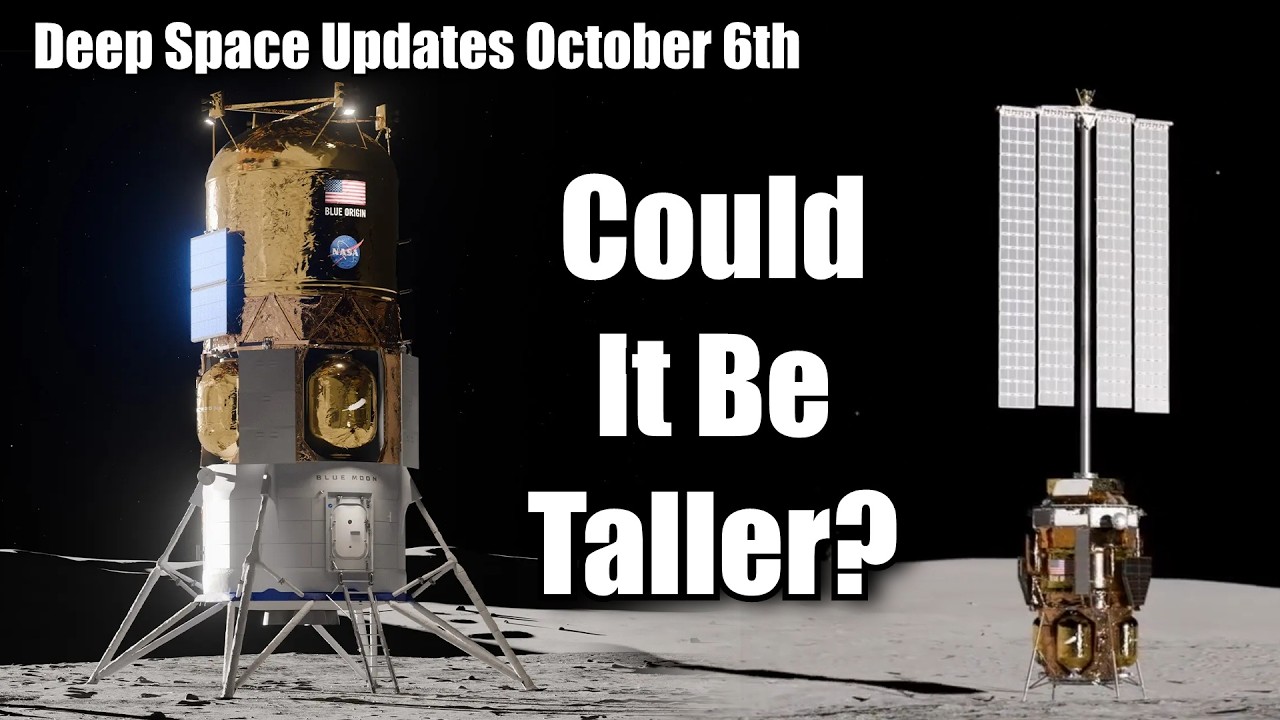
Uh, the other crewed vehicle worth mentioning is Artemis, the SLS, and Artemis 3. Uh, it’s actually getting pretty close to being stacked, right? You know, they said that they were going to go fast on this and I believe the fuel segments on both boosters are now stacked. Uh, the assemblies have still to go on and stuff like that. It’s impressive that they’ve got through the stacking so quickly. Uh, at this point though, it does sound like Artemis 3 is now looking like no earlier than June of 2027. And again, this is a low orbit flight. It’s not going to spa to the moon. It’s going to have that spacer instead of the um, the upper stage. Uh, also in the meantime, by the way, Blue Origin, they released some more details or some new renders. They released some new renders of the Mark 2 Blue Moon. Uh, and it looks different from what we had. So, previously you had this sort of pancake-shaped tank underneath the oxygen tank underneath the hydrogen tank. That is now like four separate oxygen tanks. It looks a lot closer to the Blue Moon Mark 1 and I suspect that that is just simply to minimize the number of engineering changes that they have to make. I presume these oxygen tanks are still going to be bigger, but um, yeah, that that’s uh also that’s interesting.
You know, you can see that the tank has like a new insulation. We have uh, there’s a new package of attitude control jets which we hadn’t previously seen on the Mark I have solar arrays now visible. Radiators are in different places. The landing legs are a bit stronger. So there’s just a whole lot of different stuff changing in these renders but they are renders and this is again distinct from the stripped down the Mark 1.5 that we’re going to see on Artemis 3. Uh, so anyway, yeah, they also showed off like renders of the power tower, Towers of Power. Uh, yeah, this so this is basically the power version that’s designed for lunar bases. The idea is this thing is going to come down, land somewhere, and it’s got this big tower that goes up like 20 meters on a mast and then it deploys solar panels and those can then track the sun. And this is of course it works for a polar landing site. And I guess the idea is you then plug in your cable and you’re going to know exactly what standards these things are going to use. Still going to be launched by New Glenn.
And by the way, New Glenn launch site rebuild is coming on. Dave Limp today showed that they had added another piece back to the tower. So they’re building back up now and hopefully, you know, I’m not saying it’s impossible that they launch this year and I would really like to see it but you know, you’re going fast. And great news for new uh for Blue Origin is that New Glenn 9 by 4 is now officially on the NASA launch menu. So the NASA’s launch services program. They basically have to screen the rockets and say, “Yeah, you can be part of it uh for NASA payloads.” So now New Glenn 94 is potentially an option. It sits next to obviously 72, which is not quite as capable, but um, yeah, NASA will be able to put some of their bigger payloads on there. And as I pointed out, the 94 with its big hammerhead payload could carry you wider payloads than can currently fit in Starship, especially since Starship still only has the PEZ dispenser. Even if they have a big uh, you know, door that opens up, they’re still going to be limited and it could well be that a traditional fairing is going to win out on this. So anyway, yeah, good news for Blue Origin all around.
14
posted on
10/08/2026 12:59:30 PM PDT
by
SunkenCiv
(TDS -- it's not just for DNC shills and jihadists anymore -- oh, wait, yeah it is.)
Transcript
Chapter 7: Defense and Science Updates
Okay, elsewhere. Oh, a whole bit of history retired in the last uh, you know, couple of weeks. The defense support program, that’s the infrared missile 1st of October that they’re decommissioning these finally. These date back to the 1970s. Um, and so they were, you of course they’re built to see Soviet ICBM plumes early that you would have a tight chance to actually figure out whether you wanted to actually push the red button and end the world. They flew about 23 of these over the years. 24th was canceled. The new version is called Spurs, SBIR, right? Space-based infrared system. And that has completely replaced it at this point. So they’ve switched off the old systems. But we will always have the great memories of DSP doing its space purpose.
NASA announced an award for a new mission called PRIMA or Prima the probe explorer whatever. This is a far infrared telescope as opposed to like James Webb Space Telescope which is a near infrared space telescope. Uh, this and interestingly, of course, this came up as a potential award, but it wasn’t competitive. So, there was another mission that was competing for this. It was called Axis X-ray probe, but this during development, uh, it exceeded its budget by 10%. During the development and that was blamed on basically, you know, a bunch of people being uh, fired from Goddard during the doge time and that meant that they didn’t have enough people to actually work on the project and they ended up not being able to, you know, fit to the budget and so that meant that Primo was the only candidate in this case. So yeah, um, yeah, I guess if you’re really into infrared astronomy rather than X-ray astronomy, then uh, you’re happy. Okay.
15
posted on
10/08/2026 12:59:57 PM PDT
by
SunkenCiv
(TDS -- it's not just for DNC shills and jihadists anymore -- oh, wait, yeah it is.)
Transcript
Chapter 8: New Space Industry Ventures
Um, one of my most watched videos is one about a little company called Spin Launch, who they are plan, and they got a bunch of funding to do this is to use a big spinny thing to throw payloads into space. A radical plan and one that many skeptics said that will never work. They said Spin Launch will never launch anything. But I’m going to say those people are wrong because on 28th of September, Spin Launch spun off and launched Meridian. That is their flat satellite se uh, you know, component of the company that is being spun off into a new thing and uh, yeah, so yeah, spit app it’s apparently uh, you know, they say that you can put 250 of their flat satellites on a single Falcon 9 which would be great if the Falcon 9 was going to fly when they’re ready to fly stuff and they actually flew did fly a customer like a link test satellite on transporter 18 so it is interesting that they the divorce between Spin Launch and Meridian happened the same week as Meridian launched its first demo. Um, Astroforge, they’re a fun company. They’re uh, you know, down in LA and they want to talk about mining asteroids using lasers. I’m very excited about what they do and I’m especially excited that their CEO, Matt Gallich, basically said, “Yeah, we’re going to have a fully autonomous mission on our next flight.” because they had uh, communications problems on their first flight and they said, “Hey, why don’t we just try to make this fully autonomous so it can watch all the different sensors, integrate them and make interesting reaction, you know, make, you know, good choices, informed choices.
16
posted on
10/08/2026 1:00:18 PM PDT
by
SunkenCiv
(TDS -- it's not just for DNC shills and jihadists anymore -- oh, wait, yeah it is.)
Transcript
Chapter 8: New Space Industry Ventures
Um, one of my most watched videos is one about a little company called Spin Launch, who they are plan, and they got a bunch of funding to do this is to use a big spinny thing to throw payloads into space. A radical plan and one that many skeptics said that will never work. They said Spin Launch will never launch anything. But I’m going to say those people are wrong because on the 28th of September, Spin Launch spun off and launched Meridian. That is their flat satellite, uh, you know, component of the company that is being spun off into a new thing and, uh, yeah, so yeah, spit app, it’s apparently, uh, you know, they say that you can put 250 of their flat satellites on a single Falcon 9, which would be great if the Falcon 9 was going to fly when they’re ready to fly stuff and they actually flew, did fly a customer like a link test satellite on transporter 18. So it is interesting that the divorce between Spin Launch and Meridian happened the same week as Meridian launched its first demo.
Um, Astroforge, they’re a fun company. They’re, uh, you know, down in LA and they want to talk about mining asteroids using lasers. I’m very excited about what they do and I’m especially excited that their CEO, Matt Gallich, basically said, “Yeah, we’re going to have a fully autonomous mission on our next flight.” because they had, uh, communications problems on their first flight and they said, “Hey, why don’t we just try to make this fully autonomous so it can watch all the different sensors, integrate them and make interesting reaction, you know, make, you know, good choices, informed choices.” Basically, it’s apparently a trained AI that’s going to sit on top of the regular physics soft. So, the normal flight software is going to be down here doing the low-level stuff, and then they’ll have an AI agent that is going to run the spacecraft. And they made comments to the point of like, well, I wish we didn’t have to fly or I don’t think we need to fly an antenna on this spacecraft, but I think they’re going to end up flying an antenna on this spacecraft.
Uh, so this is supposed to fly on the very first Stoke mission. So, uh, potentially next year, 2027, that will be a very cool launch. I hope maybe I’ll get to that one. That would be pretty cool. Uh, it’s also going to fly with like a helopysics payload for Goddard. But anyway, yeah, it’s not the first deep spacecraft to offer to promise some level of autonomy. I think Deep Space 1 is actually one of the famous ones. Yes, it’s well known for smashing a chunk of stuff into a comet, but it also had onboard like autonomous capabilities. And Osiris Rex, you know, it had to go do its touch-and-go sampling maneuver. That thing had to be completely automated. So again, that’s another example of a deep spacecraft which had to be fully autonomous, at least for that portion of the flight.
17
posted on
10/08/2026 1:00:39 PM PDT
by
SunkenCiv
(TDS -- it's not just for DNC shills and jihadists anymore -- oh, wait, yeah it is.)
Transcript
Chapter 9: Scottish and Small-Scale Rocketry
Okay, moving over to Scotland. Now, we all know Orbex, the Scottish rocket company, out of business. They are now being sold for parts. And one of the things that came out of this is they had a suborbital flight authorization license which has been acquired by High Impulse. Now, High Impulse is a German company, uh, which has a suborbital like sounding rocket which uses a hybrid engine. I think their engine uses liquid oxygen and paraffin wax. So, yeah, they’re potentially going to reuse that launch license. Uh, the other one is more interesting, I think, is a Portuguese company called Omnida. They basically acquired Orbex’s UK’s like manufacturing assets, the intellectual property, the brand, and associated equipment. They are planning to bring the rocket back, right? They want to make a new version of the Prime called the Prime Neo. So, it might live again. It might. I don’t know if it’ll launch from Scotland, but, uh, yeah, I’m excited to see what happens. And speaking of small rockets, we’re going to see a lot more of them because Rocket Lab has sold 20 more launches of their Electron. Yeah, this is the largest commercial contract signed so far. Again, it’s for Strix, who have been regularly launching their Strix satellites on a Rocket Lab’s Electron. So that brings their total to something like 47 contracted launches with like 13 already flown. Um, so yeah, they are by far the biggest Electron C. That’s almost like, that’s like 2/3 or one-third, sorry, of Rocket Lab’s flights are going to be from Strix. And you know what it does mean that Rocket Lab are gonna have to come up with a lot more owl puns. So if you have any owl puns that Rocket Lab could use for a mission name, please add them in the comments. I’m sure that Peter Beck would appreciate them. The 28th of September also again, the 20th of September, very busy day for us space people.
18
posted on
10/08/2026 1:01:03 PM PDT
by
SunkenCiv
(TDS -- it's not just for DNC shills and jihadists anymore -- oh, wait, yeah it is.)
Transcript
Chapter 10: Deep Space and Amateur Projects
Um, Juice, the Jupiter icy moons explorer. It performed a fly past, a gravitational slingshot flying over the Indian Ocean at 8,640 flew by. We got some photos from the engineering cameras. So yeah, it’s continuing its mission. It has one more Earth flyby in 2029 and then it should get to Jupiter in July of 2031 and start exploring those icy moons and bringing the juice back to Earth. Um, Exaunch. So, Exala, um, they fly all sorts of payloads on transporter missions and they are understandably concerned about the transporter missions going away. Well, they’ve actually booked a, uh, Starship. They’ve booked, well, they’re not booked a Starship. They’ve booked, um, Starfall Microgravity. It’s not really clear, but they are basically talking about putting customer hardware in these Starfall missions that are going to fly on Starship. So, uh, they are moving towards the New Deal in town. Um, but that is the first I’ve heard of a commercial Starfall sale. Capstone 2, we’ve now heard about it. So, Capstone, of course, is this small mission that launched in a Rocket Lab. It was supposed to demonstrate the powers of the near-rectilinear halo orbit. And boy, did they demonstrate that a near-rectilinear halo orbit could absolutely be flown in. They didn’t demonstrate that it was actually good to put a space station in. But regardless, there’s now going to be another mission, Capstone 2, and this is going to carry a couple of different payloads and stuff. So, it’s going to be a pair of 400 kg spacecraft built by Terran orbital. Um, and so they’re going to be delivered to this like near-rectilinear halo orbit. There’ll be a chaser and there’ll be a target. And the point is to demonstrate like autonomous navigation, rendezvous, proximity ops, and sis lurcoms and whatever else. And you know, this would all be really good if you were, say, wanting to like have a space station there and dock with it. But you know, whatever. Uh, this mission is going to happen.
There’s going to be, uh, a Lawrence Livermore Labs developed payload with like these cool telescopes and wide field lenses and stuff. Anyway, um, and so you’ve heard of open source, but have you heard of open turbo pumps? Yes, open turbo pumps just fired their rocket engine, which is a liquid-fueled rocket engine that includes a turbo pump. Now, now let’s get you through like the whole scale of amateur rocketry. At the bottom, you have people with solid rocket motors. You buy the motor off the shelf, you stick it in your thing and you fly and you can go to space. You can do amazing things with that. Then you have the engineers that do liquid propellant rockets and these are generally pressure fed. Look at project Keg Rocket, right? But that’s pressure-fed. You want to be a real big boy in the rocket space. You got to know how to take that fuel from the tank and that oxidizer and pressurize it using a turbo pump so you can get big chamber pressures and big performance. Well, uh, yeah. Mario Hernandez apparently doing the whole like I can build a rocket in my garage thing. Yeah, he’s done it and it generates like four kN of thrust which, you know, it’s like 400 kgs. It’s not massive, but the fact is this is something that, you know, is now within the scope of amateurs while, of course, you know, we see big companies elsewhere still using solid rocket motors and stuff because they want to get things done quickly.
19
posted on
10/08/2026 1:01:28 PM PDT
by
SunkenCiv
(TDS -- it's not just for DNC shills and jihadists anymore -- oh, wait, yeah it is.)
Transcript
Chapter 11: Rocketry Reports and Accidents
Uh, speaking of big companies with big plans, uh, Nayuta Space, you might remember, I’ve highlighted them a couple of times about how they’ve got this, uh, Starship-like thing with rockets. They’ve got a bunch of renders. Well, apparently they sort of made the news a little on the internet for a bunch of leaked internal chats. The CEO threatening to fire engineers who skipped mandatory weekend overtime on an 11-day streak. [laughter] This is not looking good for them. Apparently, there’s verbal abuse, table slamming, and nearly half the engineering team gone in under a year. It doesn’t look good for Nayuta Space, but honestly, the renders never look that realistic. Still, you know, maybe China will get its Starlink clone soon enough. Also in the internet on Twitter, Blobby, um, basically had performed a FOIA for the incident reports, the accident reports with, uh, for flight for Starship flight seven and eight, and they finally got the FOIAs, the documents back. They are heavily redacted.
There’s very little on the failure of, uh, flight number seven, but it does show a lot of cool stuff about how they, uh, used amateur photography of the re-entering Starship to figure out the exact entry path and figure out where the debris might land. They did actually find like small light debris. They haven’t found any metal. Flight eight, they actually document the fact that they saw sparks on engine one, um, about 320 seconds into the burn. And that is about 10 seconds before what is called a significant dynamic event. That is, of course, where, uh, you know, all the engines exploded and the thing spun out of control and then ultimately burned up. Uh, it’s interesting to follow up on this and go and read a lot of this, but yeah, there’s not a huge amount of new information in here. Still, it’s always cool to see the accident reports one way or another.
20
posted on
10/08/2026 1:01:52 PM PDT
by
SunkenCiv
(TDS -- it's not just for DNC shills and jihadists anymore -- oh, wait, yeah it is.)
Navigation: use the links below to view more comments.
first 1-20, 21-22 next last
Disclaimer:
Opinions posted on Free Republic are those of the individual
posters and do not necessarily represent the opinion of Free Republic or its
management. All materials posted herein are protected by copyright law and the
exemption for fair use of copyrighted works.
FreeRepublic.com is powered by software copyright 2000-2008 John Robinson