Skip to comments.
World's Largest Slingshot Threw A Spacecraft To Earth! [14:54]
YouTube ^
| September 30, 2026
| Scott Manley
Posted on 09/30/2026 8:08:51 PM PDT by SunkenCiv
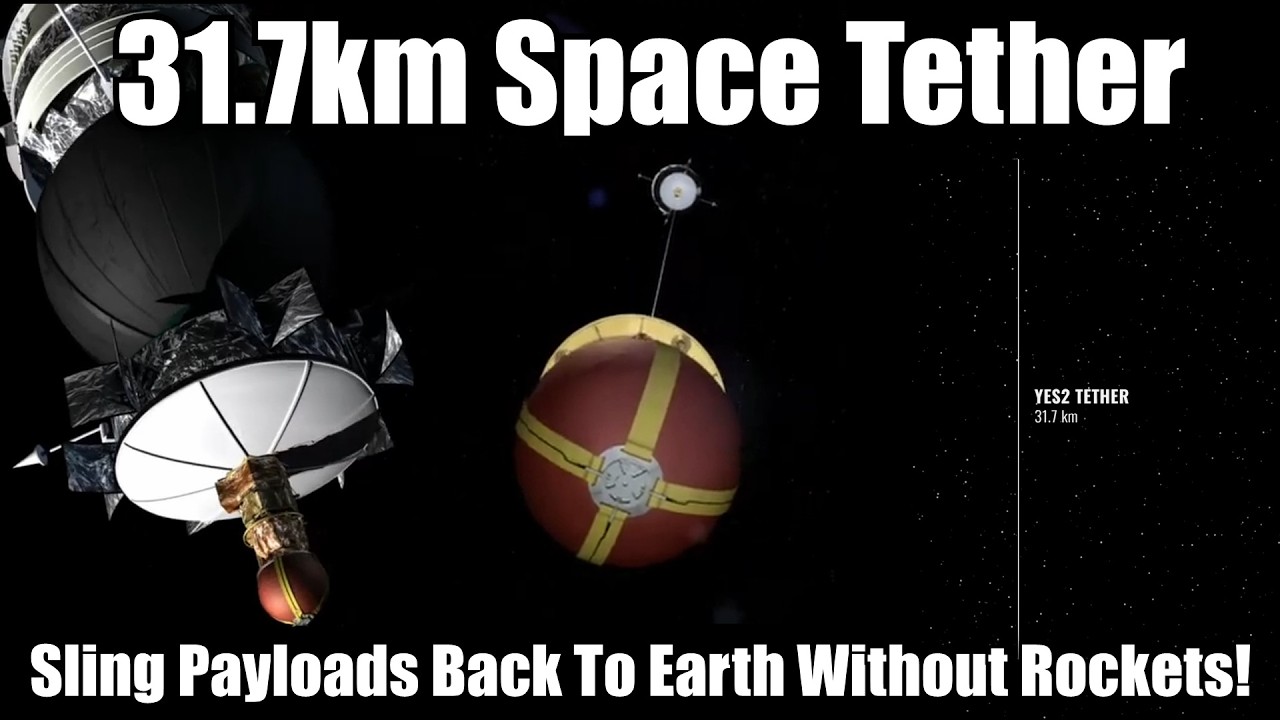
In 2007 a spacecraft was launched with a special tether experiment named 'YES2' - this was planned to deploy a 30km tether and swing it like a pendulum to return a payload to Earth without using rockets. It holds the record for the longest object ever deployed in space, but, we don't know what happened to the return capsule. World's Largest Slingshot Threw A Spacecraft To Earth! | 14:54
Scott Manley | 1.87M subscribers | 103,941 views | September 30, 2026
(Excerpt) Read more at youtube.com ...
TOPICS: Business/Economy
KEYWORDS: scottmanley
1
posted on
09/30/2026 8:08:51 PM PDT
by
SunkenCiv
To: AdmSmith; AnonymousConservative; Arthur Wildfire! March; Berosus; Bockscar; BraveMan; cardinal4; ...
2
posted on
09/30/2026 8:10:14 PM PDT
by
SunkenCiv
(TDS -- it's not just for DNC shills and jihadists anymore -- oh, wait, yeah it is.)
Transcript Chapter 1: The Longest Satellite
Hello, it’s Scott Manley here. Today I want to talk about the longest satellite. Yes, you know, we’ve seen some very big satellites out there, multi-ton constructions, but there have been some very long ones, and these ones, as you might imagine, use tethers to connect separate pieces. You may have seen images of the space shuttle in orbit deploying a long tether with the idea being that as this wire cut through the Earth’s magnetic field in the orbit, it would generate electrical power. The space shuttle was obviously exact, you know, modeling this and studying the dynamics of these tethers. Another example from the early days would be the Gemini mission where they hooked up a lasso or hooked a line around the Aena and the Gemini, and they sort of just moved around in a circle to show that yes, you can in fact do this. But yes, the longest spacecraft ever made by the tether is the YES2 spacecraft, and it deployed more than 30 kilometers of tether, or about, um, you know, 20 miles or something like that, 16 miles. It’s lots, right? [clears throat]
3
posted on
09/30/2026 8:10:38 PM PDT
by
SunkenCiv
(TDS -- it's not just for DNC shills and jihadists anymore -- oh, wait, yeah it is.)
Transcript Chapter 2: Project Goals and Origin
So, yeah, the YES2 spacecraft, YES stands for Young Engineering Satellite, and it was a European Space Agency project. Now, the original YES satellite, because it’s obviously number two, it also involved a tether. Uh, that was a sort of opportunity that arose after the failure of the very first Aran 5 launch. If you remember, they had a software error and the rocket was obviously destroyed, and suddenly nobody wanted to fly their actual scientific payloads on the second flight of the Aran 5. So ISSA threw together a couple of payloads that would attach to the mass simulator so that they could at least get some scientific value from this mission. And a Young Engineering Satellite one was part of this. It wasn’t hugely successful, although some other satellite or hardware on there called Teamsat.
But eventually, yeah, into the year 2002, a second opportunity arose for Young Engineering Satellite number two. The idea being that this was a satellite project where students across Europe could work on and contribute to it in some way, and they had a chance of it flying in space. And the idea for this was something called Photon Mail. They wanted to play out a really long tether from another satellite with a payload or a re-entry capsule on the other end and then use the interaction between the parent spacecraft and the smaller spacecraft to adjust the orbits and eventually release this package into a re-entry trajectory and recover it on the ground. So the parent spacecraft in this case was a spacecraft called Photon M3.
4
posted on
09/30/2026 8:11:17 PM PDT
by
SunkenCiv
(TDS -- it's not just for DNC shills and jihadists anymore -- oh, wait, yeah it is.)
Transcript Chapter 3: Spacecraft and Planning
The spacecraft is actually a descendant of Urugan’s Vostto. It is a spacecraft with a pressurized spherical module which can do science and then return it to the Earth. You know, the Soyuz spacecraft that Russia or the Soviet Union used, it’s great at returning people, but it doesn’t have a huge amount of cargo space. So what you found was that the Vostto spacecraft, first of all, it got adapted to be a spy satellite, and the cameras and the film would be recovered in this capsule, and later on that design was evolved so they could put science experiments in that sphere and then have that returned to Earth. And so Europe had purchased some flights on this Russian hardware. Now, this was in the early 2000s before Europe had launched the Columbus module to the International Space Station. So, uh, they were taking various bids, and this one was decided that they would add this and it would stick on the outside.
So it was actually like a Dutch engineering company that had been pitching all sorts of ideas for tethers, and they led the project. So yeah, the project obviously didn’t have huge amounts of money. There was originally a plan to test some components of it on Photon M2, but that was dropped, and instead they went straight with their first mission on Photon M3, which would be the final version. It was actually like less than a month before they launched, I think, before they were absolutely given the green light because there were some concerns over the interaction between a very long tether and the parent spacecraft. I mean, hey, I would be concerned about trailing a giant piece of cheese wire through low Earth orbit today. Back then, there was a little less in terms of Starlink satellites floating around. But yeah, so the Photon M3 would fly for a couple of weeks, and then on the final day, it would assume an attitude and then it would deploy this satellite.
5
posted on
09/30/2026 8:11:32 PM PDT
by
SunkenCiv
(TDS -- it's not just for DNC shills and jihadists anymore -- oh, wait, yeah it is.)
Transcript Chapter 4: Deployment Mechanics
So the S2 hardware was attached to the front of the rocket. It was a 30-odd kilogram package. So that’s relatively lightweight. And the idea was that it would be able to return its re-entry capsule without needing to fire any rocket engines. So the spacecraft hardware itself consisted of three parts. First of all, there was Floyd, which was the component that had the giant 30 km spool of, you know, of the tether. Then attached to that, there was an object called mass that was mechanical and data acquisition support systems. It also added extra mass, which was important because you want to have mass to pull these things apart. And then finally, there was the re-entry capsule which was called Fotino because the parent spacecraft was called Photon, and it had a big sphere that would re-enter. Futino was a much smaller sphere that would re-enter.
So the way this was designed to work was the Photon capsule would point face down towards the Earth, and then it would release the hardware, and using springs, they would separate out at a speed of about 3 meters per second, you know, 10 feet per second. And so they would initially separate, and there would be a minimal amount of tension applied to that fiber. And so they would extend out to something like 2 km. Now, the thing with orbital mechanics, as you know, is if you just push something inwards, then it’s going to go to a lower orbit, and eventually it’s going to pick up speed and start going faster than your parent vessel.
So what would happen is the payload would start to swing forwards in the orbit attached by this tether. So at a certain point, around I think it was the 2 km mark, they would stop the deployment and hold it still because they had a braking and an anchoring system in there, and that would then mean that there was tension applied between these things, and it would start to behave like a pendulum because it was lower down in the gravity field. So it would actually start to swing backwards, and as it came backwards at the right point, they would let it start deploying again. And at this point, there was enough tension on the, uh, on between the payloads that they would start pulling themselves apart due to the difference in gravity due to the tides.
Now, part of this design was that they needed to control the rate at which things were played out, and there was what was called a barber pole style braking system on it, which is a genius piece of design here. So you have this giant spool of fiber that’s coming through it, and it runs through this section where it wraps around a metal cylinder like a spiral around a barber pole a couple of times, and the more times it wraps around, the more of the fiber is in contact with the cylinder, and therefore the higher the friction. So at the bottom, there’s a deploy, there’s like a hole which can be twisted around, so that adds or removes turns from this, and the system was supposed to actively control the friction here so it would maintain like a reasonable deployment rate, and then when it got towards the final distance, it would slow things down and gently stop it because rapid changes in speed could result in, uh, you know, oscillations and stuff on the line, which they didn’t want.
6
posted on
09/30/2026 8:11:52 PM PDT
by
SunkenCiv
(TDS -- it's not just for DNC shills and jihadists anymore -- oh, wait, yeah it is.)
Transcript Chapter 5: Mission Execution Challenges
So the next stage was the deployment began happening properly on schedule with the PL, with the whole thing being timed so that the deployment would reach the correct distance and they would let it swing back and then they would release it at exactly the right time so the capsule would re-enter over Kazakhstan, roughly where the Soyuz and the Photon capsules would end up coming down. The problem was after about 8 kilometers of deployment, power was lost in the sensor system and they couldn’t detect whether it was working or not. They couldn’t tell whether it had stuck or not. That was a problem. [laughter]
So, apparently the system kept running and they did actually verify that it did release, but initially they thought that it had only released after like 8 kilometers of tether had been played out and that wouldn’t have given enough velocity to de-orbit. So they thought the mission was only a partial success. Secondly, they didn’t get any signal from the descent capsule, which of course was supposed to have a parachute and everything on it, and it was supposed to have a recovery beacon so that they would be able to locate it once it had landed in Kazakhstan.
And so they never actually were able to recover the spacecraft. They never got any signals from it and it was lost. But about a month later, the team that was working on the project actually came back with an analysis that said actually we succeeded big time except that we didn’t actually recover it. So what they found was there was another piece of hardware, another experiment which was running on the Photon spacecraft, something called DMAC DIMC, and I think it basically was a very high rate, high frequency, very sensitive accelerometer.
The idea was, I guess, this was going to be used for some science they were verifying on orbit and they had got the data from this and they could see in the data from this accelerometer the tiny tugs that were being applied to the spacecraft from this tether. They could actually see the signal changing over time as the tether began to play out faster and faster because the tether was like running around this barber pole. They could actually see oscillations running at roughly the playout frequency. So they could actually count how many loops were running through the braking system and therefore figure out how far it was getting deployed.
And they then saw also a big signal, and this big signal was when they reached the end of the cable at 31.7 km. So it had gone at that point, of course, it was the longest spacecraft ever. It had hit this maximum deployed length at a speed of about 15 meters/s or, you know, like we’re talking like, you know, 50 miles an hour or thereabouts. So this thing reached out and as soon as it hit that, it actually stretched the cable by about another 100 meters and it bounced back, and they actually can see oscillations in this DMAC data. Now it had reached this distance. It then began to swing back and apparently the deployment or the release was working on a timer. So it actually released at roughly the right time, but it was going a bit faster than expected and that meant that it actually was released at a slower velocity than originally intended and so it ended up landing a little earlier downrange.
7
posted on
09/30/2026 8:12:13 PM PDT
by
SunkenCiv
(TDS -- it's not just for DNC shills and jihadists anymore -- oh, wait, yeah it is.)
Transcript Chapter 6: Analyzing the Success
Another bit of evidence that the thing was a success was that the US Space Surveillance Network, they were of course tracking the mission and they observed that the Photon spacecraft had climbed in its altitude by about 1.3 km, which is exactly what they would have expected if the capsule was cut free at the right time on a 30 km tether. So the orbital mechanics of the parent body showed that the secondary spacecraft must have been deployed at roughly the right time and the right altitude just based on the orbital information.
So they showed basically that the system had correctly operated, but due to various complications with not being able to measure the speed, it had gone too fast and deployed the capsule. And yeah, then the second problem was the capsule didn’t actually send out any data so that they didn’t get any telemetry or anything they could lock onto. But using all this information from this highly sensitive accelerometer, they were able to show that, yeah, this would have landed in a specific area and assuming the parachute had worked, which was of course designed to work based on a pressure switch, it was entirely possible that it did successfully work. It would have been in an area that unfortunately would have been below the horizon of the recovery area. So they would not have got any signal from the beacon on board.
Now, at this point, that means that there is potentially this re-entry vehicle has landed somewhere in this area downrange in Kazakhstan. It’s a little near the Aral Sea, I believe. And there’s a bunch of lakes in the area ellipse. It’s entirely possible it landed in a lake and disappeared forever. But maybe one of these days it will be found. That might be interesting because the capsule itself includes a bunch of text that says, “Hey, if you find this, there’s a $1,000 reward if you can return it to its rightful owners. It’s still out there. It’s a very large chunk of space.” Or maybe it just burned up. But I found this is a cool little mission.
8
posted on
09/30/2026 8:12:30 PM PDT
by
SunkenCiv
(TDS -- it's not just for DNC shills and jihadists anymore -- oh, wait, yeah it is.)
Transcript Chapter 7: Legacy of the Mission
So, this idea was put together relatively quickly, and it does hold the record for the longest satellite ever at 31.7 km. Actually, slightly longer because of the stretch. They demonstrated that they were able to control the tether over these large lengths. They demonstrated that they were able to deorbit accurately. They demonstrated the de-orbit technique using a tether and a swing, essentially a giant bolas, I guess, to swing this thing around and let it go at exactly the right time so that it could actually perform a de-orbit. I think this is a really, really cool mission. I’d never seen this before until I found this here.
So yes, this was in fact the longest spacecraft ever launched and it was long for good reason. They demonstrated that using a sufficiently long tether with careful deployment dynamics, you can in fact de-orbit a spacecraft without rocket engines. Although I will say that in today’s environment with so many satellites up there, I think there will be a lot of people against a 30 km bit of cheese wire flying through their constellations and they would prefer that you just learn to use good old-fashioned rocket engines. I’m Scott Manley. Fly safe.
9
posted on
09/30/2026 8:12:47 PM PDT
by
SunkenCiv
(TDS -- it's not just for DNC shills and jihadists anymore -- oh, wait, yeah it is.)
To: All
We are being attacked by aliens. Do not be fooled by the crude weapon of a slingshot. Slinging a spacecraft at earth is not going to buff out. People, property and animals could have been in harms way. We must track these intergalactic thugs down and give them what for.
10
posted on
09/30/2026 9:30:52 PM PDT
by
BipolarBob
(I'm multilingual, I also speak Facetious.)
To: SunkenCiv
To: SunkenCiv
12
posted on
10/01/2026 5:37:52 AM PDT
by
BenLurkin
(The above is not a statement of fact. It is opinion or satire. Or both.)
To: BenLurkin
Looks like there's a bit of an accuracy problem with the method. 🙂😊😁😀😃😆😅😂🤣
13
posted on
10/01/2026 5:50:14 AM PDT
by
SunkenCiv
(TDS -- it's not just for DNC shills and jihadists anymore -- oh, wait, yeah it is.)
To: SunkenCiv
"a special tether experiment named 'YES2' - this was planned to deploy a 30km tether and swing it like a pendulum"
So, is it like a slingshot or is it like a pendulum? A pendulum moves back and forth and a slingshot does something else.
14
posted on
10/01/2026 5:54:39 AM PDT
by
equaviator
(Nobody's perfect. That's why they put pencils on erasers!)
To: equaviator
A sling, not a slingshot.
How the hell to you mis a complete planet?
15
posted on
10/01/2026 7:34:37 AM PDT
by
ASOC
(YGBSM)
Disclaimer:
Opinions posted on Free Republic are those of the individual
posters and do not necessarily represent the opinion of Free Republic or its
management. All materials posted herein are protected by copyright law and the
exemption for fair use of copyrighted works.
FreeRepublic.com is powered by software copyright 2000-2008 John Robinson