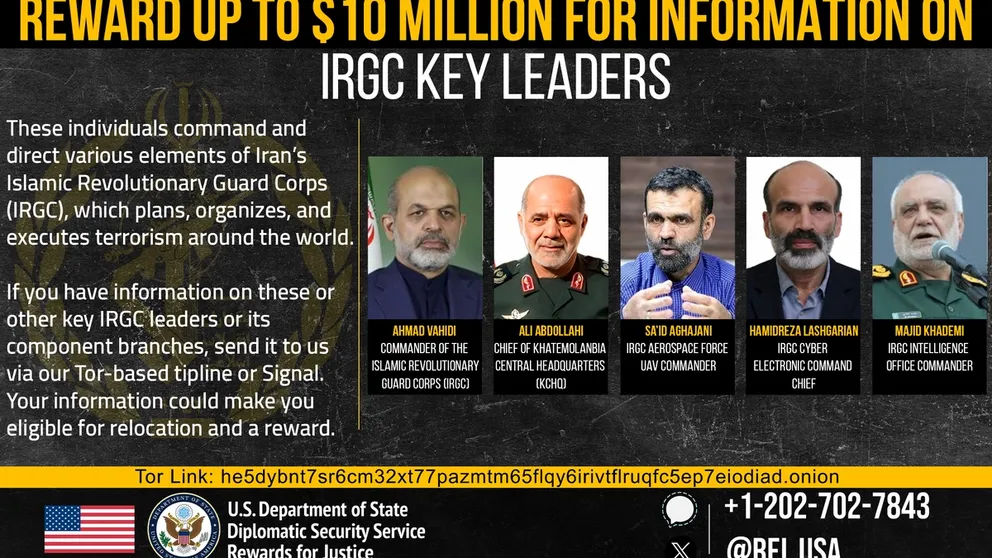
TLDR: Khademi was the boss of the internal secret police in charge of repression of the people of Iran. He is now resting, pining for the fjords.
Posted on 04/06/2026 9:30:47 AM PDT by MeanWestTexan
Majid Khademi, the IRGC intelligence chief killed in Tehran early Monday, was not a battlefield commander so much as a career security insider who rose through Iran’s secretive counterintelligence system and helped oversee repression, surveillance and anti-infiltration work.
His death matters because he sat at the junction of two of the system’s most sensitive functions: guarding the Guards from infiltration and directing the intelligence arm accused of crushing dissent.
In March, Washington’s Rewards for Justice program offered up to $10 million for information on Khademi and other senior IRGC figures, a sign that he was seen abroad not just as an internal operator but as a high-value intelligence target.
In symbolic terms, one of the men tasked with stopping penetration of the state was himself reached in the middle of Tehran.
A security man from the inner system
Khademi was one of the least public senior figures in Iran’s power structure. Iranian and regional reports have described him as being from the Fasa area in Fars province, while official and semi-official outlets have referred to him under different versions of his name, including Majid Khademi and Majid Hosseini, reflecting the opacity that surrounds senior intelligence officials.
Unlike many top IRGC commanders, he does not appear to have built his standing mainly through front-line war command. He rose instead through the quieter, more secretive world of protection, vetting and internal security.
From internal monitoring to the top intelligence job
Khademi was appointed head of the Defense Ministry’s intelligence protection organization in 2018. In 2022, after a major shake-up inside the IRGC following a series of security failures and reported Israeli penetrations, he was made head of the Guards’ Intelligence Protection Organization.
He was promoted again in June 2025, after the killing of his predecessor Mohammad Kazemi, to lead the IRGC Intelligence Organization itself.
That move put him in charge of a body the US Treasury later said had been “instrumental” in violently suppressing protests through mass violence, arbitrary detentions and intimidation.
That progression is part of what makes his killing significant. Khademi had spent years policing the system from within before ending up at the top of one of its most feared coercive institutions.
Why his role was so sensitive
The IRGC’s Intelligence Protection Organization and its Intelligence Organization do different jobs, but together they form a core part of the Islamic Republic’s security state.
The first looks inward – loyalty, secrecy, infiltration and internal discipline – while the second has been linked to domestic repression and political-security cases.
Khademi mattered because he had moved through both worlds. He was not simply another general; he was a custodian of the regime’s inner files, vulnerabilities and suspicions.
That means his loss is not only personal or symbolic, but potentially institutional, at least in the short term. This is an inference from his portfolio and the structure of the IRGC, rather than a point Iranian officials have conceded.
How Khademi framed tighter control
Khademi gave a rare interview in February to the website of former Supreme Leader Ali Khamenei, and it offered a blunt window into how he saw the country.
He framed the January uprising not as a domestic revolt against the state, but as a foreign-backed plot, and presented mass preemption as routine intelligence work.
In that interview, he said the Guard had summoned 2,735 people linked to what he called anti-security networks, “counseled” 13,000 others, seized 1,173 weapons and identified 46 people allegedly tied to foreign intelligence services. He also said authorities had received nearly 500,000 public tips and reports by the end of the month.
Those figures are important less as verified facts than as a statement of doctrine. In his telling, the answer to unrest was wider surveillance, earlier intervention and a larger dragnet.
He also recalled Khamenei telling him to “pay attention to intelligence work” because “this period is like the year 60” – a reference to the early 1980s, one of the Islamic Republic’s bloodiest and most repressive phases.
The line is revealing because it shows the regime was reading the moment through the lens of existential internal threat, not ordinary dissent.
Khademi said Khamenei had stressed “two types of infiltration”: one deliberate and one broader current of people advancing the enemy’s aims without necessarily knowing it. Read plainly, that is the language of a state that sees not only organized opponents but also ordinary social and political currents as security problems.
Another revealing part of the interview was his insistence on the “national information network,” the state-backed effort to tighten control over Iran’s internet and communications space. That linked Khademi directly to the Islamic Republic’s broader push for censorship, digital control and isolation of the domestic information sphere.
A telling figure of the post-crackdown state
Khademi’s rise after the 2022 reshuffle suggested that the Islamic Republic wanted a harder, more security-centered figure to restore trust after repeated failures. His career embodied a system trying to repair itself through tighter internal control.
His death therefore lands on two levels at once. It removes a senior official tied to repression, and it exposes the vulnerability of a security apparatus that has long defined itself through secrecy, discipline and counter-penetration.
Why the killing matters now
Khademi was not just another uniformed commander. He was a product of the Islamic Republic’s hidden architecture – the part built to monitor loyalty, protect secrets and suppress threats before they reached the street.
His killing is more than the loss of one official. It is a blow to a man who personified the Islamic Republic’s effort to defend itself from within – and a reminder that even those charged with hunting infiltration have not been beyond its reach.
Good. May worms eat his soul for eternity.
Is there a single guy pictured who doesn’t look like he’d strangle his own mother?
They’re ugly inside and out.
killing someone at the center of their “deep state” means the US-Israel has their whole power-structure mapped, and can track many of them in real-time.
Generals and battlefield commanders are far more public figures. They have big staffs, they lead men, give public orders, etc... They are much easier to see where they fit in organizations and easier to track.
Guys in positions like Khademi try to keep a low profile.
I would have liked to give him to the family of the Wrestlers he just murdered.
No more raping innocent girls for him.
Every assassination matters, problem is, since these are cockroaches we are dealing with, they just replace one roach with another roach
No. 3 looks like he’s showing how to do it.
Most Iranian civilians hate the IRGC and the Mullahs and cheer when they get blown up. I hope President Trump does not destroy civilian power and water supplies since he has broad support from them. Trump should ramp up the arming of resistance groups to overthrow the IRGC and install a new government.
The Young Men just murdered...
RIP
You’re right to a degree, but each guy has institutional knowledge that is lost, and each guy had secrets and methods he kept to himself to insure his usefulness.
Also, there becomes a gravitas and “who’s in charge” issue, after a bit.
A bench becomes shallow when 5,000 of these guys (last count) are dead and 21,000 are injured to the point of no return (also last count).
Confusion, descension, becomes the norm. And makes them vulnerable.
Ha. They would all do it
There’s ways to turn off the lights without serious permanent damage.
https://en.wikipedia.org/wiki/Graphite_bomb
Is this the guy who was in charge of the hangings?
Iran hangs college student, another man in latest anti-regime protest executions
I know its easy to replace someone, one for another..but its funny hearing the commie crowd who keep claiming that “Iran is winning” just imagine if 80 percent of Trumps Administration were all killed, that is what basically happened to Iranian’s regime I doubt they would be saying we were winning
No, that’s the judiciary.
There are also being targeted.
I posted a (long and hard to read, as it was translated from Persian) article about the various attacks, including the judiciary. Just search under my name.
The last time I had a lengthy power outage was caused by a vehicle crash taking out an area power pole.
You’re right that does work.
But so does a graphite bombs or conductive chaff bombs, both of which we have in our arsenal, and both of which we have used in this theater.
Disclaimer: Opinions posted on Free Republic are those of the individual posters and do not necessarily represent the opinion of Free Republic or its management. All materials posted herein are protected by copyright law and the exemption for fair use of copyrighted works.