Posted on 05/05/2021 4:45:21 PM PDT by DoodleBob
“Free Covid test! Free vaccine! Have you gotten your vaccine?”
One afternoon last week, Humaira Choudhury called forth outside the East New York office of the nonprofit where she works, catching the attention of Johnny Flynn, 63, who lives around the corner. Like most residents in Brooklyn’s 11208 zip code, Flynn had yet to get his first COVID-19 shot—though not due to a lack of interest. It had just proven more difficult than he anticipated.
Flynn initially inquired at his local pharmacy, but they weren’t offering it. “They said ‘try online, something will come up,’” he recalled, but he struck out there, too. “So, I’ve just been waiting.”
As the city moves toward Mayor Bill de Blasio’s goal of vaccinating 5 million people by July 1st, it’s becoming increasingly important to figure out why some haven’t been able to get vaccinated or have put it off. Health experts are citing hesitancy as a major reason why herd immunity may not be achievable in the U.S. But barriers to access are also keeping people away from shots. Labor organizations in New Jersey, for example, are coordinating late-night shots for warehouse employees.
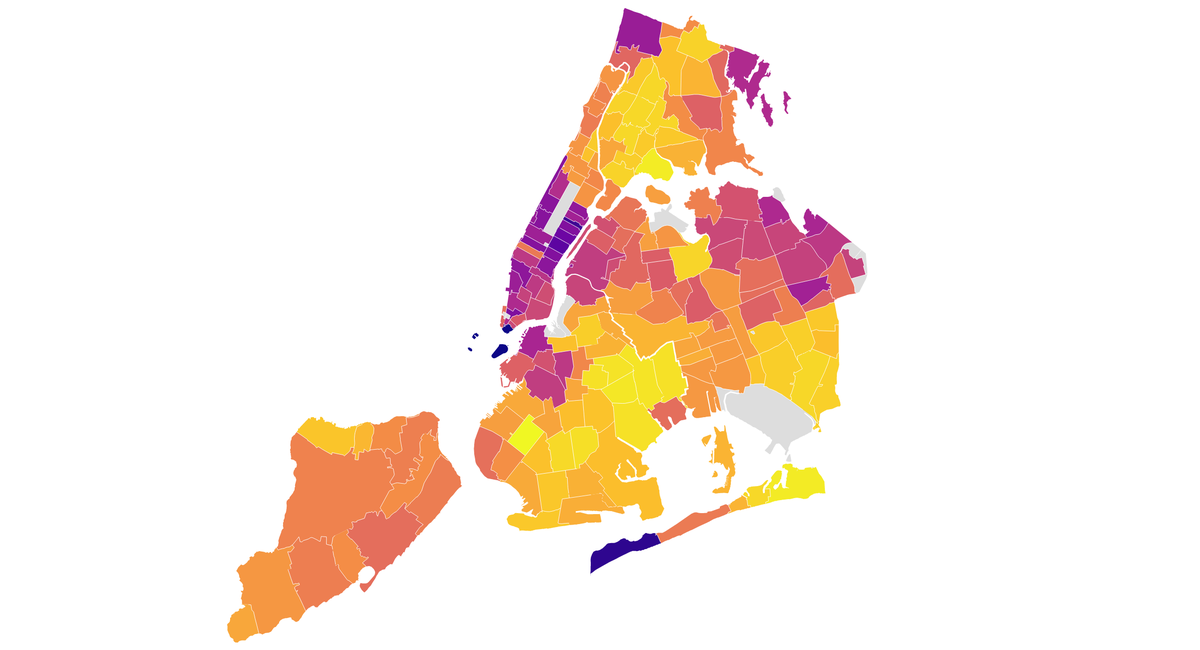
About 44% of New York City residents have received at least one COVID-19 shot, and about 32% are fully vaccinated. But some neighborhoods are much further along than others. In wealthier and whiter zip codes, more than two-thirds of residents are at least partially vaccinated (one zip code in the Financial District is at 89%). Most neighborhoods in upper Manhattan, Queens, The Bronx, Brooklyn and Staten Island are well below half their populations being fully vaccinated.
East New York's three zip codes, on average, sit at 34% with at least one shot and 24% fully vaccinated—even as the governor and mayor lift restrictions on social venues and city offices. By the time Israel rolled back its lockdown in mid-March, 50% of its residents had been fully vaccinated, and 60% had taken one dose. Israel's population is similar in size to New York City.
Fully Vaccinated Population Percentage by NYC ZIP Code (darkest=65%, lightest=17%)
Community organizations, such as the Bangladeshi American Community Development and Youth Services (BACDYS) where Choudhury works, are striving to boost the vaccination rate in their neighborhoods—person by person. BACDYS is culturally aligned with the local Bengali and Muslim populations in East New York but also serves the broader area, which is predominantly Black and Latino. But addressing people’s complex needs and concerns can be a slow process.
Flynn was intrigued when Choudhury handed him a flyer with a list of vaccine sites around the city that now allow walk-ins. But, with limited mobility following a stroke, he said the locations were all too far away. BACDYS was planning a vaccine pop-up but hadn’t yet locked down a date. Choudhury took down Flynn’s number and said she’d keep him in the loop. “If they do it, I’ll go ahead quick,” Flynn said.
Now that the city has vaccinated the “eager group” with the time and enthusiasm to get their shots quickly, it’s essential to focus on making the process more convenient, said Dr. Wafaa El-Sadr, professor of epidemiology and medicine at Columbia University and director of ICAP. She recommended deploying trusted messengers to distribute information about the vaccines and the shots themselves.
When it comes to convenience, it’s a matter of addressing practical impediments, “whether they're financial gaps or transportation issues or mobility issues or language issues or access to the Internet,” said El-Sadr.
I know they’re trying hard in New York, but they’re not achieving the results that are needed.
After months of making people navigate a maze of websites and phone numbers to get an appointment for a COVID-19 shot, the de Blasio administration announced on April 23rd that it would start allowing walk-ins at all city-run sites. State officials mimicked this decision days later.
“We do need to do more work in the communities hardest hit by COVID,” de Blasio said at a press conference on April 29th. “What I’m finding is the more we make vaccination convenient, the better we’re doing.”
Those working on expanding vaccine access say the move could be a game-changer.
“The online registration was a challenge because people don't necessarily have the time to navigate that or the access to the appropriate computer,” said Colette Pean, executive director of the East New York Restoration Local Development Corp. “And the hours were a challenge because you might get an appointment that doesn't match your work hours or your child care. So walk-ins are always better.”
So far, walk-ins haven’t reversed the downward trend in demand for the COVID-19 vaccines—as judged by the number of New York City residents receiving their first doses every day. Some groups are much harder to reach than others, such as the 500,000 undocumented people in the city.
“We have a lot of clients that are not willing to show photo I.D.,” said Afsana Monir, executive director of BACDYS. “We try our best to tell them it's fine; it’s not going to be shared. They’re like, ‘No, they're going to put my name in the system.’”
The rollout has not completely stalled in East New York, with the portion covered rising about 6% in two weeks. But because the city does not provide data on how vaccination rates are changing in zip codes from week to week, it’s hard to compare the rate of progress in different communities and target interventions accordingly, said Dr. Tom Frieden, former director of the Centers for Disease Control and Prevention and one-time commissioner of the city’s Health Department. He said cumulative vaccination rates only show part of the picture.
“What gets measured can get managed better,” Frieden said. “I know they’re trying hard in New York, but they’re not achieving the results that are needed.”
Primary care doctors can help push the effort forward, Dr. El-Sadr said. After giving private practices a minimal part during the early months of the rollout, the state recently began allocating doses to doctors in the SOMOS Community Care network.
But people living in low-income communities often have less access to primary care, and benefit from receiving health information and services through community activities, said Pean. She noted that there was food, free masks, blood pressure screenings, and assistance with setting up vaccine appointments at a recent event hosted by Brookdale hospital.
“In a community that has so many health problems, the whole discussion is how do we get into preventive health, of which the vaccine is one aspect,” Pean said.
Conducting this work requires resources, which are not distributed evenly. East New York Restoration and BACDYS are among seven organizations that recently won $10,000 each from the Brooklyn Community Foundation to promote vaccine access and address hesitancy.
Only 25% of Far Rockaway residents have gotten their first shot.
But over in Far Rockaway, Queens, Jeanne DuPont, executive director of the community organization RISE, says she lacks the resources she needs to do aggressive outreach. Only 25% of Far Rockaway residents have gotten their first shot, compared with 71% in wealthier, whiter Breezy Point at the other end of the peninsula.
DuPont said she tried unsuccessfully to convince the city to send over a mobile vaccine van or help her turn her building, which is no longer being used for in-person activities, into a hub.
“Out on the street, when I talk to people and ask them about it, they tell you that they don't feel comfortable getting vaccinated,” said DuPont. “And that includes kids in our program. That includes families. There has to be more people on the ground doing education about vaccinations and also literally getting people vaccinated.”
A city spokesperson countered that Far Rockaway’s 11691 “has multiple vaccination resources, including a hub and additional sites, as well as a pharmacy. Appointments are available now, and we encourage everyone to roll up their sleeves and get vaccinated as soon as possible.”
The city has launched more initiatives to penetrate deeper into lagging communities. In March, the de Blasio administration announced that it is setting aside funds for groups that can coordinate networks of local stakeholders to educate people about vaccines and direct them to other resources related to COVID-19 recovery. The city is still targeting 33 neighborhoods first identified by the mayor’s Taskforce on Racial Inclusion and Equity when disparities in vaccine access became apparent in January.
The question is whether all of these efforts will be enough to get New York to herd immunity without leaving pockets of the city behind that could be vulnerable to future spread. Citywide, some 31% of white New Yorkers have gotten at least one dose, compared with just 17% of Black people and 19% of Latinos–a trend that mirrors racial disparities nationwide. Based on existing trends, researchers from Stanford University predicted that people of color in New York state would reach 75% vaccine coverage three to four weeks after whites–leaving them exposed to the virus for longer.
Photo I.D.!?! Isn't photo id racist? /s
Those who trust Fauci & Co and those who don’t.
The meek shall inherit the earth?
I saw the barriers to access with my own eyes. In front of every clinic there were gaggles of wypipo dressed in sheets beating up any brown person who even looked in the direction of the entrance
Illegals.
But Spike Lee says it’s cool
Thank you and your kin for doing your part.
There is no way to get a free covid vaccine or even a free test without a photo id.
Someone needs to speak publicly about this. Are minorities capable of acquiring a photo ID, or is it “racist” to ask them to? Is the vaccine infrastructure also “racist” to ask for photo IDs?
This is because democrats are afraid to do what gutsy Trump did and criticize the media for their portrayal of these unproven and unsubstantiated charges of side affects from the vaccines. If the democrats would get some fortitude and start coming down on loose media reports, perhaps they would have a better record of vaccinations. They have to man up!
And how many had it?
Have to add that.
A huge number of NYC residents had it. Most without even knowing it.
Yes this should become a major “talking point” in all the “right wing media” and especially all the “alt-right media”. They want to reduce “vaccine hesitancy”, maybe they should get rid of the clearly “racist Jim Crow” style demand to provide ID.
“A huge number of NYC residents had it. Most without even knowing it”
....and you know this how?
Is anybody doing antibody studies?
If not, why in Hades not??
And if they have been, what the heck have the results shown? And why are the PTB keeping it a state secret??
“....and you know this how”
Anti-Sars2 antibody studies.
Your questions are valid, and no they are not doing vast antibody tests because the results would mean all the masking/distancing/lockdowns (ie their power) would have to end.
Even those gladly taking the vaccine are not having themselves checked before taking it. Worse yet, doctors are recommending vax even after covid recovery. How crazy is that?!
I don’t think pointing out the MSM’s avoidance that these jabs were released under the Emergency Use Authorization (EUA) whereby the FDA allowed the injection of unapproved medical products, that none of these immunizations are a guarantee against infection or re-infection, or that they may not be of help against mutations, or that there ARE side effects, and that you can’t sue the developers, will enhance the vaccination rates. But it would balance the information set available to consumers so they can be fully informed.
My local Wal-Mart in Florida was offering vaccinations today.
I walked past the pharmacy area and I saw one customer.
Demand has pretty much dried up.
I already got my two Moderna shots.
I tried to get my second shot appointment online, but kept missing the random two-hour sign-up window e-mails.
I read my local vaccination center here in Florida was offering first dose walk-ups, so I walked up for my second dose and only had to wait 15 minutes.
Disclaimer: Opinions posted on Free Republic are those of the individual posters and do not necessarily represent the opinion of Free Republic or its management. All materials posted herein are protected by copyright law and the exemption for fair use of copyrighted works.