Posted on 01/21/2013 7:37:45 AM PST by ProgressingAmerica
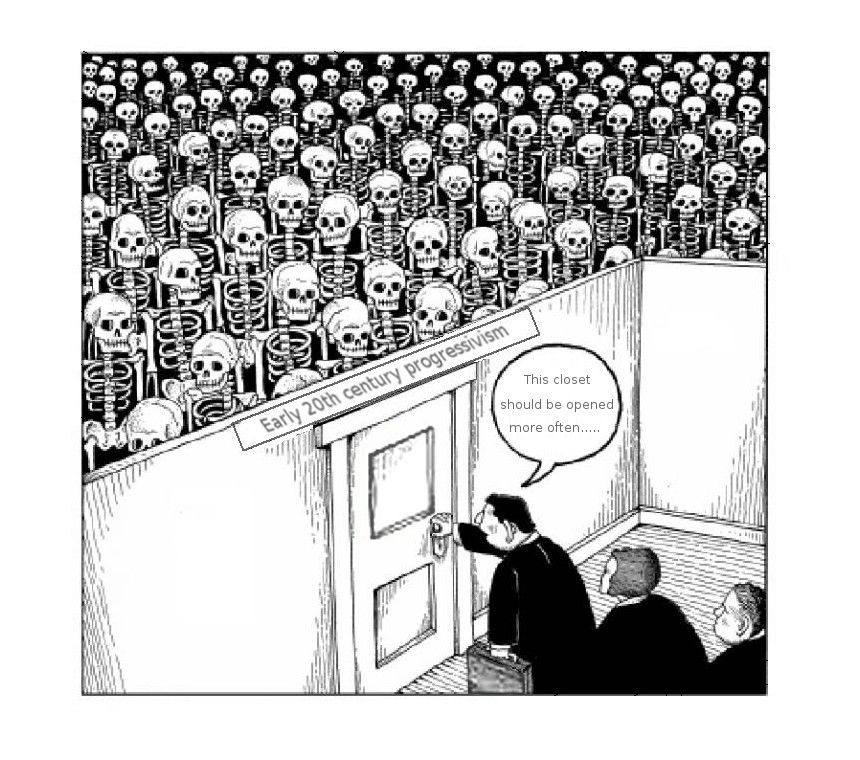
Progressives have talked a good game about "democracy" for generations now, but if you'll note they never link that word together with another which is just as important in the mixture of Liberty: "Consent". If you are an admirer of the Founders as I am, you've seen this word "Consent" routinely. Consent of the governed is something that was paramount in the belief of those who secured our rights. Progressives primarily use the word "democracy" because they know that we generally associate the word with a free people, because that's what we're taught by progressive professors to believe that's what it means, all the while what they mean by "democracy" is a euphemism for "socialism" and I am going to again demonstrate this.
When speaking of the "Problems of Democracy", John Dewey, the widely acknowledged Father of Modern American Education and President of the radical group League for Industrial Democracy, wrote in an essay titled "Liberalism and Social Action":
The problem of democracy becomes the problem of that form of social organization, extending to all the areas and ways of living, in which the powers of individuals shall not be merely released from mechanical external constraint but shall be fed, sustained and directed.
When seeing this, it's no wonder that progressives never speak of "consent". They don't mean democracy as a free society. True democracies - if they ever are free societies when they begin, are never free for long, and nearly every Founding Father as made some comment or another about this true historical fact of how dangerous democracies are. Which again, gets at the socialistic nature of democracy, as I demonstrated above in the first link. How shall you vote, for what or how many bureaucracies, which shall control the lives of individuals in how many ways?
That's surely democratic, but it's clearly socialistic. But not so socialistic as to outright nationalize everything. Progressivism is instead "regulation, not socialism" - it's "control without ownership". That's the dividing line between the ideologies. Now, there's a greater context to this quote. Why does Dewey believe that the problem of democracy is a social organization which feeds, sustains, and directs the lives of individuals?
The reliance of liberalism is not upon the mere abstraction of a native endowment unaffected by social relationships, but upon the fact that native capacity is sufficient to enable the average individual to respond to and to use the knowledge and the skill that are embodied in the social conditions in which he lives, moves and has his being. There are few individuals who have the native capacity that was required to invent the stationary steam-engine, locomotive, dynamo or telephone. But there are none so mean that they cannot intelligently utilize these embodiments of intelligence once they are a part of the organized means of associated living.
Because he fully rejects the Founders ideals that we are endowed by our creator, natural law, and the whole lot. We aren't born with any gifts whatsoever to speak of. As I mentioned yesterday, Dewey believed that government needed to "create individuals". Inherently(as the quote above makes clear), progressives do not think highly of individuals. We are nothing without government.
Going back to the original quote above, but looking at it's larger context:
The life-long struggle of Mill to reconcile these ideas with those which were deeply graven in his being by his earlier Benthamism concern us here only as a symbol of the enduring crisis of belief and action brought about in liberalism itself when the need arose for uniting earlier ideas of freedom with an insistent demand for social organization, that is, for constructive synthesis in the realm of thought and social institutions. The problem of achieving freedom was immeasurably widened and deepened. It did not now present itself as a conflict between government and the liberty of individuals in matters of conscience and economic action, but as a problem of establishing an entire social order, possessed of a spiritual authority that would nurture and direct the inner as well as the outer life of individuals. The problem of science was no longer merely technological applications for increase of material productivity, but imbuing the minds of individuals with the spirit of reasonableness, fostered by social organization and contributing to its development. The problem of democracy was seen to be not solved, hardly more than externally touched, by the establishment of universal suffrage and representative government. As Havelock Ellis has said, "We see now that the vote and the ballot-box do not make the voter free from even external pressure; and, which is of much more consequence, they do not necessarily free him from his own slavish instincts." The problem of democracy becomes the problem of that form of social organization, extending to all the areas and ways of living, in which the powers of individuals shall not be merely released from mechanical external constraint but shall be fed, sustained and directed. Such an organization demands much more of education than general school, which without a renewal of the springs of purpose and desire becomes a new mode of mechanization and formalization, as hostile to liberty as ever was governmental constraint. It demands of science much more than external technical application--which again leads to mechanization of life and results in a new kind of enslavement. It demands that the method of inquiry, of discrimination, of test by verifiable consequences, be naturalized in all the matters, of large and of detailed scope, that arise for judgment.
There's a lot here in this paragraph, so I'm going to try to wrap this all up as best as I can. I once wrote a comparative article detailing how the evolution of progressivism followed a similar path to the Fabians over in Britain, and you see that here in Dewey's writings, as he makes it clear that he was deep in thought about Mill and Bentham. Furthermore, the comparison continues as Dewey quotes directly from Havelock Ellis, who was one of the founding members of the Fabian Society. I have also written in the past about the friendly relationship between progressives and Fabians. I typically mean this ideologically as shown above, not friendly personally.(though that did exist too, see Margaret Sanger in that link)
As I mentioned above, Dewey was president of the group LID, and according to the LID themselves, they were America's Fabian Society.
We know what Fabians think of individuals. The key phrase is "big organization of our society". That's exactly what Dewey is talking about. That's the problem of democracy, the bigness of the organization, not the consent of the governed. The consent of the governed is the problem of a republic, of a society which still has it's liberty and doesn't live under bureaucratic despotism - progressivism.
That's the classical definition of fascism, of course.
Progressives don’t admirer the Founders they admire the Godfathers.
Motto: Take it all
PGA, your work continues to expose the roots of the philosophy whose consequences are all around us. Dewey's rejection of the idea of Creator-endowed life, rights and liberty and his counterfeit idea's hold on what is known as "public education" is having its negative effect in our society today.
In order to "change" America from its foundations, "progressives" had to gain access to the very young.
[The following is excerpted from a series entitled, "Lessons on Liberty," by the Co-Editor of "Our Ageless Constitution" & "Rediscovering the Ideas of Liberty." The "Lesson" contrasts the Founders' Ideas of Liberty" which the Founders intended would be taught to rising generations, with the Counterfeit Ideas being promoted in the so-called "public schools" of America for decades.
“The God who gave us life gave us liberty at the same time; the hand of force may destroy, but cannot disjoin them.” (Jefferson - 1774)
“Statesmen may plan and speculate for Liberty, but it is Religion and Morality alone which can establish the principles upon which Freedom can securely stand.” (John Adams - 1775)
“The Sacred Rights of Mankind are not to be rummaged for among old parchments or musty records. They are written, as with a sunbeam, in the whole volume of human nature, by the Hand of the Divinity itself, and can never be erased or obscured by mortal power.” (Alexander Hamilton)
“Without God, there could be no American form of government, nor an American way of life. Recognition of the Supreme Being is the first and the most basic expression of Americanism. Thus the founding fathers saw it, and thus, with God’s help, it will continue to be.” (Dwight Eisenhower)
“The same revolutionary beliefs for which our forebears fought are still at issue around the globe, the belief that the rights of man come not from the generosity of the state but from the hand of God.” (John F. Kennedy - 1961 Inaugural)
“…it is the duty of all nations to acknowledge the providence of Almighty God, to obey his will, to be grateful for his benefits, and humbly implore His protection and favor….”(George Washington)
“Now the virtue which had been infused into the Constitution…and was to give it…the stability and duration to which it was destined, was no other than…those abstract principles…proclaimed in the Declaration of Independence—namely, the self-evident truths of the…unalienable rights of man…the…sovereignty of the people, always subordinate to a rule of right and wrong, and always responsible to the Supreme Ruler of the universe for the rightful exercise of that sovereign…power.” (John Quincy Adams, on the occasion of The Jubilee of the Constitution - 1839)
"Today, across our nation, we see consequences of decades of gross neglect and outright censorship of the Founders’ ideas from textbooks and from our public discourse. We have allowed counterfeit ideas to dominate the public square, and the Founders’ principles have been crowded out.
Unwittingly, many teachers and other unknowing officials have participated in the agenda of an unelected mind-controlling elite whose tyrannical actions have robbed generations of Americans from reading or studying the ideas that made America free. Like termites, they have eroded our foundations as effectively as if they had burned the books. Yet, not once have they been willing to call it by its rightful name—censorship. Once, in America, stifling ideas about the Creator and Creator-endowed liberty was considered unthinkable. . . .
"The ideas of liberty must be passed on from generation to generation if liberty is to survive. These ideas, when they are allowed to be examined freely, will prevail, because their appeal is to reason and to the love for liberty that is deep in the human heart. John Adams warned: “The people of America now have the best opportunity and the greatest trust in their hands, that Providence ever committed to so small a number…if they betray their trust, their guilt will merit even greater punishment than other nations have suffered, and the indignation of Heaven.”
“The idea of God is the keystone of a perverted society. The true root of liberty, equality and culture is atheism.” (Karl Marx)
Our thinking is enlightened “in the degree in which we cease to depend upon belief in the supernatural.” (John Dewey, father of ‘progressive education’ and 1st President of American Humanist Society)
“…democracy is a human faith and movement, unencumbered by supernatural preconceptions.” (John Childs, a protégé of John Dewey at Columbia)
“…the majority of our youth still hold the values of their parents, and if we do not alter this pattern, if we do not resocialize ourselves to accept change, our society may decay.” (John Goodlad, 1971 Report to President, Schooling for the Future)
“As in 1933, humanists still believe that traditional theism, especially a faith in the prayer-hearing God, who is assumed to love and care for persons, to hear and understand their prayers, and be able to do something about them, is an unproved and outmoded faith.” (Humanist Manifesto II, 1973)
“…the most important factor moving us toward a secular society has been the educational factor. Our schools may not teach Johnny to read properly, but the fact that Johnny is in school until he is sixteen tends to lead toward elimination of religious superstition.” (Paul Blanshard, The Humanist, March-April, 1976)
“It [the Nat’l. Education Association’s publication list] includes the delegitimizing of all authority save that of the state, the degradation of traditional morality and the encouragement of citizens in general and children in particular to despise the rules and customs that make their society a functional democracy. The NEA is drifting into exceedingly dangerous waters, and probably carrying more than a few teachers and pupils with it.” (Chester E. Finn, Jr., Ass’t. Sec. Of Education & Prof. Of Education & Public Policy, Vanderbilt Univ., 1982)
--------------
“Now, my countrymen, if you have been taught doctrines which conflict with the great landmarks of the Declaration of Independence…let me entreat you to come back. Return to the fountains whose waters spring close to the blood of the Revolution.” (Abraham Lincoln)
Disclaimer: Opinions posted on Free Republic are those of the individual posters and do not necessarily represent the opinion of Free Republic or its management. All materials posted herein are protected by copyright law and the exemption for fair use of copyrighted works.