But if you wish to fantasize such a tariff "war", then you must assume that Congress would quickly adjust Union tariffs to make them more competitive, and the result would not be economic ruin in the North. Lower revenue collections? Congress? Be serious.
Even with tariffs of the same percentage, Cotton and Tobacco no longer going through New York would have been a massive impact to the economic system of New York.
Look at this picture again. Imagine 80% of that pile moved over to South Carolina.
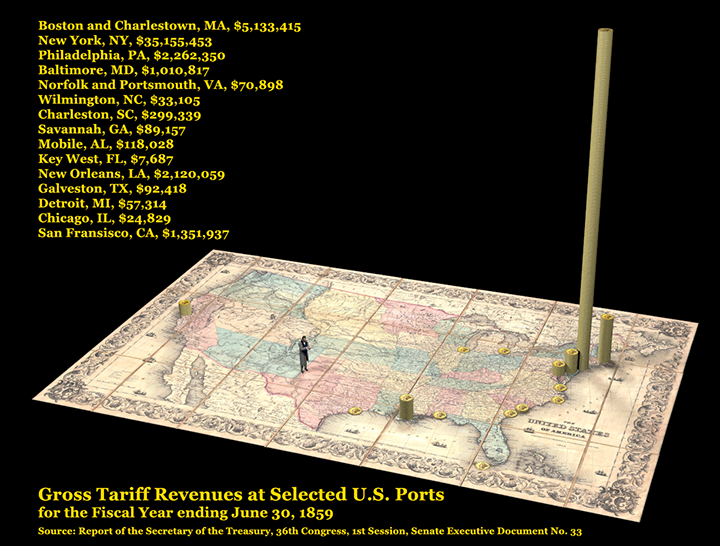
Over time, the shipping to Charleston would have simply increased more and more, and the City would have started to rival the economic might of New York. The primary conduit of European goods and services to the interior of the US would have come through Southern ports instead of New England ports.
Very big money, eventually. So big that New England could not allow it to happen.
DiogenesLamp:
"Lower revenue collections? Congress? Be serious."Seriously, from Day 1 of the Constitutional Republic, tariff rates went up, down and sideways every few years, depending on political winds of the time.
Changing tariff rates was a pretty big deal, but had often been done before.
In 1815 tariffs reached a low of 6% overall, in 1830 a high of 30% and by 1860 were back down to 15%.
The Confederate tariff was set around 15%.
So tariffs went up and down as perceptions changed.
There is no reason to suppose that Congress wouldn't quickly adjust tariffs to match, or beat, those of Confederate competitors.
DiogenesLamp: "Even with tariffs of the same percentage, Cotton and Tobacco no longer going through New York would have been a massive impact to the economic system of New York."
No, as I said: 50% of US cotton exports already went through New Orleans, with no "massive impact" on the economy in New York.
And, while New Orleans shipped only 15% of its cotton to US customers, we can well suppose that cotton grown in the Southeast would ship more to Northeastern customers, perhaps 50%.
That would leave 50% of cotton transshipped from New York to foreign countries like Britain & France.
If that 50% (of 50% or 25% overall) now shipped directly overseas, how much would it effect New York's economy?
Answer: next to none, because the only service New Yorkers performed there was to take cotton off smaller packets from the South and put it on larger freighters to Europe.
So, there would be some New York stevedores looking for work elsewhere.
Hardly a "massive impact."
DiogenesLamp: "Look at this picture again. Imagine 80% of that pile moved over to South Carolina."
Except there's no possibility of 80% moving from New York to South Carolina.
Ten percent is a possibility, corresponding to the maximum conceivable value of cotton which might ship from Charleston.
Here's a key point to keep in mind: even by 1861, the Union population and economy outnumbered Confederate states by over five-to-one, so natural demand for commerce in the North was many times higher than any conceivable needs in the Confederacy.
That means: if Confederacy attempted to juice-up its commercial activities through, in effect, cut-throat pricing of tariffs, then the Union would preserve itself by reducing its own tariffs correspondingly.
Yes, agreed, there could be some marginal increase in commerce through Charleston -- maybe 10% -- but it would have no significant effect on Northern cities.
We know the Northern effects for certain, because that's just what happened during the Civil War.
DiogenesLamp: "Very big money, eventually. So big that New England could not allow it to happen."
But the choice to start war was not New England's, it was Jefferson Davis' choice.
The choice to accept war, once started, fell on Abraham Lincoln.
And historical fact is: the people most opposed to war were those very New York, Philadelphia & Boston stevadores (Democrats!) who you claim were most demanding it.
So all your theory is bunk, nonsense, bovine excrement, fancifully unrelated to actual historical facts & events, FRiend.