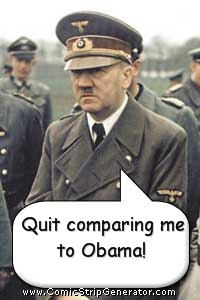
It is a mistake to try and portray something that evil as human. Never forget his consequences.
It is a mistake to try and portray something that evil as human. Never forget his consequences.True. But it's also important to keep in mind the Banality of Evil.
Remember that Germany circa 1920 was made up of ex-independent nation states. Germany was a very modern nation-state about fifty years old (formal unification occurred in 1871). This made Germany younger than the US was when the American Civil War began. So the Nazi Party was dressing up in clothes than made them just like grandfather Herman in Bavaria, Munich,...
Question - how different is this from Mitt or Rick, or Howard coming into your state and eating at the local fairground/dinner to prove he is just like Uncle Ed, Frank, Joe, or ...?
I think quite the opposite: it is a mistake to forget that anything that evil was human. The Hitler who unleashed war and genocide was also the Hitler who liked the German forests, loved dogs and small children, was sentimental about protecting German troops (to their harm because that sentimentality resulted in over-armored tanks that sank in the Russian mud). . .
The next time, the monster will have endearingly human qualities, too. Remembering Hitler’s in context may make it easier to recognize the next monster and stop him.
On the contrary. It's a mistake to portray Hitler as non-human. Our natural reaction to Hitler and others as depraved is to disown them as "monsters," and "inhuman," but human is exactly what Hitler was, nothing more or less. It does not aid our learning or practiced skill at avoiding evil choices or behaviors when we dismiss Hitler as "non-human," and thereby excuse ourselves from self-examination. Of course, our purpose is not to excuse ourselves in such a way when we shun such people. We really mean to set ourselves and our culture and habits apart from such people, to say they are not kin, that they are outside our tribe and taboo. That, in itself, is a good thing, but we often carry such language too far, I think, and risk forgetting the very human capacity for both good and evil.
We know both, all too well, as an essential part of being human.
When a cat captures and teases a mouse to the point of exhaustion and death we might be horrified but we generally understand that the cat is doing his "natural born thing," as a creature born free from the responsibilities that come (whether one likes it or not) with "knowing good and evil."
When Cousin Lenny captures and teases a mouse to death we call the men in white coats, because Lenny is human and, as such, is born responsible, whether Lenny has "impulse control" or not and regardless of his education. Lenny is stained with true moral guilt regardless of any capacity for guilty feelings.
Ironically, Hitler and the Nazis arose out of a fashionable flight from moral responsibility, which makes dismissing him as "non-human" particularly dangerous.
Your greater point, that the author is treading dangerous ground by seeming to counter Hitler's "history" with the idea of a man being "quite happy camping it up in the woods" is a correct response, however. Among other things Hitler probably lacked any true capacity for happiness, and hated all who were not similarly messed up. That was a choice for evil that arises all to often from the depths of human hearts.
You are unbelievably wrong. Its a mistake to caricature evil as being monstrous and obvious. Just as Satan masquerades as an angel of light, so evil men ALWAYS portray themselves as reasonable and good. They say things like "Hope", "Change" and "Freedom" as an excuse to cease power and commit atrocities.
People can't recognize evil today because they think that the evil men of the past walked around with blood dripping from their mouths screaming "Evil!" and well, since Dr. Ezekiel J. Emanuel doesn't have blood dripping from his mouth he must be ok.