FreeRepublic , LLC
PO BOX 9771
FRESNO, CA 93794
STOP BY AND BUMP THE FUNDRAISER THREAD
A vast territory is needed to support herds of domestic stock. The Scythians or steppe people were (initially) nomads relying on the horse and wagon for mobility, living in stout felt tents, and subsisting largely on horse's milk and cheese, as well as on food from hunting and fishing. When well established, the tribes in the west of the Scythian empire became agriculturists who raised wheat, some of it for export. Eastward the Scythians stayed as pastoral normads; among these nomads was the ruling tribe, which the Greeks called the Royal Scythes. In the spring and summer they ranged about the open steppe seeking pasture for their herds. In the winter they camped along protected river valleys. The men rode on horseback, the women on cattle-drawn wagons on which their felt tents were set. Polygamy was practiced, at least among families of chiefs, and the son inherited his father's wives. The Scythians never washed in water, but for ritual purification they had a kind of vapor bath. Men wore trousers tucked into soft boots. In fighting, the Scythes used bows and arrows from horseback, and followed the guerrilla tactics typical of central Asian nomads.
The Russian archaeologist Sergei Ivanovich Rudenko, who did four large excavations at Pazyryk in northeastern Siberia between 1947-9. He reports, that the chiefs of Pazyryk were elaborately tattooed, wore woolen and leather clothes, and employed skillful artists to adorn their horse trappings and harnesses with elaborate stylized animal art. After death the body of an ordinary Scythian was drawn in a wagon among the tribal camps for forty days, [LT: Why 40 days?] then buried. The corpse was laid on the bottom of a small log tomb, usually on its back, head towards the east and arms and legs extended.
For a king, or high official, the funeral cortege was more elaborate. On burial the body was placed in a special coffin made of a larch tree trunk and placed into a large log square pit or barrow. The body was embalmed or mummified. Concubines and attendants were sacrificed and laid beside the royal corpse with full compliment articles (Chinese silk and mirrors, jewelry). Fine chariots and valuable horses were killed and placed into the barrows as well. Because of lack of space their bodies often lay in a shaft one on top of another, dressed with bridle, saddle and head decorations. Tombs are still scattered throughout southern Russia and the Crimea, the Caucasus, and Anatolia. Modern archeology have recovered artifacts of metal treasures, funeral ornaments and furnishings of elaborate burials. Whether of their own manufacturer, or the work of Greek craftsmen, Scythian gold ornaments attest to what an ancient Roman author calls the "Scythian lust for gold." Later tombs dated from the sixth century BCE include the Sarmatians as well as the Scythians. [LT: These dates are just after the MILLIONS from The Lost Tribes of Israel disappeared in this same area.]
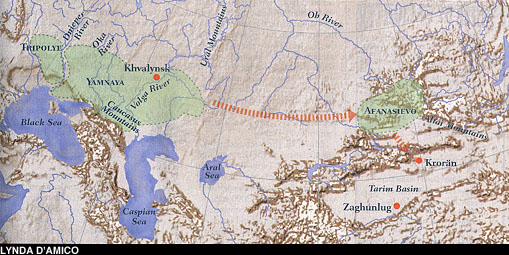
The Scythians lived to the north of the well-traveled trade routes we call today "The Silk Routes." Their territory was constantly being explored and sometimes colonized by settled farmers, whose own lands were becoming overpopulated or overgrazed. Enormous areas of steppe was needed to support even a small band of horsemen, for just a slight increase in population could drastically affect the food supplies of the original inhabitants. The result was constant displacement of populations as the Scythians sought to expand their shrinking territory to accommodate their own population pressures. [LT: This suggests tremendous pressure on the 5 MILLION+ refugees from the Northern Kingdom to disperse.]