To: petuniasevan
Didn't Russia send a probe to the Venusian surface that got crushed by the pressure?
7 posted on
03/13/2002 12:11:43 PM PST by
snowfox
To: snowfox
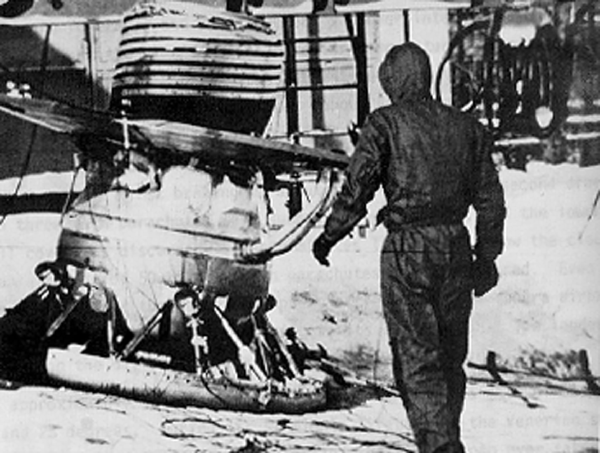
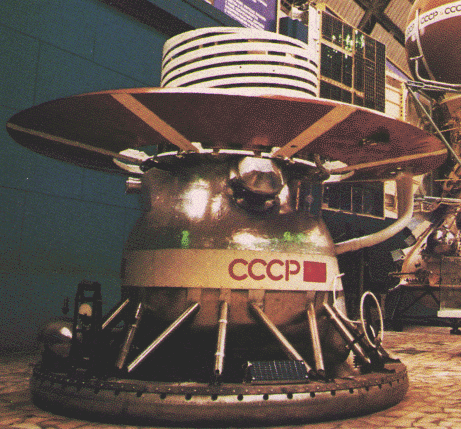
Venera 9 Descent Craft
NSSDC ID:1975-050D
Launch Date/Time: 1975-06-08 at 02:38:00 UTC
On-orbit dry mass: 2015 kg
Description
On October 20, 1975, this spacecraft was separated from the Orbiter, and landing was made with the sun near zenith at 0513 UT on October 22.
A system of circulating fluid was used to distribute the heat load. This system, plus precooling prior to entry, permitted operation of the spacecraft for 53 min after landing. During descent, heat dissipation and deceleration were accomplished sequentially by protective hemispheric shells, three parachutes, a disk-shaped drag brake, and a compressible, metal, doughnut-shaped, landing cushion. The landing was about 2,200 km from the Venera 10 landing site. Preliminary results indicated: (A) clouds 30-40 km thick with bases at 30-35 km altitude, (B) atmospheric constituents including HCl, HF, Br, and I, (C) surface pressure about 90 (earth) atmospheres, (D) surface temperature 485 deg C, (E) light levels comparable to those at earth midlatitudes on a cloudy summer day, and (F) successful TV photography showing shadows, no apparent dust in the air, and a variety of 30-40 cm rocks which were not eroded.
To: snowfox
Venera 10 Descent Craft
NSSDC ID:1975-054D
Launch Date/Time: 1975-06-14 at 03:00:31 UTC
On-orbit dry mass: 2015 kg
Description
On October 23, 1975, this spacecraft was separated from the Orbiter, and landing was made with the sun near zenith, at 0517 UT, on October 25.
A system of circulating fluid was used to distribute the heat load. This system, plus precooling prior to entry, permitted operation of the spacecraft for 65 min after landing. During descent, heat dissipation and deceleration were accomplished sequentially by protective hemispheric shells, three parachutes, a disk-shaped drag brake, and a compressible, metal, doughnut-shaped, landing cushion. The landing was about 2,200 km distant from Venera 9. Preliminary results provided: (A) profile of altitude (km)/pressure (earth atmospheres)/temperature (deg C) of 42/3.3/158, 15/37/363, and 0/92/465, (B) successful TV photography showing large pancake rocks with lava or other weathered rocks in between, and (C) surface wind speed of 3.5 m/s.
To: snowfox
Venera 13 Descent Craft
NSSDC ID:1981-106D
Other Name(s)
Launch Date/Time: 1981-10-30 at 06:04:00 UTC
On-orbit dry mass: 760 kg
Description
Venera 13 and 14 were identical spacecraft built to take advantage of the 1981 Venus launch opportunity and launched 5 days apart. The Venera 13 mission consisted of a bus (81-106A) and an attached descent craft (81-106D). The Venera 13 descent craft/lander was a hermetically sealed pressure vessel, which contained most of the instrumentation and electronics, mounted on a ring-shaped landing platform and topped by an antenna. The design was similar to the earlier Venera 9-12 landers. It carried instruments to take chemical and isotopic measurements, monitor the spectrum of scattered sunlight, and record electric discharges during its descent phase through the Venusian atmosphere. The spacecraft utilized a camera system, an X-ray fluorescence spectrometer, a screw drill and surface sampler, a dynamic penetrometer, and a seismometer to conduct investigations on the surface.
After launch and a four month cruise to Venus, the descent vehicle separated from the bus and plunged into the Venus atmosphere on 1 March 1982. After entering the atmosphere a parachute was deployed. At an altitude of 47 km the parachute was released and simple airbraking was used the rest of the way to the surface. Venera 13 landed about 950 km northeast of Venera 14 at 7 deg 30 min S, 303 E, just east of the eastern extension of an elevated region known as Phoebe Regio. The area was composed of bedrock outcrops surrounded by dark, fine-grained soil. After landing an imaging panorama was started and a mechanical drilling arm reached to the surface and obtained a sample, which was deposited in a hermetically sealed chamber, maintained at 30 degrees C and a pressure of about .05 atmospheres. The composition of the sample determined by the X-ray flourescence spectrometer put it in the class of weakly differentiated melanocratic alkaline gabbroids. The lander survived for 127 minutes (the planned design life was 32 minutes) in an environment with a temperature of 457 degrees C and a pressure of 84 Earth atmospheres. The descent vehicle transmitted data to the bus, which acted as a data relay as it flew by Venus.
To: snowfox
In other words, these craft had to be built like a cross between a refrigerator and a fireproof safe, yet with a window to allow imaging.
Not only are we talking surface temps of around 900 degrees F, and atmospheric pressures of 90 times Earth sea level pressure, but also a strongly acidic environment.
Here's an image from one lander.
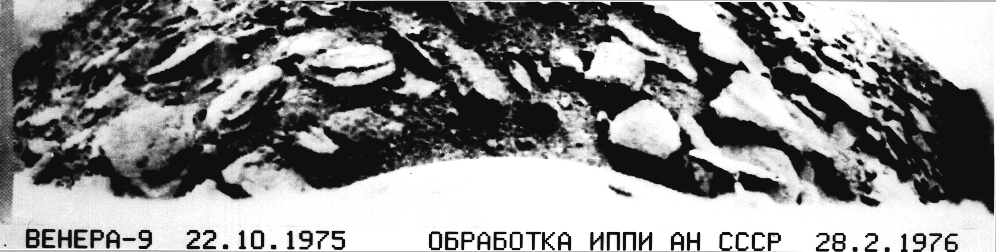
Venera 9 Lander image of the surface of Venus at about 32 S, 291 E. The Lander touched down at 5:13 UT with the sun near zenith on 22 October 1975 and operated for 53 minutes, allowing return of this single image. The white object at the bottom of the image is part of the lander. The distortion is caused by the Venera imaging system. Angular and partly weathered rocks, about 30 to 40 cm across, dominate the landscape, many partly buried in soil. The horizon is visible in the upper left and right corners. (Venera 9 Lander, surface image)
FreeRepublic.com is powered by software copyright 2000-2008 John Robinson