
Posted on 07/20/2026 5:20:02 AM PDT by MtnClimber
Trust is important. Verification is essential.
More than 2,000 years ago, the Roman poet Juvenal posed a timeless question: Quis custodiet ipsos custodes? — “Who will guard the guards themselves?” or “Who watches the watchers?”
The Romans could never have imagined artificial intelligence, facial recognition, or nationwide networks of automated license-plate readers. Yet their question may be even more relevant today than it was three millennia ago.
Recent debate over Flock Safety cameras illustrates why.
The cameras have become an invaluable law enforcement tool. A stolen vehicle that crosses several jurisdictions can now be identified in minutes rather than days. An abducted child can sometimes be located before the child reaches another state.
Investigators can reconstruct a suspect's movements at speeds unimaginable only a generation ago. These advances are remarkable and save lives and solve crimes.
Few Americans would willingly return to the days when solving a crime depended solely on eyewitness accounts or grainy surveillance footage from convenience stores.
Yet reports have surfaced that individual officers allegedly used these systems to monitor former spouses, girlfriends, or acquaintances for purely personal reasons. If true, those actions are not an indictment of the technology or of law enforcement as a whole. They are a reminder of a far older truth: every concentration of power invites the possibility of abuse.
(Excerpt) Read more at americanthinker.com ...
Dear FRiends,
We need your continuing support to keep FR funded. Your donations are our sole source of funding. No sugar daddies, no advertisers, no paid memberships, no commercial sales, no gimmicks, no tax subsidies. No spam, no pop-ups, no ad trackers.
If you enjoy using FR and agree it's a worthwhile endeavor, please consider making a contribution today:
Click here: to donate by Credit Card
Or here: to donate by PayPal
Or by mail to: Free Republic, LLC - PO Box 9771 - Fresno, CA 93794
Thank you very much and God bless you,
Jim
Your cell phone surveils you more than a Flock camera.
Just another lost freedom. You used to be able to cross this country without being tracked, now you can’t cross the street.
Problem: States don’t want to solve crimes because it results in racist crime statistics, especially if it involves black victims. They are cherry-picking cases to even the odds. Having the data becomes basically useless.
“It’s the Phone Cops, man!”
“Who watches the watchers?”
The watched.
Who gets to hold whom accountable is a question.
“Your cell phone surveils you more than a Flock camera.”
Police need a WARRANT for a cell phone search, they only need a password for a Flock search. That may not be much of a different for Trump and other Republicans trying to prevent the destruction of the country (since Comey and others make up shit to get warrants), but it is a BIG DIFFERENCE for the rest of us. Example, young cop is interested in 16 year old daughter so he signs into Flock to track her movements...not good. He could risk everything trying to get a warrant to for her phone...but he won’t.
Excellent article. We must have accountability.
It is lacking in many areas.
I admit I am a little disappointed an article like this gets 8 replies, but...a thread on "Man arrested after surfing naked on top of moving locomotive" gets 64 replies!!!! Well, given my observations below, I guess I shouldn't be surprised...especially since I was one of those 64 replies on that thread...:)
I think that proves that fundamental human nature doesn't change!
Anyway, here was my observation from the locked thread that was a duplicate of yours:
An excellent article from Brian C. Joondeph at American Thinker. He makes an excellent point:
"...Technology doesn’t change human nature. It amplifies it..."
I just finished reading the Bible from cover to cover recently, and although it took me a long time (nearly two years...because I had to scale back my reading speed in an attempt to take it all in...when I read something interesting, I tend to speed up) it made one thing absolutely clear to me:
Fundamental human nature has not changed at all since creation. Many things have changed drastically and nearly unrecognizably. We may have changed social mores on a large scale (ie. Slavery is now widely considered to be a bad thing, even if it is still practiced in a variety of ways)
And Technology has changed dramatically in ways the ancients would never have foreseen. But the one thing that is constant is fundamental human nature.
Reading the Bible drove that home in me, again, and again. And while all the positive traits of human nature are also relatively unchanging, it is the unchanging negative traits of human nature that struck me so decisively. Pride. Greed. Lust. Envy. Gluttony. Wrath. Sloth. Hate. Anger. Jealousy. Deceit. Criminality. Violence. Basically, the Seven Deadly Sins, and more.
And Technology, which has changed our lives in so many ways, has done so in both good ways and bad ways.
As the author accurately states in the article: "...Throughout history, every transformative invention has brought both promise and peril..."
And that Promise has been amplified...as has the Peril.
I have long held close the belief that there is a duality in nearly everything, that is, for every good thing, there is a potential bad thing associated.
For example, a hammer can be used to build a beautiful home, or it can be used to bash in the head of another human being. And that dynamic of duality is true for just about everything.
In this case, the author uses the following example of Flock cameras, and expands upon with various valid references to AI. The author states the following with respect to risks and technology like AI: "...The risks posed by powerful technologies generally fall into three categories: malicious misuse, human error, and technological flaws..."
I think that is a fine place to start when assessing the risks of technology in the hands of unchanging human nature. We do not wish to crush the "good" that may be done by those who possess and are driven by the positive and unchanging aspects of human nature, but we don't want to ignore things like malicious misuse, human error, and technological flaws when assessing the risks that may accompany those good things. We must keep those risks in mind, and be mindful we don't unnecessarily allow those risks to strangle the good things that are possible as they lay forming in a cradle.
It is a balancing act, and we must be judicious.
Yes, and directly proportionally.
For example: the concentration of power in Washington and the possibility of abuse.
Yes, as Tom Homan explained yesterday to idiot Margaret Brennan as to why ICE agents do not have cameras.
Brennan: You’ve seen that on video, because we haven’t? Because in the videos that we’ve seen, there aren’t (any emergency lights on ICE Vehicles).
Homan: As far as the cameras, Margaret, you know, everybody in ICE would have a camera now if the government wasn’t shut down by Democratic members of Congress. There was money in that bill that they held up. I think it was $120 million to equip all ICE officers with cameras. But because the government shut down, we’re behind on that. But the cameras have been purchased.”
There was funding for the cameras after reconciliation and the cameras are being deployed nation wide, not a moment too soon.
“I could use some monitoring”

Geofencing: "Think of it as an Invisible Fence around you... that will be related to your Face Recognition, Digital Identity, and Access Control "
Big Tech whistleblower Aman Jabbi exposes the Digital Prison being constructed all around us in this clip from The Agenda: Their… pic.twitter.com/wrtYxorf4R— Oracle Films (@OracleFilmsUK) July 12, 2025
“Don’t use my name!”
Ping to Thread 🧵🧵🧵
God bless ✝️✝️✝️
Bkmk
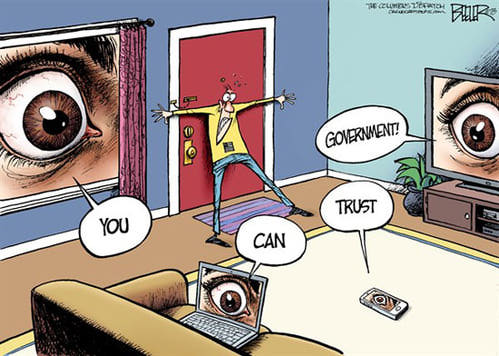
In America television watches you.
Disclaimer: Opinions posted on Free Republic are those of the individual posters and do not necessarily represent the opinion of Free Republic or its management. All materials posted herein are protected by copyright law and the exemption for fair use of copyrighted works.