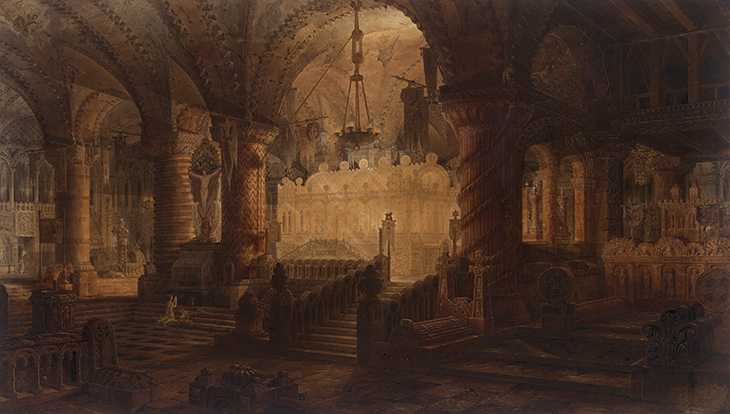
Among the most spectacular works exhibited on the walls of the Royal Academy in 1815 was Gandy's The Tomb of Merlin, a mystical scene that draws the viewer into a glowing central core. In this case, Gandy was pursuing his own penchant for fantasy, architectural as well as literary, backed up by poetic quotations in the catalogue. But the glowing sepulchre also has recognisable elements of the 15th-century Rosslyn Chapel in Midlothian, Scotland, which Gandy had earlier measured and drawn for publication. There, as in the painting, one sturdy column is wreathed in vines, the so-called Apprentice Pillar. It is said to denote a Masonic myth of a workman who surpasses his master's ability and is killed for it, an assistant who came to outperform his master. Perpetually hard-up, Gandy offered to sell The Tomb of Merlin to Soane, only to be refused.The Tomb of Merlin | Joseph Michael Gandy | 1815The visionary artist who saw into the mind of John Soane | Joseph Gandy's dramatic paintings turned John Soane's neoclassical designs into full-blown Romantic fantasies | Gillian Darley | 1 September 2021 | Apollo Magazine